Polls close in landmark Taiwan election
Pro-independence Tsai Ing-wen is expected to be thrust into the job, becoming the country’s first female president.
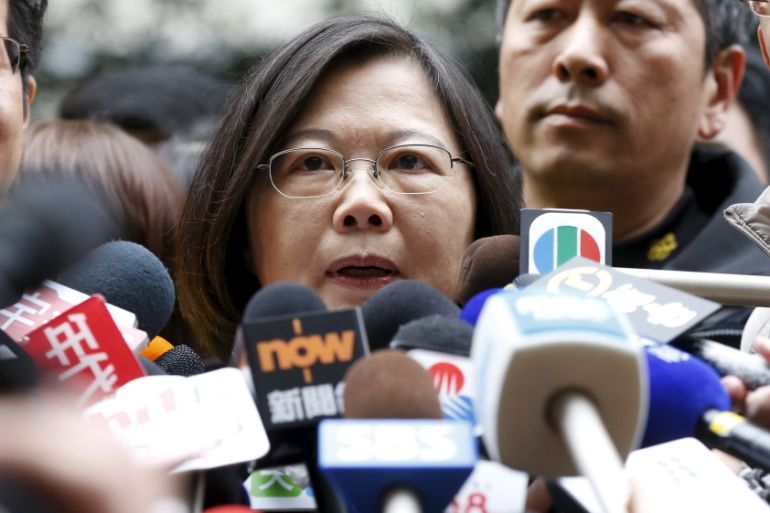
Polls have closed in Taiwan in a presidential election that is expected to propel the pro-independence opposition party to power.
The Democratic Progressive Party’s (DPP) Tsai Ing-wen is poised to become the self-governing island’s first female president, returning the main opposition party to power after eight years under the China-friendly Nationalist, or Kuomintang, Party (KMT).
Recommended Stories
list of 4 items- list 1 of 4Nepal’s new PM gives message to nation in rap, ahead of swearing in
- list 2 of 4Now in power, Nepal’s rapper-politician Balen Shah faces new challenge
- list 3 of 4Democrat Emily Gregory wins Florida seat in Trump’s Mar-a-Lago district
- list 4 of 4Danish PM Mette Frederiksen’s left-wing bloc fails to win majority in vote
Pre-election polls showed that scholar-turned-politician Tsai Ing-wen, with a far more careful approach to China than the ruling KMT of President Ma Ying-jeou, will win the election.
Reporter’s Notebook: China’s shadow looms over crucial Taiwan election
Parliamentary polls were also held, and if the DPP wins those too, Tsai will get an even stronger mandate.
Tsai has walked a careful path on her China strategy, saying she wants to maintain the “status quo” with Beijing.
However, the DPP is traditionally a pro-independence party and opponents say Tsai will destabilise relations.
Rapprochement
After decades of enmity, current KMT President Ma Ying-jeou has overseen a dramatic rapprochement with China since coming to power in 2008.
Although Taiwan is self-ruling after it split with China following a civil war in 1949, it has never formally declared independence, and Beijing still sees it as part of its territory awaiting reunification – by force if necessary.

The thaw culminated in a summit between Ma and Chinese President Xi Jinping in November.
Yet, despite more than 20 deals and a tourist boom, closer ties have exacerbated fears that China is eroding Taiwan’s sovereignty by making it economically dependent.
In 2014, the government was forced to shelve a trade pact after student-led protesters occupied parliament.
Beijing has warned it will not deal with any leader who does not recognise the “one China” principle, part of a tacit agreement between Beijing and the KMT known as the “1992 Consensus”. The DPP has never recognised the consensus.