Skip linksSkip to Content
play
Live
Navigation menu
  • News
    • Africa
    • Asia
    • US & Canada
    • Latin America
    • Europe
    • Asia Pacific
  • Middle East
  • Explained
  • Opinion
  • Sport
  • Video
    • Features
    • Economy
    • Human Rights
    • Climate Crisis
    • Investigations
    • Interactives
    • In Pictures
    • Science & Technology
    • Podcasts
    • Travel
play
Live

In Pictures

Gallery

In Pictures: Zimbabwe’s flood victims

More than 20,000 people were moved to Chingwizi camp after the heaviest rain in 40 years wreaked havoc.
Save

Share

facebooktwitterwhatsappcopylink
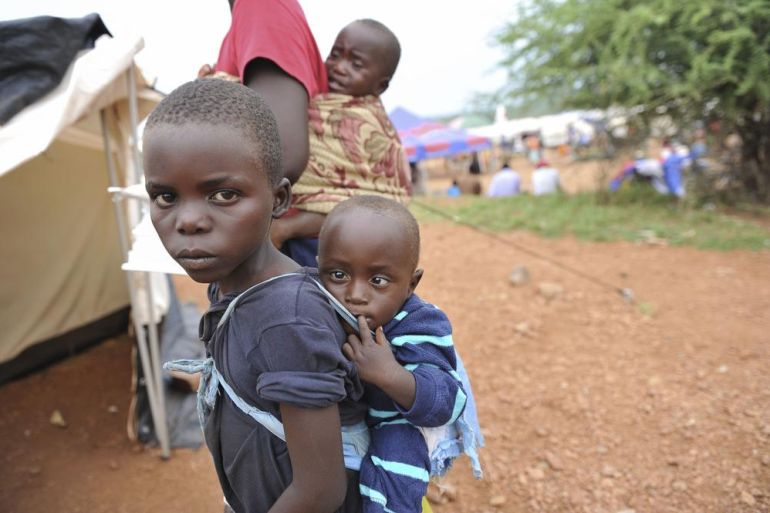
Children wait for treatment outside Chingwizi camp(***)s only medical clinic, a makeshift hospital serving more than 20,000 people. 
By Ihsaan Haffejee
Published On 7 Apr 20147 Apr 2014

Chingwizi, Zimbabwe – The Tokwe-Mukorsi dam project was meant to be the solution to the irrigation and electricity problems facing communities in southeastern Zimbabwe. 

However, the heaviest rainfall experienced in Masvingo province in more than 40 years resulted in heavy flooding in recent months, culminating in the partial collapse of the dam. Thousands of farmers and their families had to flee their homes, leaving their crops and livestock behind at the mercy of the rising waters. The area was declared a state of disaster in February.

More than 20,000 displaced people have now been moved by the Zimbabwean government to the Chingwizi camp on the Naunetsi Ranch several hundred kilometres away. The government has indicated that land in Naunetsi will be allocated to the families affected by the flooding, but almost two months later people are still awaiting compensation.

The inhabitants of the camp were once fully self-sustaining, implementing both commercial and subsistence farming. Now, however, they are fully dependent on aid for their basic needs.

Samuel Marebe, a 43-year-old farmer from Nungirai village in the Chivi district, survived the flooding and now lives in the camp with his five children.

“We were attacked by the water,” says Marebe. “My family managed to leave before our entire home and farm went under water. Other people became trapped by the water and had to be rescued by helicopter.

“Now we are here at Chingwizi camp, which is 178km from our home. Conditions here are difficult. With the overcrowding we are worried about the health risks to our children, and they are also missing out on their schooling. We hope the government allocates us land very soon because now we are living like refugees in our own country.”

Advertisement
An elderly woman struggles to her feet in order to get in line for food rations at the Chingwizi camp in southeastern Zimbabwe.
Advertisement
In front of a baobab tree, children play with a ball they made with plastic packets. Parents are concerned their children will miss out on their education, as there is only one temporary school located 3.5km away.
Women pump water from a borehole for cooking and cleaning. Most here were farmers who lost all their property in the floods and are now waiting for the Zimbabwean government to allocate new land at the Nuanetsi Ranch.
More than 20,000 people are now living in the Chingwizi camp after being displaced by heavy flooding that partially destroyed the Tokwe Mukorsi dam.
A boy shows off a goat that he just caught. Some of the farmers managed to rescue a few of their animals as they fled the flooding.
Girls skip rope as women collect water behind them at Chingwizi camp.
Advertisement
Women at the Chingwizi camp wait as food and other aid is delivered in southeastern Zimbabwe.
The heaviest rainfall in more than 40 years caused major flooding in the area, forcing thousands to flee their farms.
A child sits with a bowl outside his makeshift home and eats maize meal.
Many parents indicated they were afraid for the health of their children as overcrowding and poor sanitation at the camp could easily lead to the spread of disease.
Families wait patiently at the entrance of the aid distribution centre to receive the food that has been allocated to them.
A boy carries two bags of maize meal he collected at the food distribution centre.
A girl stokes the fire that she uses to cook supper for her family.

More from Gallery

  • Photos: Manila’s streets empty as fuel prices surge amid Hormuz crisis

    A sharp increase in prices of basic commodities and the possible loss of employment for thousands of people due to the fuel price hike have raised the spectre of stagflation in the Philippines.
    This gallery article has 10 imagescamera10
  • Photos: More than one million displaced by Israel’s evacuations in Lebanon

    Over one million displaced by Israel’s evacuations in Lebanon
    This gallery article has 10 imagescamera10
  • Migrants march in southern Mexico to denounce immigration restrictions

    Migrants, some carrying children, walk on the highway through the municipality of Huehuetan, Chiapas state, Mexico, Wednesday, March 25, 2026, after leaving Tapachula the previous night. (AP Photo/Edgar H. Clemente)
    This gallery article has 9 imagescamera9
  • Photos: Iran fires new waves of missiles at Israel

    This picture shows damaged buildings at the site of an Iranian missile strike in Tel Aviv
    This gallery article has 8 imagescamera8

Most popular

  • Tehran vows to extract ‘heavy price’ for Israeli hits on two nuclear sites

    TOPSHOT - This video grab taken from images released by the Iranian state broadcaster (IRIB) on March 26, 2026, shows what it says is the second phase of the 82nd wave of missiles launched against Israel and US bases in the United Arab Emirates and Kuwait.
  • US diplomat Marco Rubio denounces settler violence, tolls in Hormuz strait

    US Secretary of State Marco Rubio looks on as he speaks to the press before his departure following a G7 Foreign Ministers' meeting with Partner Countries before his departure at the Bourget airport in Le Bourget, outside Paris, France, March 27, 2026. Brendan Smialowski/Pool via REUTERS
  • How extensive is Russia’s military aid to Iran?

    Iranian missile strikes
  • Israel launches strikes on nuclear sites as Iran warns of retaliation

    People gather near a damaged car at the site of a residential building damaged by a strike, amid the U.S.-Israeli conflict with Iran, in Tehran, Iran, March 27, 2026. Majid Asgaripour/WANA (West Asia News Agency) via REUTERS ATTENTION EDITORS - THIS PICTURE WAS PROVIDED BY A THIRD PARTY

  • About

    • About Us
    • Code of Ethics
    • Terms and Conditions
    • EU/EEA Regulatory Notice
    • Privacy Policy
    • Cookie Policy
    • Cookie Preferences
    • Accessibility Statement
    • Sitemap
    • Work for us
  • Connect

    • Contact Us
    • User Accounts Help
    • Advertise with us
    • Stay Connected
    • Newsletters
    • Channel Finder
    • TV Schedule
    • Podcasts
    • Submit a Tip
    • Paid Partner Content
  • Our Channels

    • Al Jazeera Arabic
    • Al Jazeera English
    • Al Jazeera Investigative Unit
    • Al Jazeera Mubasher
    • Al Jazeera Documentary
    • Al Jazeera Balkans
    • AJ+
  • Our Network

    • Al Jazeera Centre for Studies
    • Al Jazeera Media Institute
    • Learn Arabic
    • Al Jazeera Centre for Public Liberties & Human Rights
    • Al Jazeera Forum
    • Al Jazeera Hotel Partners

Follow Al Jazeera English:

  • facebook
  • twitter
  • youtube
  • instagram-colored-outline
  • rss
Al Jazeera Media Network logo
© 2026 Al Jazeera Media Network