Skip linksSkip to Content
play
Live
Navigation menu
  • News
    • Africa
    • Asia
    • US & Canada
    • Latin America
    • Europe
    • Asia Pacific
  • Middle East
  • Explained
  • Opinion
  • Sport
  • Video
    • Features
    • Economy
    • Human Rights
    • Climate Crisis
    • Investigations
    • Interactives
    • In Pictures
    • Science & Technology
    • Podcasts
    • Travel
play
Live

In Pictures

Gallery|Poverty and Development

In Pictures: Cambodia’s floating villages

Most ethnic Vietnamese cannot buy land so they live in floating villages in Tonle Sap, Southeast Asia’s largest lake.


Save

Share

facebooktwitterwhatsappcopylink
Southeast Asia(***)s largest freshwater lake, Tonle Sap, is home to most of the ethnic Vietnamese living in Cambodia.
By Vincenzo Floramo and Laura Villadiego
Published On 10 Aug 201410 Aug 2014

Tonle Sap, Cambodia – All that 61-year-old Thou Yien Son owns floats on water. His house is a precarious wooden platform tied to a bamboo raft and his income comes from a boat that he uses to catch fish and bring it to the local market. Yien Son doesn’t have anything else, not even Cambodian citizenship. He is one of the 700,000 ethnic Vietnamese living in Cambodia, a country that doesn’t consider them as citizens even though they’ve lived in the country for generations.

Most of the ethnic Vietnamese arrived in Cambodia during the French Protectorate (1863- 1953) to work in administration positions and in the countryside. In 1975, the Khmer Rouge took power and the Vietnamese were forcibly deported to Vietnam or killed. During the exile, most of them lost the papers that proved their Cambodian origin. On their return in the 1980s, they were considered migrants and became stateless.

Without papers, ethnic Vietnamese cannot buy land and most of them live in floating villages in Tonle Sap, Southeast Asia’s largest freshwater lake, located deep inside Cambodia. Yien Son, told Al Jazeera: “I came back because my grandparents and my parents were born and died here. This is my land.”

But there is one hope for the ethnic Vietnamese. The Khmer Rouge Tribunal opened a new case against the top leaders of the regime, that will judge, among other crimes, the genocide committed against the Vietnamese community, which ethnic Vietnamese civil society leaders hope to use to gain repatriation. This same tribunal just condemned Nuon Chea, the second most senior leader in the Khmer Rouge, and Khieu Samphan, the former head of state, to life in prison for crimes against humanity.
Advertisement
Young children in the village often wear life jackets to avoid drowning. Many ethnic Vietnamese living in floating villages have drowned because they cannot swim.
Advertisement
Without papers, ethnic Vietnamese cannot find jobs on the mainland and many of them face unemployment.
Small boats are the primary method of transportation in the floating villages. Children use large tubs to cover short distances between houses.
About 180 students attend this private floating school where they learn basic writing and reading skills in Khmer and Vietnamese. Most of them leave the school after one year to start helping their fathers with fishing.
Villagers normally work from dawn to late night, but they often rest during the hottest hours of the day.
Families in the Vietnamese floating villages normally consist of four or five members. Different generations of the same family often live next to each other.
Advertisement
Thou Yien Son, 61, was born in Kompong Thom, a village in Cambodia. He was deported by the Khmer Rouge in 1975, but when he came back in 1983 he was not allowed to buy a house so he moved to the water.
Yim My was born two months ago in a floating house, where her mother only had the assistance of a local midwife during delivery. The family said that they cannot afford to pay the small fee required to register the infant.
Tonle Sap suffers from widespread contamination and water pollution, which has brought disease to the local population.
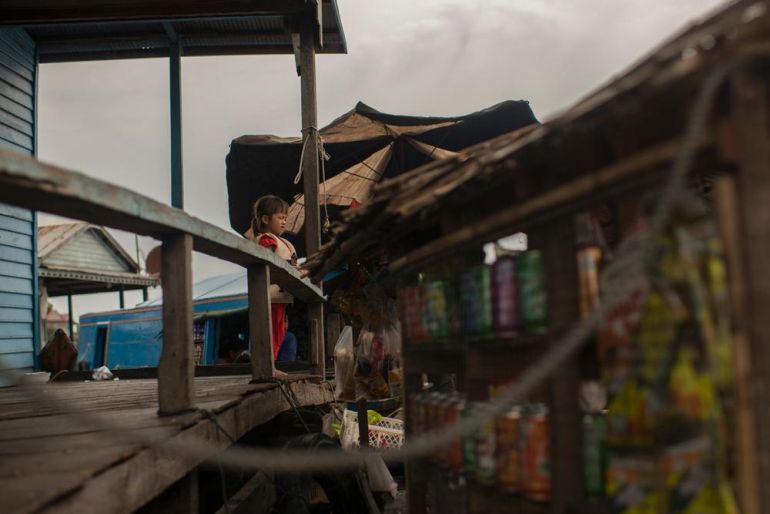
Most of the houses in Phum Kandal are wooden platforms floating on bamboo rafts. They usually consist of two small rooms, a kitchen, and a latrine that opens directly into the water.
Houses are usually connected to a precarious grid hanging on thin sticks a few metres over the water. Some of them have small batteries to run the front-door light.
Most of the villagers make a living from fishing. Fish are grown in controlled ponds for several months, then are caught and prepared for sale in mainland markets.
In Phum Kandal, there are no shops, only small boats that sell fresh vegetables, bread, cooked food, sweets, and medicine.

Related

  • ‘Junk’: Faulty electronics from rich countries flood Nigeria with e-waste

    Discarded, near-end-of-life electronics shipped from developed countries are adding to Nigeria’s growing e-waste burden.

    Published On 27 Mar 202627 Mar 2026
    Market in Kano, Nigeria
  • In Cape Town’s historic Bo-Kaap, locals priced out by rich foreign buyers

    Amid digital nomads, a tourism boom and a housing crisis, can the people who built the city still afford to live in it?

    Published On 18 Mar 202618 Mar 2026
    Bo Kaap
  • Cuba restores power after 29-hour blackout amid US oil blockade

    The national power grid comes back on after Cuba’s 10 million people were plunged into darkness overnight.

    Published On 18 Mar 202618 Mar 2026
    A street vendor tends to a customer on the Malecón during a blackout in Havana, Monday, March 16, 2026. (AP Photo/Ramon Espinosa)
  • How Carney’s ‘build fast’ push divides Canada’s Indigenous peoples

    Some First Nations are challenging Carney’s resource-extraction plans to strengthen Canadian economy from US threats.

    Published On 14 Mar 202614 Mar 2026
    Canada's Prime Minister Mark Carney meets with local municipal police chiefs, the RCMP, CBSA, and local caucus members at the RCMP E-Division headquarters in Surrey, British Columbia, Canada, February 19, 2026. REUTERS/Jennifer Gauthier

More from Gallery

  • Photos: Manila’s streets empty as fuel prices surge amid Hormuz crisis

    A sharp increase in prices of basic commodities and the possible loss of employment for thousands of people due to the fuel price hike have raised the spectre of stagflation in the Philippines.
    This gallery article has 10 imagescamera10
  • Photos: More than one million displaced by Israel’s evacuations in Lebanon

    Over one million displaced by Israel’s evacuations in Lebanon
    This gallery article has 10 imagescamera10
  • Migrants march in southern Mexico to denounce immigration restrictions

    Migrants, some carrying children, walk on the highway through the municipality of Huehuetan, Chiapas state, Mexico, Wednesday, March 25, 2026, after leaving Tapachula the previous night. (AP Photo/Edgar H. Clemente)
    This gallery article has 9 imagescamera9
  • Photos: Iran fires new waves of missiles at Israel

    This picture shows damaged buildings at the site of an Iranian missile strike in Tel Aviv
    This gallery article has 8 imagescamera8

Most popular

  • US-Israeli war on Iran widens with first attack from Yemen

    epaselect epa12854185 Rescuers work at a site following an Israeli airstrike that targeted a building in the village of Al Saksakiyah, southern Lebanon, 27 March 2026. According to the Lebanese Ministry of Public Health, at least 1,116 people have been killed and over 3,229 others injured in airstrikes across Beirut's southern suburbs and villages in southern Lebanon since the start of renewed hostilities. EPA/STRINGER
  • Yemen’s Houthis launch missile attack on Israel as war with Iran intensifies

    FILE PHOTO: Members of Houthi military forces parade in the Red Sea port city of Hodeida, Yemen September 1, 2022. Houthi Military Media/Handout via REUTERS ATTENTION EDITORS - THIS IMAGE HAS BEEN SUPPLIED BY A THIRD PARTY./File Photo
  • US-Israel war on Iran: What’s happening on day 29 of attacks?

    A man gestures at the site of a destroyed building.
  • US diplomat Marco Rubio denounces settler violence, tolls in Hormuz strait

    US Secretary of State Marco Rubio looks on as he speaks to the press before his departure following a G7 Foreign Ministers' meeting with Partner Countries before his departure at the Bourget airport in Le Bourget, outside Paris, France, March 27, 2026. Brendan Smialowski/Pool via REUTERS

  • About

    • About Us
    • Code of Ethics
    • Terms and Conditions
    • EU/EEA Regulatory Notice
    • Privacy Policy
    • Cookie Policy
    • Cookie Preferences
    • Accessibility Statement
    • Sitemap
    • Work for us
  • Connect

    • Contact Us
    • User Accounts Help
    • Advertise with us
    • Stay Connected
    • Newsletters
    • Channel Finder
    • TV Schedule
    • Podcasts
    • Submit a Tip
    • Paid Partner Content
  • Our Channels

    • Al Jazeera Arabic
    • Al Jazeera English
    • Al Jazeera Investigative Unit
    • Al Jazeera Mubasher
    • Al Jazeera Documentary
    • Al Jazeera Balkans
    • AJ+
  • Our Network

    • Al Jazeera Centre for Studies
    • Al Jazeera Media Institute
    • Learn Arabic
    • Al Jazeera Centre for Public Liberties & Human Rights
    • Al Jazeera Forum
    • Al Jazeera Hotel Partners

Follow Al Jazeera English:

  • facebook
  • twitter
  • youtube
  • instagram-colored-outline
  • rss
Al Jazeera Media Network logo
© 2026 Al Jazeera Media Network