Skip linksSkip to Content
play
Live
Navigation menu
  • News
    • Africa
    • Asia
    • US & Canada
    • Latin America
    • Europe
    • Asia Pacific
  • Middle East
  • Explained
  • Opinion
  • Sport
  • Video
    • Features
    • Economy
    • Human Rights
    • Climate Crisis
    • Investigations
    • Interactives
    • In Pictures
    • Science & Technology
    • Podcasts
    • Travel
play
Live

In Pictures

Gallery|Poverty and Development

Pakistan’s street children

An estimated 1.5 million children living on streets are vulnerable to sexual abuse and drugs on daily basis.
Save

Share

facebooktwitterwhatsappcopylink
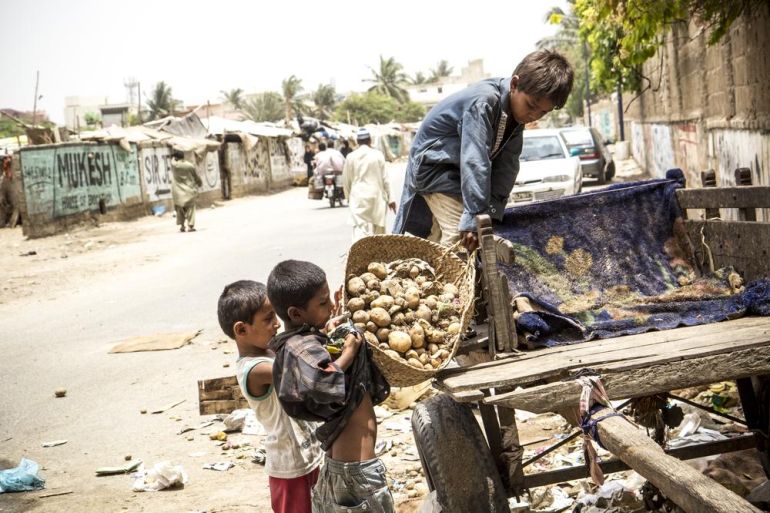
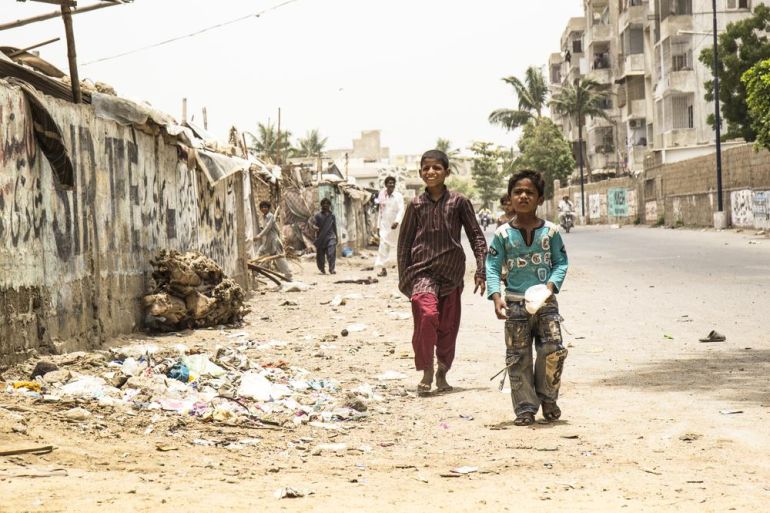
There are two types of street children in Pakistan. Those who start and end their day on the streets while the latter live with their families but are sent to the streets to make money. [Faras Ghani/Al Jazeera]
By Faras Ghani
Published On 20 Aug 201420 Aug 2014

The number of children found living, working and begging on Pakistan’s streets has been growing despite efforts to provide basic education and aid.

An estimated 1.5 million children live on the streets of Pakistan, according to various numbers from government surveys and private organisations.

Rana Asif, who launched the NGO, Initiator, a decade ago to tackle this problem, said that inflation and refugee migration were the main contributing factors.

According to Initiator’s recent survey, 66 percent of street children are runaways who were forced to leave their homes after experiencing violence in household, workplace and educational institutions.

But the runaway children appear to be more vulnerable to abuse than before. The issue was highlighted in December 1999, when serial killer Javed Iqbal sent a letter to a newspaper confessing to the murders of 100 street children in the city of Lahore.

Iqbal committed suicide in prison before he was due to be hanged in front of the parents of the children he had murdered and sexually abused.

There are people such as Asif who want to help, but many others gain financially by keeping the children on the streets.

Asif told Al Jazeera that in cities such as Karachi, mafia exploit the street children by forcing them into begging and stealing.

“We provide some education, training and Eid gifts for these street children but as the mafia sees them stepping away from begging and stealing, the children are swiftly transported to other parts of the country. Some are even smuggled abroad, mostly to Iran,” Asif said.

Advertisement

Follow Faras Ghani on Twitter: @farasG
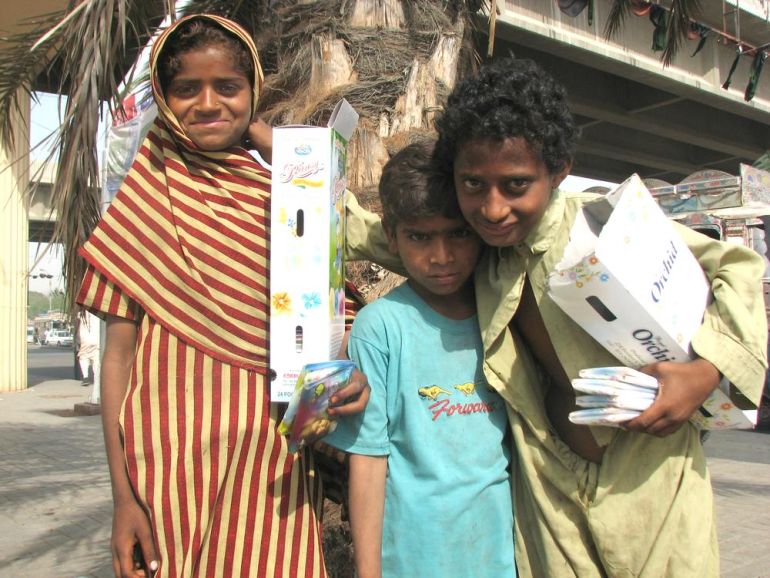
About 25,000 children daily defy the weather and physical restraints and wander on Karachi's roads to sell tissue papers, clean windscreens or just knock on car windows begging. [Faras Ghani/Al Jazeera]
Advertisement
Street children are vulnerable to sexual abuse on a daily basis. More than 90 percent have been sexually assaulted and the biggest culprits are police officials, according to Asif. [Faras Ghani/Al Jazeera]
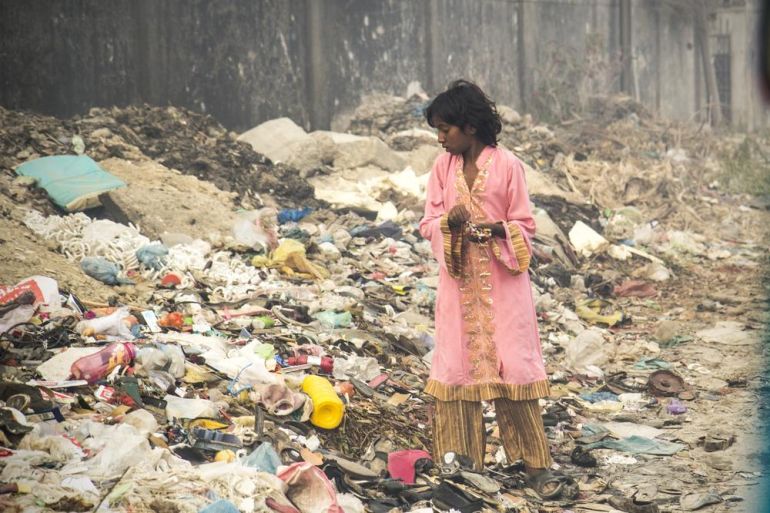
Only eight percent of children living on the streets in Pakistan are female. Most of them are picked up when they arrive on the streets and then sold off into prostitution for about Rs 25,000 each ($250). [Faras Ghani/Al Jazeera]
Apart from a huge number of Afghan migrants, about 45 percent of street children in Pakistan are Myanmarese and Bengalis, with those communities having 58 settlements in Karachi alone. [Faras Ghani/Al Jazeera]
Shrines, where these children visit regularly to fill up their stomachs, are the most popular places for the mafia to recruit them. These locations also act as hotspots for children to acquire cheap drugs and heroin, costing around 20 cents ($0.20). [Faras Ghani/Al Jazeera]
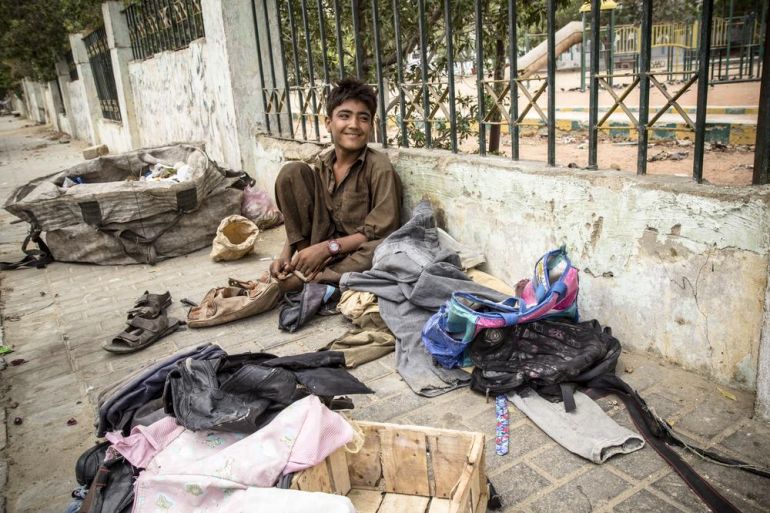
The hustle-bustle of the city life enticed Ali to leave his village home. The video game shops, the sight of "better" food, the availability of cheap drugs and glue-sniffing, made him forget his "plain and stagnant" life at home. [Faras Ghani/Al Jazeera]
Advertisement
There is no law against internal trafficking in Pakistan, Asif said, as children from the north often end up in Pakistan’s metropolises. [Faras Ghani/Al Jazeera]
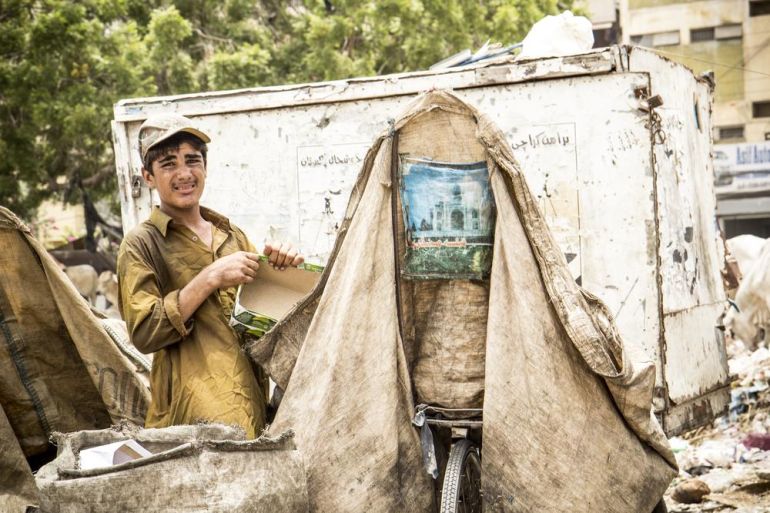
Despite the hardship, children working and earning a livelihood are content with life. "I’ve learnt how to work and I’m glad I don’t have to resort to begging on the streets or steal copper wire or side-view mirrors," said Asfand. [Faras Ghani/Al Jazeera]

Related

  • ‘Junk’: Faulty electronics from rich countries flood Nigeria with e-waste

    Discarded, near-end-of-life electronics shipped from developed countries are adding to Nigeria’s growing e-waste burden.

    Published On 27 Mar 202627 Mar 2026
    Market in Kano, Nigeria
  • In Cape Town’s historic Bo-Kaap, locals priced out by rich foreign buyers

    Amid digital nomads, a tourism boom and a housing crisis, can the people who built the city still afford to live in it?

    Published On 18 Mar 202618 Mar 2026
    Bo Kaap
  • Cuba restores power after 29-hour blackout amid US oil blockade

    The national power grid comes back on after Cuba’s 10 million people were plunged into darkness overnight.

    Published On 18 Mar 202618 Mar 2026
    A street vendor tends to a customer on the Malecón during a blackout in Havana, Monday, March 16, 2026. (AP Photo/Ramon Espinosa)
  • How Carney’s ‘build fast’ push divides Canada’s Indigenous peoples

    Some First Nations are challenging Carney’s resource-extraction plans to strengthen Canadian economy from US threats.

    Published On 14 Mar 202614 Mar 2026
    Canada's Prime Minister Mark Carney meets with local municipal police chiefs, the RCMP, CBSA, and local caucus members at the RCMP E-Division headquarters in Surrey, British Columbia, Canada, February 19, 2026. REUTERS/Jennifer Gauthier

More from Gallery

  • Photos: Manila’s streets empty as fuel prices surge amid Hormuz crisis

    A sharp increase in prices of basic commodities and the possible loss of employment for thousands of people due to the fuel price hike have raised the spectre of stagflation in the Philippines.
    This gallery article has 10 imagescamera10
  • Photos: More than one million displaced by Israel’s evacuations in Lebanon

    Over one million displaced by Israel’s evacuations in Lebanon
    This gallery article has 10 imagescamera10
  • Migrants march in southern Mexico to denounce immigration restrictions

    Migrants, some carrying children, walk on the highway through the municipality of Huehuetan, Chiapas state, Mexico, Wednesday, March 25, 2026, after leaving Tapachula the previous night. (AP Photo/Edgar H. Clemente)
    This gallery article has 9 imagescamera9
  • Photos: Iran fires new waves of missiles at Israel

    This picture shows damaged buildings at the site of an Iranian missile strike in Tel Aviv
    This gallery article has 8 imagescamera8

Most popular

  • ‘Playing with fire’: Iran vows response after civilian nuclear sites struck

    epaselect epa12854185 Rescuers work at a site following an Israeli airstrike that targeted a building in the village of Al Saksakiyah, southern Lebanon, 27 March 2026. According to the Lebanese Ministry of Public Health, at least 1,116 people have been killed and over 3,229 others injured in airstrikes across Beirut's southern suburbs and villages in southern Lebanon since the start of renewed hostilities. EPA/STRINGER
  • Iran war updates: Tehran vows retaliation for Israeli hits on nuclear sites

    TOPSHOT - This video grab taken from images released by the Iranian state broadcaster (IRIB) on March 26, 2026, shows what it says is the second phase of the 82nd wave of missiles launched against Israel and US bases in the United Arab Emirates and Kuwait.
  • US diplomat Marco Rubio denounces settler violence, tolls in Hormuz strait

    US Secretary of State Marco Rubio looks on as he speaks to the press before his departure following a G7 Foreign Ministers' meeting with Partner Countries before his departure at the Bourget airport in Le Bourget, outside Paris, France, March 27, 2026. Brendan Smialowski/Pool via REUTERS
  • Guns in the streets as US, Israel intensify month-long attacks across Iran

    TEHRAN, IRAN - MARCH 27: A resident cleans up debris in a damaged apartment across from another residential building following an airstrike in the early hours of March 27, 2026 in Tehran, Iran. The Israeli military said that it had carried out strikes on targets across Tehran and other Iranian cities overnight. The United States and Israel have continued their joint attack on Iran that began on February 28. Iran retaliated by firing waves of missiles and drones at Israel and U.S. allies in the region, while also effectively blockading the Strait of Hormuz, a critical shipping route. (Photo by Majid Saeedi/Getty Images)

  • About

    • About Us
    • Code of Ethics
    • Terms and Conditions
    • EU/EEA Regulatory Notice
    • Privacy Policy
    • Cookie Policy
    • Cookie Preferences
    • Accessibility Statement
    • Sitemap
    • Work for us
  • Connect

    • Contact Us
    • User Accounts Help
    • Advertise with us
    • Stay Connected
    • Newsletters
    • Channel Finder
    • TV Schedule
    • Podcasts
    • Submit a Tip
    • Paid Partner Content
  • Our Channels

    • Al Jazeera Arabic
    • Al Jazeera English
    • Al Jazeera Investigative Unit
    • Al Jazeera Mubasher
    • Al Jazeera Documentary
    • Al Jazeera Balkans
    • AJ+
  • Our Network

    • Al Jazeera Centre for Studies
    • Al Jazeera Media Institute
    • Learn Arabic
    • Al Jazeera Centre for Public Liberties & Human Rights
    • Al Jazeera Forum
    • Al Jazeera Hotel Partners

Follow Al Jazeera English:

  • facebook
  • twitter
  • youtube
  • instagram-colored-outline
  • rss
Al Jazeera Media Network logo
© 2026 Al Jazeera Media Network