Skip linksSkip to Content
play
Live
Navigation menu
  • News
    • Africa
    • Asia
    • US & Canada
    • Latin America
    • Europe
    • Asia Pacific
  • Middle East
  • Explained
  • Opinion
  • Sport
  • Video
    • Features
    • Economy
    • Human Rights
    • Climate Crisis
    • Investigations
    • Interactives
    • In Pictures
    • Science & Technology
    • Podcasts
    • Travel
play
Live

In Pictures

Gallery|Arts and Culture

Off the Rails

Rural train lines, important lifelines for towns across Japan, are increasingly at risk of closing down.
Save

Share

facebooktwitterwhatsappcopylink
Japan trains
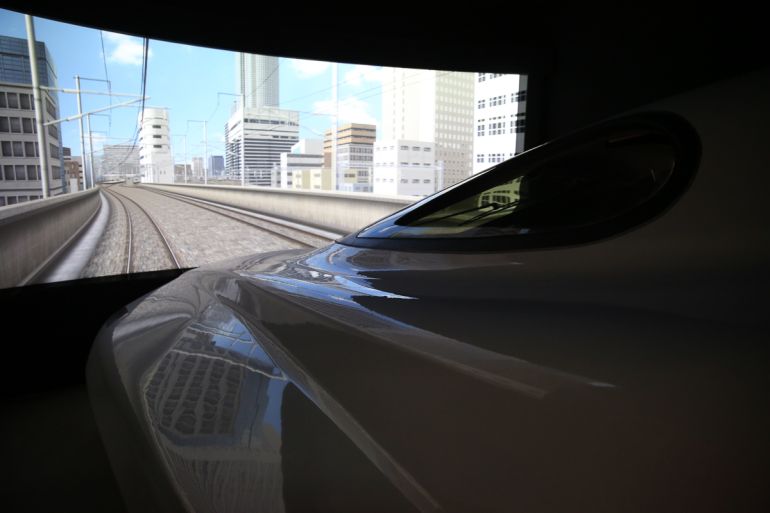
A bullet train simulator at the SCMaglev and Railway Park Museum run by JR Central in Nagoya. [Marie-Helene Carleton/Four Corners Media]
By Al Jazeera Correspondent
Published On 1 Oct 20151 Oct 2015

Japan has one of the fastest, most complex, and innovative train systems in the world, and train culture is

deeply engrained in Japanese life. 

As Japan rebuilt after World War II, it created a network of high-speed trains, bringing the country together, and linking the urban business centres of Tokyo and Osaka, and helping to establish Tokyo as one of the world’s first megacities. 

Ridership on Japan’s rural train lines – once important lifelines for small towns across Japan – has declined as the country’s overall population has decreased and the younger generation moved to urban areas. The privatisation of Japan’s rail system in the 1980s has meant rural lines are increasingly at risk of closing as transportation shifts to buses and cars. 

Rural northern Japan was already struggling with a dwindling ridership when the earthquake and the ensuing tsunami of March 2011 destroyed train lines along the coast.

Osamu Shimomoto, a driver for the Sanriku Railway in Iwate Prefecture, was driving a train the day the tsunami swept away a large portion of the rail line his train was on. Luckily, he stopped at a place along the track that wasn’t hit, and his passengers survived; but the tsunami washed away the stations ahead of and just behind his train. 

Shimomoto says the tsunami changed his life-long relationship with the sea. It took a long time before he could even approach the water’s edge, though, eventually, he did make peace with the sea. For him and for the local area, the rebuilding of the Sanriku Railway was an important symbol of recovery. Other lines, however, in the north of the country have not been rebuilt and it remains uncertain whether they ever will be.

Advertisement

The concern about the future of rural lines in northern Japan is a sign not only of the uncertainty surrounding the recovery of the region, but also the important role that rural trains, and trains in general, play in Japanese society. 


Off the Rails: A Journey Through Japan


Japan trains
A view from the driver’s cabin on a train headed from Kokura to Nobeoka, on the island of Kyushu in southern Japan. [Marie-Helene Carleton/Four Corners Media]
Advertisement
Japan trains
A local food seller awaits the arrival of tourists on the Tama Train at the Idakiso Station along the Kishigawa Line in Wakayama Prefecture, Japan. Tama the Stationmaster Cat increased ridership along the line that was facing closure due to financial hardship and declining ridership. [Marie-Helene Carleton/Four Corners Media]
Japan trains
A tourist poses with a life-sized Tama-chan at Idakiso Station in Wakayama Prefecture. [Marie-Helene Carleton/Four Corners Media]
Japan trains
Memorial stupas in the Okuno-in at Koya-san. It is considered to be the holiest place in Koya-san, and over 200,000 stupas have been erected in the cedar forest as memorials. [Marie-Helene Carleton/Four Corners Media]
Japan trains
Kazutaro Oishi, one of the first drivers during the launch of the bullet train on October 1, 1964, stands in front of the first generation shinkansen with decorative streamers and garlands that awaited his arrival in Tokyo. [Marie-Helene Carleton/Four Corners Media]
Japan trains
Akira Shirai, a former executive and chief engineer of the Oigawa Railway Company in front of a commuter train in Shin-Kaneya, Shizuoka Prefecture. The Oigawa Railway runs a restored steam locomotive as a tourist attraction, in part to try and keep the rural railway line alive. [Marie-Helene Carleton/Four Corners Media]
Advertisement
Japan trains
Yasuhiko Hashimoto, current bullet train driver for JR Central, holds his driver's watch. [Marie-Helene Carleton/Four Corners Media]
Japan trains
Professor Kinji Mori, creator of the ATOS system, a decentralised computer system used to regulate the flow of train traffic, at his university office in Tokyo. [Marie-Helene Carleton/Four Corners Media]
Japan trains
Tunnel along the Sanriku Railway in northern Japan that was devastated by the earthquake and tsunami of March 2011. [Marie-Helene Carleton/Four Corners Media]
Japan trains
A stop along the Sanriku Railway at a station that was washed away by the tsunami and rebuilt in northern Japan. [Marie-Helene Carleton/Four Corners Media]
Japan trains
Osamu Shimomoto, driver for the Sanriku Railway in his cabin as he drives along the rail line that was devastated by the tsunami of March 2011 in Iwate Prefecture. [Marie-Helene Carleton/Four Corners Media]
Japan trains
Kuji Station along the Sanriku Railway, a local train line, in Iwate Prefecture. [Marie-Helene Carleton/Four Corners Media]
Japan trains
An abandoned railway line in Iwate Prefecture in northern Japan that was destroyed by the tsunami of March 2011 and has not been rebuilt. [Marie-Helene Carleton/Four Corners Media]

Related

  • Japan security bill prompts heated debate

    Upper house to vote on legislation that would allow troops to fight on foreign soil for first time since World War II.

    Published On 18 Sep 201518 Sep 2015
    Demonstrators protest against security bills
  • A new fan of Japan after Rugby World Cup upset

    The South Africa vs Japan game will go down as one of the classic matches in the history of the World Cup.

    Published On 19 Sep 201519 Sep 2015
    South Africa v Japan - IRB Rugby World Cup 2015 Pool B

More from Gallery

  • Photos: Manila’s streets empty as fuel prices surge amid Hormuz crisis

    A sharp increase in prices of basic commodities and the possible loss of employment for thousands of people due to the fuel price hike have raised the spectre of stagflation in the Philippines.
    This gallery article has 10 imagescamera10
  • Photos: More than one million displaced by Israel’s evacuations in Lebanon

    Over one million displaced by Israel’s evacuations in Lebanon
    This gallery article has 10 imagescamera10
  • Migrants march in southern Mexico to denounce immigration restrictions

    Migrants, some carrying children, walk on the highway through the municipality of Huehuetan, Chiapas state, Mexico, Wednesday, March 25, 2026, after leaving Tapachula the previous night. (AP Photo/Edgar H. Clemente)
    This gallery article has 9 imagescamera9
  • Photos: Iran fires new waves of missiles at Israel

    This picture shows damaged buildings at the site of an Iranian missile strike in Tel Aviv
    This gallery article has 8 imagescamera8

Most popular

  • Tehran vows to extract ‘heavy price’ for Israeli hits on two nuclear sites

    TOPSHOT - This video grab taken from images released by the Iranian state broadcaster (IRIB) on March 26, 2026, shows what it says is the second phase of the 82nd wave of missiles launched against Israel and US bases in the United Arab Emirates and Kuwait.
  • US diplomat Marco Rubio denounces settler violence, tolls in Hormuz strait

    US Secretary of State Marco Rubio looks on as he speaks to the press before his departure following a G7 Foreign Ministers' meeting with Partner Countries before his departure at the Bourget airport in Le Bourget, outside Paris, France, March 27, 2026. Brendan Smialowski/Pool via REUTERS
  • FBI director Kash Patel’s emails, photos hacked by Iran-linked group

    FILE PHOTO: FBI Director Kash Patel announces the apprehension of Ryan Wedding, a former Canadian Olympic snowboarder who was on the FBI's Ten Most Wanted Fugitive list, during a press conference in Ontario, California, U.S., January 23, 2026. REUTERS/Mike Blake//File Photo
  • How extensive is Russia’s military aid to Iran?

    Iranian missile strikes

  • About

    • About Us
    • Code of Ethics
    • Terms and Conditions
    • EU/EEA Regulatory Notice
    • Privacy Policy
    • Cookie Policy
    • Cookie Preferences
    • Accessibility Statement
    • Sitemap
    • Work for us
  • Connect

    • Contact Us
    • User Accounts Help
    • Advertise with us
    • Stay Connected
    • Newsletters
    • Channel Finder
    • TV Schedule
    • Podcasts
    • Submit a Tip
    • Paid Partner Content
  • Our Channels

    • Al Jazeera Arabic
    • Al Jazeera English
    • Al Jazeera Investigative Unit
    • Al Jazeera Mubasher
    • Al Jazeera Documentary
    • Al Jazeera Balkans
    • AJ+
  • Our Network

    • Al Jazeera Centre for Studies
    • Al Jazeera Media Institute
    • Learn Arabic
    • Al Jazeera Centre for Public Liberties & Human Rights
    • Al Jazeera Forum
    • Al Jazeera Hotel Partners

Follow Al Jazeera English:

  • facebook
  • twitter
  • youtube
  • instagram-colored-outline
  • rss
Al Jazeera Media Network logo
© 2026 Al Jazeera Media Network