Skip linksSkip to Content
play
Live
Navigation menu
  • News
    • Africa
    • Asia
    • US & Canada
    • Latin America
    • Europe
    • Asia Pacific
  • Middle East
  • Explained
  • Opinion
  • Sport
  • Video
    • Features
    • Economy
    • Human Rights
    • Climate Crisis
    • Investigations
    • Interactives
    • In Pictures
    • Science & Technology
    • Podcasts
    • Travel
play
Live

In Pictures

Gallery|Refugees

A refugee journey: All they left behind

Refugees abandon their possessions en-route to safe-haven, as they flee danger in rush to catch boats, trains and buses.
Save

Share

facebooktwitterwhatsappcopylink
Phil Moore/ DO NOT USE/ ALJAZEERA
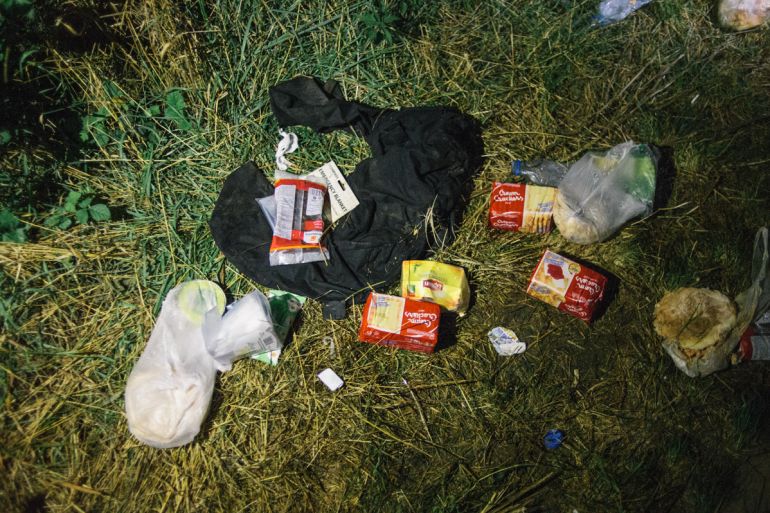
Clothes and foodstuffs lay discarded at the side of a track cutting through fields, between the Serbian and Croatian border, where a group of Syrian refugees crossed the border at night. [Phil Moore/Al Jazeera]
By Phil Moore
Published On 16 Oct 201516 Oct 2015

Tovarnik, Croatia – Imagine leaving behind your home, your life, fleeing war and persecution, taking with you only what you can carry. Thousands of kilometres later, these fragments of your life lay discarded on the roadside and platform edges, the only traces that your anguish passed through these nondescript towns.

Over half a million people have crossed the Mediterranean to Europe this year, with over half of them coming from Syria, according to the United Nations Commissioner for Refugees.

Since September 15, when Hungary closed its border with Serbia, over 80,000 people have crossed through Croatia, many through the small town of Tovarnik, just over the border from Serbia.

The majority of these people crossed the Aegean sea, paying smugglers to cram them into tiny boats leaving Turkey, bound for Greek islands. Refugees in Tovarnik told Al Jazeera smugglers had thrown their bags of clothes and trinkets into the sea, the last vestiges of their lives “too heavy”. They were left with the clothes on their backs, and the promise of what lay ahead.

Their route to Croatia involved a string of buses, trains, and taxis, punctuated by long walks, crossing borders through fields. Entering the European Union, their momentum was halted by the fences that Hungary erected, and the human tailbacks this caused in Croatia. At each point along the way, items of clothing, a lost shoe, crushed sunglasses, marked their passage.  


Related: Refugees at Croatia – Serbia border


Phil Moore/ DO NOT USE/ ALJAZEERA
A child's shoe on the roadside in the town of Tovarnik, early in the morning, as hundreds of people crowded to get on buses, leaving for a location unknown to them at the time. [Phil Moore/Al Jazeera]
Advertisement
Phil Moore/ DO NOT USE/ ALJAZEERA
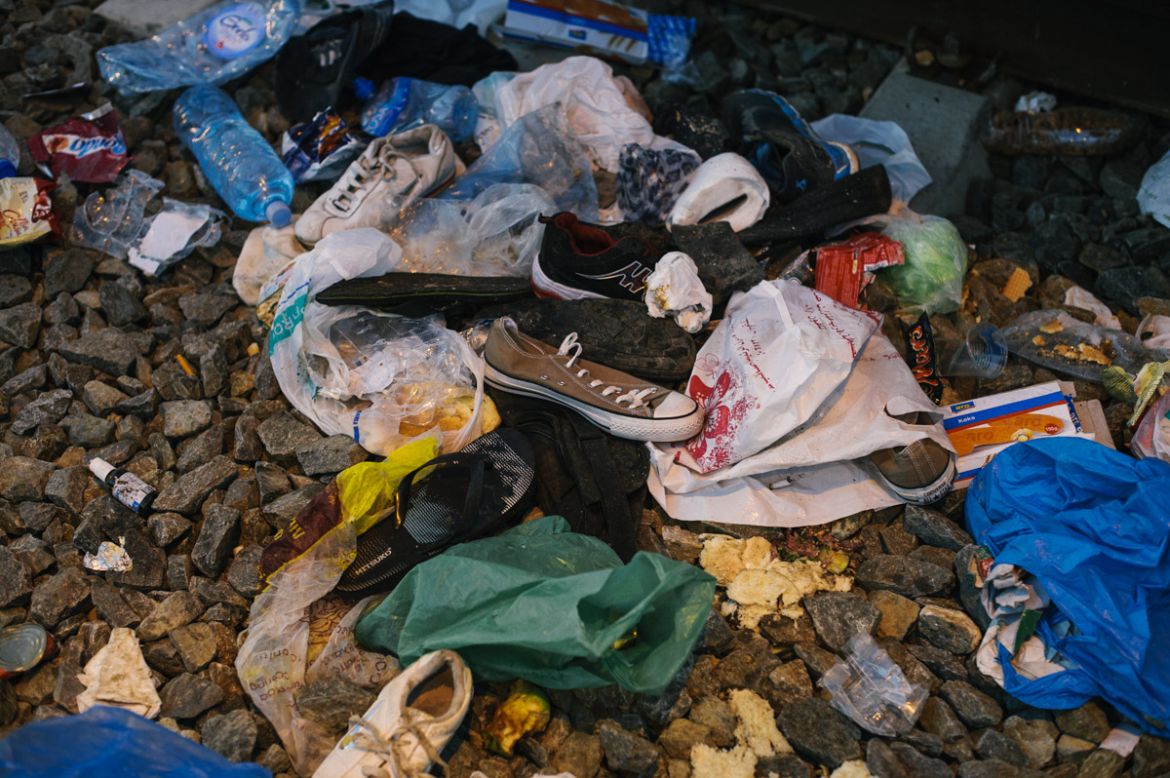
Shoes and rubbish on the railway tracks beside a train leaving Tovarnik. The train stood in the station, crammed with people, for hours as those onboard complained of the heat and lack of air. [Phil Moore/Al Jazeera]
Phil Moore/ DO NOT USE/ ALJAZEERA
A broken pair of sunglasses lay fallen next to railway tracks in Tovarnik as hundreds of people pushed to try and board the train, their only option to leave Tovarnik. [Phil Moore/Al Jazeera]
Phil Moore/ DO NOT USE/ ALJAZEERA
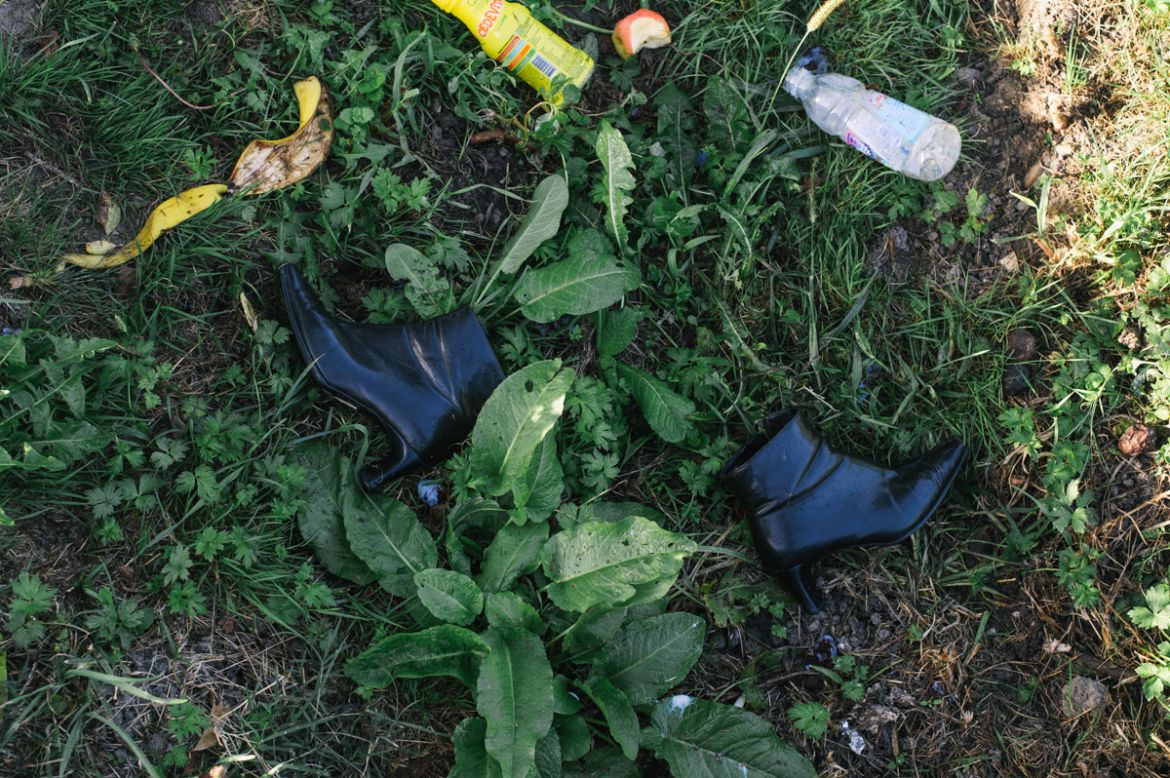
A pair of ladies' boots lay by the roadside in Tovarnik. Thousands of people had arrived here, waiting sometimes for days while authorities struggled to organise buses and trains to take them onwards to the border with Hungary or Slovenia. [Phil Moore/Al Jazeera]
Phil Moore/ DO NOT USE/ ALJAZEERA
Clothes hang to dry on a tree in an orchard in Tovarnik. Thousands of people were stranded here for days at a time, often living with little or no access to basic services, including running water and toilets. [Phil Moore/Al Jazeera]
Phil Moore/ DO NOT USE/ ALJAZEERA
Clothes, shoes, and a bag lay discarded in a bush by the roadside leading to the station in Tovarnik. Volunteers were handing out blankets and food items to some of those stranded here. [Phil Moore/Al Jazeera]
Advertisement
Phil Moore/ DO NOT USE/ ALJAZEERA
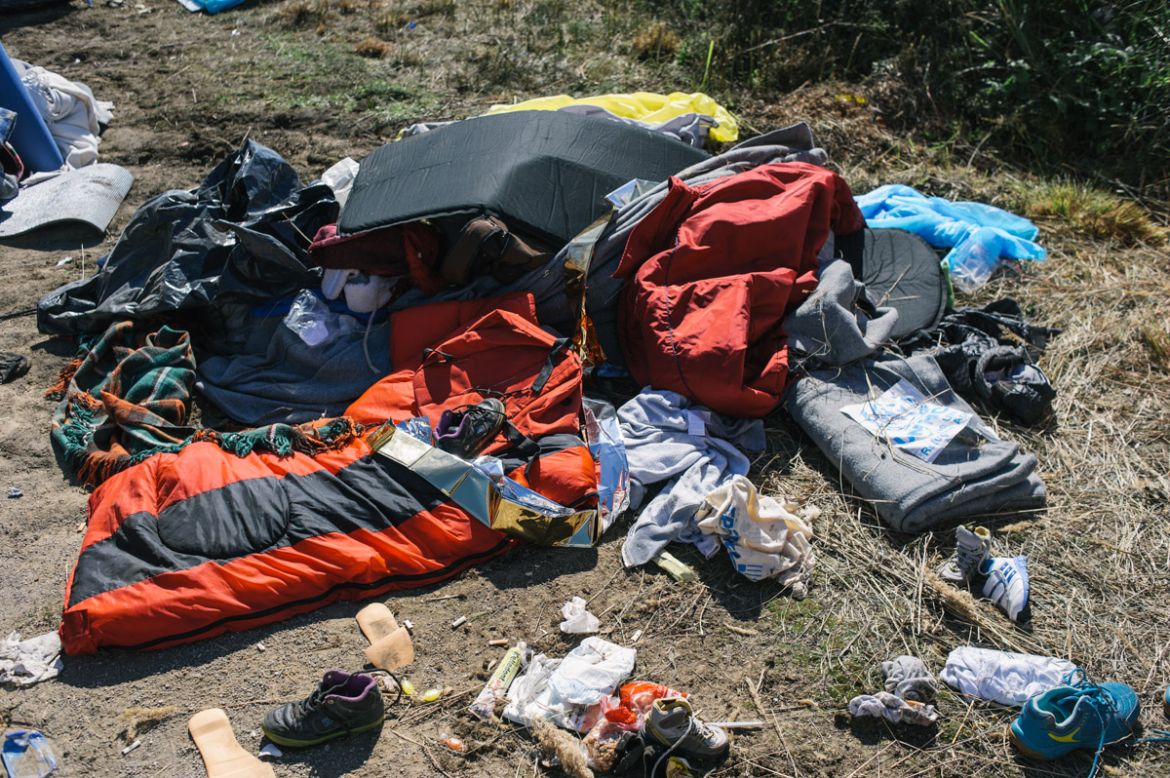
Tents, clothes and sleeping bags lay discarded by the side of the road in Tovarnik. Some of those stranded here slept in tents they had bought en-route. Many tents were left behind as people rushed to get on buses to travel onwards. [Phil Moore/Al Jazeera]
Phil Moore/ DO NOT USE/ ALJAZEERA
In the rush to board the waves of buses that came to collect people for onward travel, much was left behind in the panic. [Phil Moore/Al Jazeera]
Phil Moore/ DO NOT USE/ ALJAZEERA
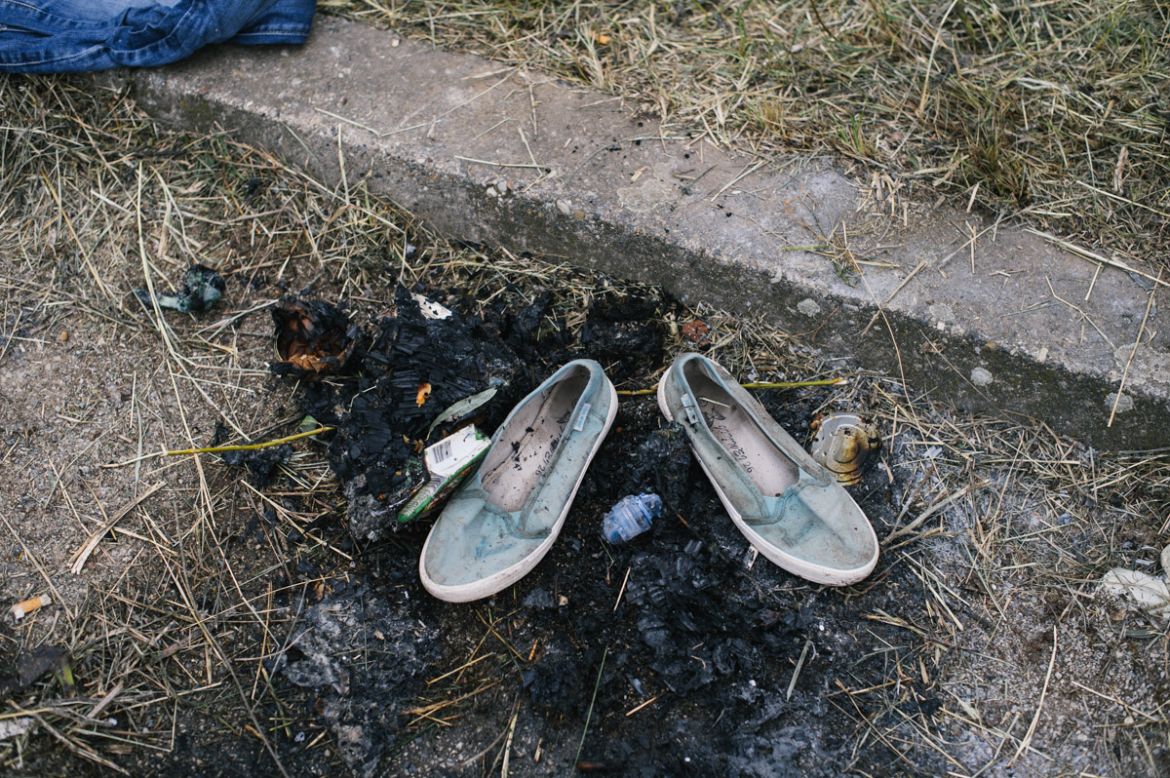
A pair of shoes lay discarded in the ashes of a fire outside the transit centre set-up near Opatovac. Croatia struggled to deal with the people crossing its borders. This temporary camp built for 4,000 people was quickly overwhelmed. [Phil Moore/Al Jazeera]
Phil Moore/ DO NOT USE/ ALJAZEERA
Shoes lay discarded next to a blanket given out by the United Nations Refugee Agency outside the transit centre in Opatovac. When the camp filled and queues formed to enter, many were forced to sleep outside. [Phil Moore/Al Jazeera]
Phil Moore/ DO NOT USE/ ALJAZEERA
Outside the Opatovac transit centre, people rushed to board buses that came to transport them onwards, abandoning their possessions. [Phil Moore/Al Jazeera]

Related

  • The refugees’ passage to Europe

    With temperatures dropping, the journey for those caught between borders is becoming even more difficult.

    Published On 27 Sep 201527 Sep 2015
    Refugees Croatia Border/ DO NOT USE/ RESTRICTED
    This gallery article has 14 imagescamera14
  • Refugees stuck at Croatia’s border with Slovenia

    Hundreds demanding entry to Slovenia from Croatia en route to Western Europe stranded in a stretch of no-man’s land.

    Published On 21 Sep 201521 Sep 2015
    Croatia refugees

More from Gallery

  • Photos: Manila’s streets empty as fuel prices surge amid Hormuz crisis

    A sharp increase in prices of basic commodities and the possible loss of employment for thousands of people due to the fuel price hike have raised the spectre of stagflation in the Philippines.
    This gallery article has 10 imagescamera10
  • Photos: More than one million displaced by Israel’s evacuations in Lebanon

    Over one million displaced by Israel’s evacuations in Lebanon
    This gallery article has 10 imagescamera10
  • Migrants march in southern Mexico to denounce immigration restrictions

    Migrants, some carrying children, walk on the highway through the municipality of Huehuetan, Chiapas state, Mexico, Wednesday, March 25, 2026, after leaving Tapachula the previous night. (AP Photo/Edgar H. Clemente)
    This gallery article has 9 imagescamera9
  • Photos: Iran fires new waves of missiles at Israel

    This picture shows damaged buildings at the site of an Iranian missile strike in Tel Aviv
    This gallery article has 8 imagescamera8

Most popular

  • Tehran vows to extract ‘heavy price’ for Israeli hits on two nuclear sites

    TOPSHOT - This video grab taken from images released by the Iranian state broadcaster (IRIB) on March 26, 2026, shows what it says is the second phase of the 82nd wave of missiles launched against Israel and US bases in the United Arab Emirates and Kuwait.
  • US diplomat Marco Rubio denounces settler violence, tolls in Hormuz strait

    US Secretary of State Marco Rubio looks on as he speaks to the press before his departure following a G7 Foreign Ministers' meeting with Partner Countries before his departure at the Bourget airport in Le Bourget, outside Paris, France, March 27, 2026. Brendan Smialowski/Pool via REUTERS
  • Guns in the streets as US, Israel intensify month-long attacks across Iran

    TEHRAN, IRAN - MARCH 27: A resident cleans up debris in a damaged apartment across from another residential building following an airstrike in the early hours of March 27, 2026 in Tehran, Iran. The Israeli military said that it had carried out strikes on targets across Tehran and other Iranian cities overnight. The United States and Israel have continued their joint attack on Iran that began on February 28. Iran retaliated by firing waves of missiles and drones at Israel and U.S. allies in the region, while also effectively blockading the Strait of Hormuz, a critical shipping route. (Photo by Majid Saeedi/Getty Images)
  • How extensive is Russia’s military aid to Iran?

    Iranian missile strikes

  • About

    • About Us
    • Code of Ethics
    • Terms and Conditions
    • EU/EEA Regulatory Notice
    • Privacy Policy
    • Cookie Policy
    • Cookie Preferences
    • Accessibility Statement
    • Sitemap
    • Work for us
  • Connect

    • Contact Us
    • User Accounts Help
    • Advertise with us
    • Stay Connected
    • Newsletters
    • Channel Finder
    • TV Schedule
    • Podcasts
    • Submit a Tip
    • Paid Partner Content
  • Our Channels

    • Al Jazeera Arabic
    • Al Jazeera English
    • Al Jazeera Investigative Unit
    • Al Jazeera Mubasher
    • Al Jazeera Documentary
    • Al Jazeera Balkans
    • AJ+
  • Our Network

    • Al Jazeera Centre for Studies
    • Al Jazeera Media Institute
    • Learn Arabic
    • Al Jazeera Centre for Public Liberties & Human Rights
    • Al Jazeera Forum
    • Al Jazeera Hotel Partners

Follow Al Jazeera English:

  • facebook
  • twitter
  • youtube
  • instagram-colored-outline
  • rss
Al Jazeera Media Network logo
© 2026 Al Jazeera Media Network