Skip linksSkip to Content
play
Live
Navigation menu
  • News
    • Africa
    • Asia
    • US & Canada
    • Latin America
    • Europe
    • Asia Pacific
  • Middle East
  • Explained
  • Opinion
  • Sport
  • Video
    • Features
    • Economy
    • Human Rights
    • Climate Crisis
    • Investigations
    • Interactives
    • In Pictures
    • Science & Technology
    • Podcasts
    • Travel
play
Live

In Pictures

Gallery

Syria Civil War: Inside the bomb shelter

Driven by fear for his family’s safety, a Syrian fighter constructs a bomb shelter in besieged Ghouta.
Save

Share

facebooktwitterwhatsappcopylink
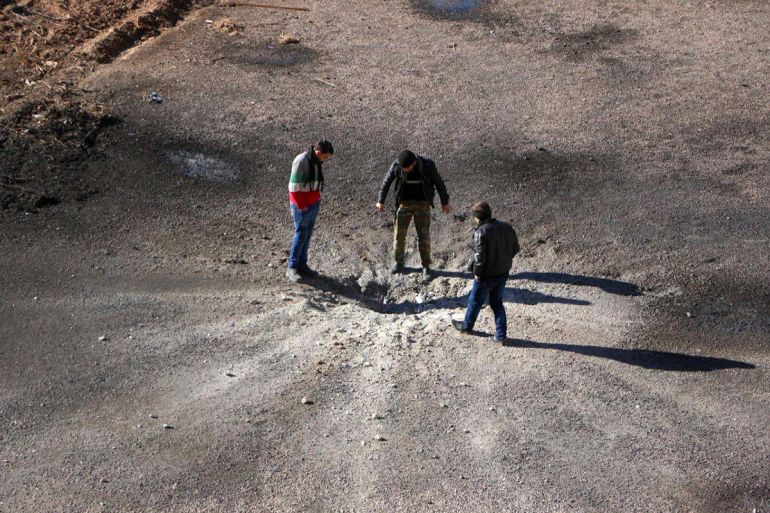
Syria so bad crater
Government forces have regularly carried out air strikes across the Ghouta region. [Msallam Abd Albaset/Al Jazeera]
By Msallam Abd Albaset
Published On 27 Apr 201627 Apr 2016

Abu Nidal Abed, a 43-year-old fighter in the Free Syria Army (FSA), his wife and two children have been sleeping in a hastily constructed bomb shelter for months.

Located in the Saqba town in the Ghouta area of Damascus’ countryside, their home has been damaged by air strikes launched by the Syrian government throughout the five-year civil war. 

“I spent 45 days building the bomb shelter to protect us from the rocket fire and air strikes,” he told Al Jazeera.

The Syrian conflict broke out as a largely unarmed uprising against President Bashar al-Assad in March 2011, but it was not long before it evolved into a full-on civil war. 

The UN special envoy for Syria, Steffan de Mistura, estimated last week that more than 400,000 people have been killed throughout the fighting in Syria. 

Much of the Ghouta region is under siege by government forces and pro-Assad armed groups, including the Lebanese Hezbollah.

The siege has made it difficult for residents to access humanitarian supplies, including medicine and vaccinations, resulting in a wave of illnesses. 

Explaining that he had already lost one son in the civil war, Abed said he was motivated by fear for his children’s safety, hoping to protect them from the exposure to the Syrian government’s air strikes.

Abed’s son, 25-year-old Nidal, was killed while fighting with the FSA in the Damascus countryside in 2015. 

Syrian home saqba
The Abed family's home was first hit by an air strike in 2013, partially damaging it. [Msallam Abd Albaset/Al Jazeera]
Advertisement
Syrian bad house 1
Abu Nidal spent 43 days building the bomb shelter by himself. [Msallam Abd Albaset/Al Jazeera]
Syria home bad
Abu Nidal says because the area is besieged, he only had access to very basic tools. [Msallam Abd Albaset/Al Jazeera]
Syrian home destroyed
'Before we built this, the kids were always scared of air strikes, especially when I wasn't at home,' he recalled. [Msallam Abd Albaset/Al Jazeera]
Syrian home
The UN estimates that more than 400,000 Syrians live in areas under siege by government or opposition. [Msallam Abd Albaset/Al Jazeera]
Syrian home destroyed
Save The Children estimates that 250,000 children are among those in besieged areas. [Msallam Abd Albaset/Al Jazeera]
Advertisement
Syrian home destroyed saqba
The Ghouta region has been hit particularly hard by air strikes from both the Assad government and Russian forces. [Msallam Abd Albaset/Al Jazeera]
Syrian home destroyed
'Now [the shelter] has put their minds at ease, much more than before,' Abed said. [Msallam Abd Albaset/Al Jazeera]

Related

  • No vaccinations for children in Syria’s Eastern Ghouta

    With no access to vaccinations for their children, Syrians in the besieged Eastern Ghouta fear the worst.

    Published On 14 Feb 201614 Feb 2016
    Ghouta Vaccines - Please don''t use
  • Letter from Ghouta: The fear of coming home to nothing

    A resident of Syria’s besieged eastern Ghouta recounts the daily anxieties of waiting for bombs to fall.

    Published On 11 Dec 201511 Dec 2015
    Syrian houses
  • In Pictures: The children of Syria’s Ghouta

    Young people living in war-ravaged Damascus suburbs often lack basic necessities and live in fear from shelling.

    Published On 10 Jan 201410 Jan 2014
    Ten-year-old Mohammed dropped out from school to work and help his parents and three younger siblings. Every day, the young boy roams the streets collecting wooden doors and furniture from shelled houses as well as material like nylon. Mohammed also collects metal or anything that seems valuable and sells it for extra money.
    This gallery article has 7 imagescamera7

More from Gallery

  • Photos: Manila’s streets empty as fuel prices surge amid Hormuz crisis

    A sharp increase in prices of basic commodities and the possible loss of employment for thousands of people due to the fuel price hike have raised the spectre of stagflation in the Philippines.
    This gallery article has 10 imagescamera10
  • Photos: More than one million displaced by Israel’s evacuations in Lebanon

    Over one million displaced by Israel’s evacuations in Lebanon
    This gallery article has 10 imagescamera10
  • Migrants march in southern Mexico to denounce immigration restrictions

    Migrants, some carrying children, walk on the highway through the municipality of Huehuetan, Chiapas state, Mexico, Wednesday, March 25, 2026, after leaving Tapachula the previous night. (AP Photo/Edgar H. Clemente)
    This gallery article has 9 imagescamera9
  • Photos: Iran fires new waves of missiles at Israel

    This picture shows damaged buildings at the site of an Iranian missile strike in Tel Aviv
    This gallery article has 8 imagescamera8

Most popular

  • ‘Playing with fire’: Iran vows response after civilian nuclear sites struck

    epaselect epa12854185 Rescuers work at a site following an Israeli airstrike that targeted a building in the village of Al Saksakiyah, southern Lebanon, 27 March 2026. According to the Lebanese Ministry of Public Health, at least 1,116 people have been killed and over 3,229 others injured in airstrikes across Beirut's southern suburbs and villages in southern Lebanon since the start of renewed hostilities. EPA/STRINGER
  • Iran war updates: Tehran vows retaliation for Israeli hits on nuclear sites

    TOPSHOT - This video grab taken from images released by the Iranian state broadcaster (IRIB) on March 26, 2026, shows what it says is the second phase of the 82nd wave of missiles launched against Israel and US bases in the United Arab Emirates and Kuwait.
  • US diplomat Marco Rubio denounces settler violence, tolls in Hormuz strait

    US Secretary of State Marco Rubio looks on as he speaks to the press before his departure following a G7 Foreign Ministers' meeting with Partner Countries before his departure at the Bourget airport in Le Bourget, outside Paris, France, March 27, 2026. Brendan Smialowski/Pool via REUTERS
  • Israel launches strikes on nuclear sites as Iran warns of retaliation

    People gather near a damaged car at the site of a residential building damaged by a strike, amid the U.S.-Israeli conflict with Iran, in Tehran, Iran, March 27, 2026. Majid Asgaripour/WANA (West Asia News Agency) via REUTERS ATTENTION EDITORS - THIS PICTURE WAS PROVIDED BY A THIRD PARTY

  • About

    • About Us
    • Code of Ethics
    • Terms and Conditions
    • EU/EEA Regulatory Notice
    • Privacy Policy
    • Cookie Policy
    • Cookie Preferences
    • Accessibility Statement
    • Sitemap
    • Work for us
  • Connect

    • Contact Us
    • User Accounts Help
    • Advertise with us
    • Stay Connected
    • Newsletters
    • Channel Finder
    • TV Schedule
    • Podcasts
    • Submit a Tip
    • Paid Partner Content
  • Our Channels

    • Al Jazeera Arabic
    • Al Jazeera English
    • Al Jazeera Investigative Unit
    • Al Jazeera Mubasher
    • Al Jazeera Documentary
    • Al Jazeera Balkans
    • AJ+
  • Our Network

    • Al Jazeera Centre for Studies
    • Al Jazeera Media Institute
    • Learn Arabic
    • Al Jazeera Centre for Public Liberties & Human Rights
    • Al Jazeera Forum
    • Al Jazeera Hotel Partners

Follow Al Jazeera English:

  • facebook
  • twitter
  • youtube
  • instagram-colored-outline
  • rss
Al Jazeera Media Network logo
© 2026 Al Jazeera Media Network