Skip linksSkip to Content
play
Live
Navigation menu
  • News
    • Africa
    • Asia
    • US & Canada
    • Latin America
    • Europe
    • Asia Pacific
  • Middle East
  • Explained
  • Opinion
  • Sport
  • Video
    • Features
    • Economy
    • Human Rights
    • Climate Crisis
    • Investigations
    • Interactives
    • In Pictures
    • Science & Technology
    • Podcasts
    • Travel
play
Live

In Pictures

Gallery|Racism

Homes burned, shops looted in anti-migrant attacks

Renewed anti-foreigner violence has raised fresh fears and uncertainty among members of migrant communities in S Africa.
Save

Share

facebooktwitterwhatsappcopylink
Xenophobia/ Please Do Not Use
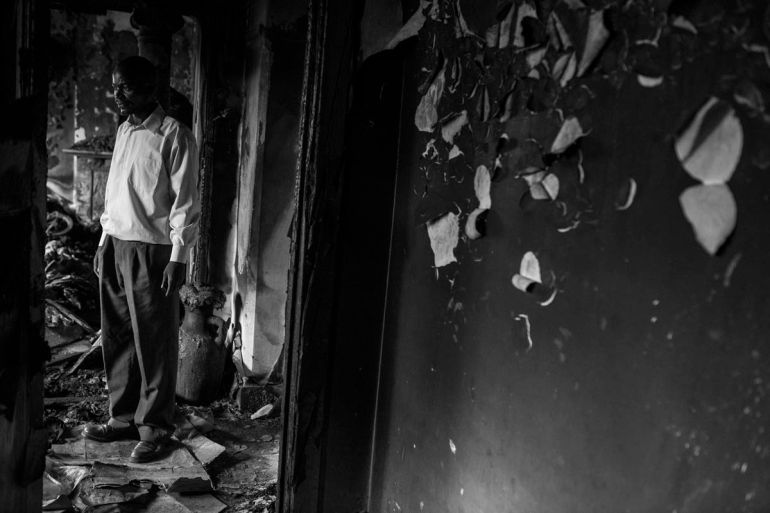
Anderson Mapata, a migrant from Malawi, is seen in a home destroyed in an arson attack in the Johannesburg suburb of Rosettenville. [Ihsaan Haffejee/Al Jazeera]
By Ihsaan Haffejee
Published On 27 Feb 201727 Feb 2017

Violence against foreigners has flared up again in parts of South Africa.

Earlier this month, immigrants’ homes and businesses were looted and torched in suburbs of Johannesburg and Pretoria, the capital city, raising concerns about anti-foreigner sentiment in the country.

The latest attacks follow previous bouts of xenophobic violence in 2008 and 2015 which resulted in the deaths of foreign nationals and the displacement of hundreds of migrants who were too afraid to continue living in the new communities they now called home.

With the end of apartheid and the dawn of democracy in 1994, South Africa opened itself up to the world.
A steady stream of migrants from around Africa made their way south in search of safety and better opportunities, in what was once the continent’s fastest-growing and largest economy.

But nowadays, with the economy static and youth unemployment rising, some locals are accusing foreigners of stealing jobs and of being involved in criminal activities, such as drug peddling and prostitution.

Anti-immigrant sentiment is on the rise with community leaders and some in government echoing the dangerous rhetoric heard in parts of Europe and the United States.

On Friday, authorities gave permission to a group of people to hold an anti-immigrant rally in Pretoria. The march descended into violence when some protesters attempted to storm into a suburb of Pretoria West, which is home to a predominantly migrant community. 

The migrants in the area mobilised and vowed to fight back as a large contingent of riot police had to be deployed to avoid large-scale violence between the two groups.

Advertisement
Xenophobia/ Please Do Not Use
Malawian migrant Elube Mwalwen, 34, walks through Rosettenville with her 18-month-old son Brian, looking for a place to stay for the night after their home was torched. Local protesters claimed that Nigerians were using houses in the area to peddle drugs. [Ihsaan Haffejee/Al Jazeera]
Advertisement
Xenophobia/ Please Do Not Use
Groups of anti-immigrant protesters on Friday making their way towards a suburb of Pretoria West, which is home to a predominantly migrant community. Police stood between the two groups to calm the situation, but failed to prevent clashes erupting. [Ihsaan Haffejee/Al Jazeera]
Xenophobia/ Please Do Not Use
Foreign nationals armed with sticks and rocks confront a group of anti-immigrant protesters in Pretoria West. [Ihsaan Haffejee/Al Jazeera]
Xenophobia/ Please Do Not Use
A police helicopter flies overhead as members of the South African police step in between groups of anti-immigrant protesters and migrant communities in Pretoria. [Ihsaan Haffejee/Al Jazeera]
Xenophobia/ Please Do Not Use
Leaders of a migrant community form a human chain to keep others from approaching a group of anti-immigrant protesters who were attempting to enter a Pretoria West suburb. Foreign nationals mobilised and armed themselves with stones and sticks in an attempt to defend their neighbourhood from the anti-immigrant group. [Ihsaan Haffejee/Al Jazeera]
Xenophobia/ Please Do Not Use
A man who took part in the anti-immigrant rally lies injured on the ground after police fired tear gas and stun grenades to disperse the protesters. [Ihsaan Haffejee/Al Jazeera]
Advertisement
Xenophobia/ Please Do Not Use
Foreign nationals lock themselves behind the gates in their homes after the clashes in Pretoria West. [Ihsaan Haffejee/Al Jazeera]
Xenophobia/ Please Do Not Use
Local protesters blame foreign nationals for unemployment and crime. [Ihsaan Haffejee/Al Jazeera]
Xenophobia/ Please Do Not Use
A Muslim migrant can be seen standing guard at the entrance of a Musjid in a suburb of Pretoria West. The man was forced to close the main entrance to the prayer facility after the area came under attack. [Ihsaan Haffejee/Al Jazeera]
Xenophobia/ Please Do Not Use
Men who were marched through Pretoria threatening foreign nationals are arrested by police. The group, which had been on the rampage all day, were isolated by the police and made to lie on the ground. [Ihsaan Haffejee/Al Jazeera]

Related

  • Pretoria: Violence erupts at anti-migrant protest

    Police fire tear gas and rubber bullets to break up local protesters who blame foreigners for unemployment and crime.

    Published On 25 Feb 201725 Feb 2017
    South Africa xenophobia
  • In Pictures: Cape Town’s xenophobia

    South African city said to be one of the most unequal in the country with foreigners facing increasing discrimination.

    Published On 4 Dec 20144 Dec 2014
    <p>Abdulle lives in Bo-Kaap close to the heart of Cape Town(***)s central business district. Every morning he wakes up before 5am to set up his stall in the city centre. </p>
    This gallery article has 12 imagescamera12

More from Gallery

  • Photos: Manila’s streets empty as fuel prices surge amid Hormuz crisis

    A sharp increase in prices of basic commodities and the possible loss of employment for thousands of people due to the fuel price hike have raised the spectre of stagflation in the Philippines.
    This gallery article has 10 imagescamera10
  • Photos: More than one million displaced by Israel’s evacuations in Lebanon

    Over one million displaced by Israel’s evacuations in Lebanon
    This gallery article has 10 imagescamera10
  • Migrants march in southern Mexico to denounce immigration restrictions

    Migrants, some carrying children, walk on the highway through the municipality of Huehuetan, Chiapas state, Mexico, Wednesday, March 25, 2026, after leaving Tapachula the previous night. (AP Photo/Edgar H. Clemente)
    This gallery article has 9 imagescamera9
  • Photos: Iran fires new waves of missiles at Israel

    This picture shows damaged buildings at the site of an Iranian missile strike in Tel Aviv
    This gallery article has 8 imagescamera8

Most popular

  • ‘Playing with fire’: Iran vows response after civilian nuclear sites struck

    epaselect epa12854185 Rescuers work at a site following an Israeli airstrike that targeted a building in the village of Al Saksakiyah, southern Lebanon, 27 March 2026. According to the Lebanese Ministry of Public Health, at least 1,116 people have been killed and over 3,229 others injured in airstrikes across Beirut's southern suburbs and villages in southern Lebanon since the start of renewed hostilities. EPA/STRINGER
  • US diplomat Marco Rubio denounces settler violence, tolls in Hormuz strait

    US Secretary of State Marco Rubio looks on as he speaks to the press before his departure following a G7 Foreign Ministers' meeting with Partner Countries before his departure at the Bourget airport in Le Bourget, outside Paris, France, March 27, 2026. Brendan Smialowski/Pool via REUTERS
  • Iran war updates: Tehran vows retaliation for Israeli hits on nuclear sites

    TOPSHOT - This video grab taken from images released by the Iranian state broadcaster (IRIB) on March 26, 2026, shows what it says is the second phase of the 82nd wave of missiles launched against Israel and US bases in the United Arab Emirates and Kuwait.
  • Guns in the streets as US, Israel intensify month-long attacks across Iran

    TEHRAN, IRAN - MARCH 27: A resident cleans up debris in a damaged apartment across from another residential building following an airstrike in the early hours of March 27, 2026 in Tehran, Iran. The Israeli military said that it had carried out strikes on targets across Tehran and other Iranian cities overnight. The United States and Israel have continued their joint attack on Iran that began on February 28. Iran retaliated by firing waves of missiles and drones at Israel and U.S. allies in the region, while also effectively blockading the Strait of Hormuz, a critical shipping route. (Photo by Majid Saeedi/Getty Images)

  • About

    • About Us
    • Code of Ethics
    • Terms and Conditions
    • EU/EEA Regulatory Notice
    • Privacy Policy
    • Cookie Policy
    • Cookie Preferences
    • Accessibility Statement
    • Sitemap
    • Work for us
  • Connect

    • Contact Us
    • User Accounts Help
    • Advertise with us
    • Stay Connected
    • Newsletters
    • Channel Finder
    • TV Schedule
    • Podcasts
    • Submit a Tip
    • Paid Partner Content
  • Our Channels

    • Al Jazeera Arabic
    • Al Jazeera English
    • Al Jazeera Investigative Unit
    • Al Jazeera Mubasher
    • Al Jazeera Documentary
    • Al Jazeera Balkans
    • AJ+
  • Our Network

    • Al Jazeera Centre for Studies
    • Al Jazeera Media Institute
    • Learn Arabic
    • Al Jazeera Centre for Public Liberties & Human Rights
    • Al Jazeera Forum
    • Al Jazeera Hotel Partners

Follow Al Jazeera English:

  • facebook
  • twitter
  • youtube
  • instagram-colored-outline
  • rss
Al Jazeera Media Network logo
© 2026 Al Jazeera Media Network