Skip linksSkip to Content
play
Live
Navigation menu
  • News
    • Africa
    • Asia
    • US & Canada
    • Latin America
    • Europe
    • Asia Pacific
  • Middle East
  • Explained
  • Opinion
  • Sport
  • Video
    • Features
    • Economy
    • Human Rights
    • Climate Crisis
    • Investigations
    • Interactives
    • In Pictures
    • Science & Technology
    • Podcasts
    • Travel
play
Live

In Pictures

Gallery|Climate Crisis

Bolivia’s indigenous women cope with climate change

Government agencies and NGOs collaborate to empower Bolivian women to take on a greater role in their communities.

Save

Share

facebooktwitterwhatsappcopylink
While her son plays in the fields Juanita Terrazas, living in the community of Pucara, makes use of ecological produced herbicides to protect the crops in her vegetable garden (30-1-2018) With help o
With her son playing next to her, Juanita Terrazas uses natural herbicides to protect the crops in her vegetable garden. The NGO Belgian Solidagro helps finance projects in her community. [Sanne Derks/Al Jazeera]
By Sanne Derks
Published On 22 Feb 201822 Feb 2018

Bolivia is among the many countries around the world now dealing with the consequences of global warming, including extreme weather patterns. 

Especially vulnerable are the mostly indigenous farmer communities, which depend on regular seasonal patterns to make a living.

For the Quechua community in southwestern Bolivia, the reduction of the rainy season from five to two months and the flooding and erosion it brings result in a loss of crops and livestock.

During the extended dry season, the community is left with meagre sources of water, affecting the amount and quality of the farmers’ harvest. Pest outbreaks have also increased, damaging many crops.

Tiraque is a town located 3,300 metres up the Cochabamba Valley in the country’s central region. It has 147 indigenous communities, who mostly depend on agriculture.  

Here, women are responsible for providing food for the family, and their options are usually limited to working in agriculture.

Because of deep-rooted gender inequality, women are less informed, less valued by men and excluded from the decision-making process in the community, making them even more vulnerable.

In the past 10 years, NGOs and the government have focused on reducing the gender gap and teaching the community how to adapt to climate change, while empowering women to take on a greater role in society.

1 Lucy Lopez, single mother of two, prepares food for her children in the community of Ch’akamayu (1-2-2018). For women it is a challenge to prepare sufficient and healthy food, as the harvest is affe
Lucy Lopez, single mother of two, prepares food for her children in the community of Ch'akamayu. For women, it is a challenge to prepare sufficient and healthy food, as the harvest is affected by climate change. [Sanne Derks/Al Jazeera]
Advertisement
Arminda Cossío takes care of her four kinds while her husband is growing coca in the Chapare region (1-2-2018). Women are responsible for the upbringing of their children. Now incomes have decreased
Arminda Cossio takes care of her four kids while her husband is growing coca in the country's Chapare region. Women are left to raise children as their husbands migrate to find work elsewhere. [Sanne Derks/Al Jazeera]
Although it has diversification and a more healthy diet as a consequence, it is also much more labor intense to grow these crops. Every onion has to be planted manual like here is Pucara, Tiraque (30-
Oligario Cossio shares chicha, a fermented mais drink, with his neighbour Manuel. Men usually have to travel for work. [Sanne Derks/Al Jazeera]
Potatoes are harvested during the rainy season. It is a communal job in which men harvest and women select the potatoes, such as here in community 25 de Octubre (12-2-2018). Before the climatological
Potatoes are harvested during the rainy season. It is a communal job; men harvest, and women sort the potatoes, such as here in the community of 25 de Octubre. People can now apply for 'agricultural insurance' to protect their harvest from unpredictable climate. [Sanne Derks/Al Jazeera]
The community of Ch’akamayu is working together on the construction of tubes for irrigation 2-2-2018). Water is indispensable for the farming communities. In the dry season drought is becoming a serio
The community of Ch'akamayu works together on the construction of channels for irrigation. Water is indispensable for the farming communities, especially during the dry season. [Sanne Derks/Al Jazeera]
On the farmyard of Juanita Terrazas there is one tap for her, her son, her mother and father (30-1-2018). She explains that water pipes have been constructed to their region five years ago with help f
In Juanita Terrazas' farmyard, there is one tap for her family. Water pipes were installed in her region five years ago. The oven behind her was constructed by INCCA group to help her cook [Sanne Derks/Al Jazeera]
Advertisement
On Friday Trinidad Cossío from Virvini will sell chicharron de pollo, a Bolivian chicken dish, at the local market in Tiraque 31-1-2018). Women often rely on a women’s network if they need help. For
On Fridays, Trinidad Cossío from Virvini attends the local market in Tiraque where she sells chicharron de pollo, a Bolivian chicken dish. Women often rely on their networks for help. For a small fee, neighbouring women come to help her slaughter and clean the chicken. [Sanne Derks/Al Jazeera]
Primavera Besara is cleaning the interiors of a sheep with her daughter Melinda (9-2-2018). The meat will be used to prepare a Carnaval meal. The skin is drying to be sold. People live with small eco
Primavera Besara's daughter helps her prepare lamb meat. The fleece is sold separately. The money she makes is used to invest in livestock and to buy necessities such as clothes and medicines. [Sanne Derks/Al Jazeera]
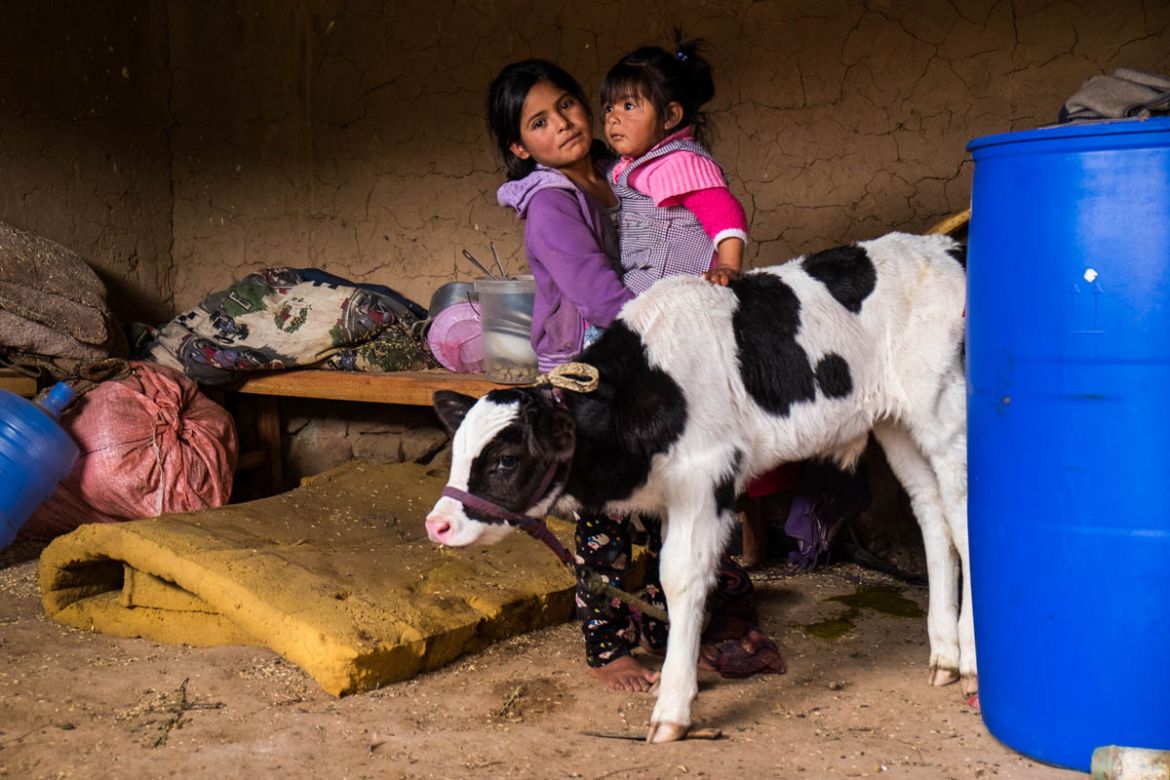
Melinda takes her “pet calf” to the living room (31-1-2018). One way to make an additional living is buying a little calf for around 100 Bolivianos (12 euro), grow it for half a year and sell it at 5
Melinda takes her 'pet calf' to the living room. One way to make an additional living is buying a calf for around $15 to raise for half a year and sell for $74 during the dry season. [Sanne Derks/Al Jazeera]
In Virvini women participate in a workshop by INCCA and Solidagro to decide on what programs will be proposed in 2018 (10-2-2018). Under Evo Morales progress has been made to reduce gender inequality
In Virvini, women participate in a workshop by the INCCA conservation group and Solidagro, a food security NGO, to decide on the programmes to be proposed in 2018. Nowadays, women have a greater say in the decision-making process for the community.[Sanne Derks/Al Jazeera]
Trinidad Cossío proudly shows the new cow she was granted. In case of reproduction, she has to give the calf to another Bartolina (31-1-2018). Due to Morales’ politics on gender inclusion, women were
Trinidad Cossio proudly shows the new cow she obtained with the help of Las Bartolinas, the women-oriented farmers' group in Tiraque. A total of 200 cows were donated to Tiraque by the Fondo Indígena, a fund for indigenous communities in Latin America. [Sanne Derks/Al Jazeera]
In workshops women learn to stand up and speak up for themselves. They learn that their opinions matter and that men also have to respect their voice (9-2-2018). According to the law fifty percent of
During community workshops, women learn to stand up and speak up for themselves. They learn that their opinions matter and that men have to respect their voice. [Sanne Derks/Al Jazeera]
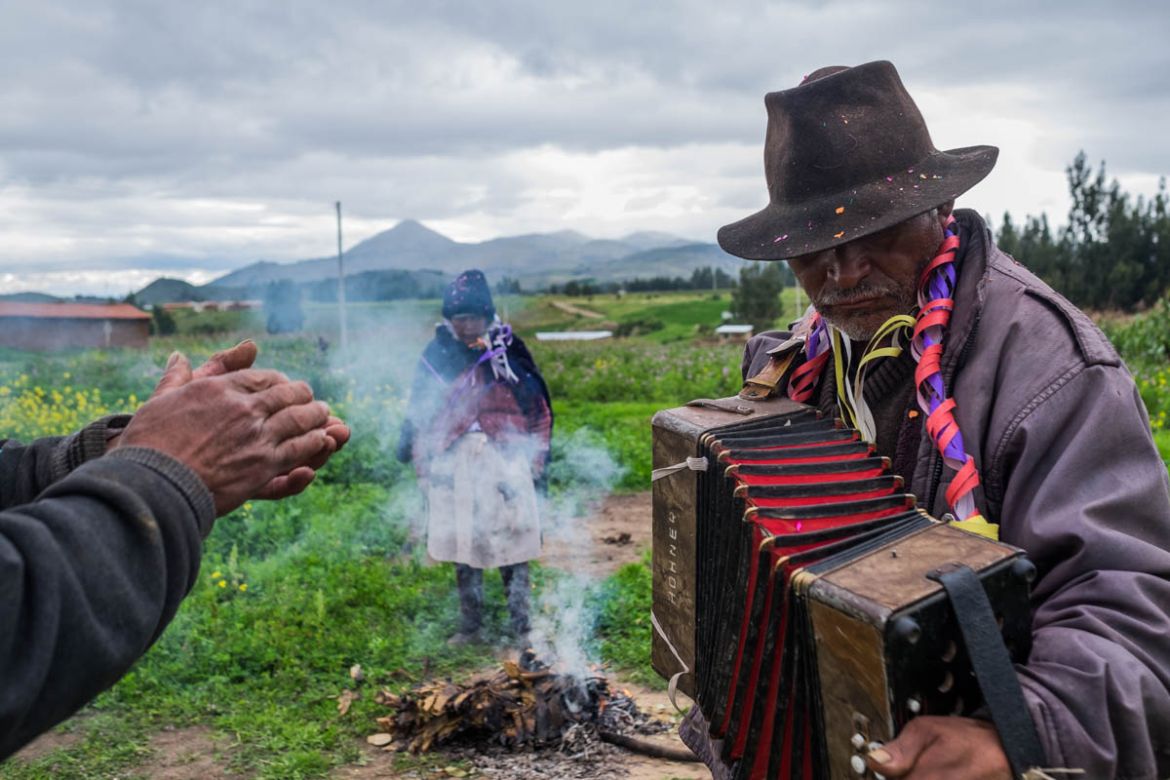
‘Martes de la Ch’alla’ in Virvini with Oligario and Gregoria Cossío (13-2-2018). One of the main feasts in the agricultural calendar is the ‘Martes de la Ch’alla’ or Tuesday of Carnaval. This day far
One of the main feasts in the agricultural calendar is the Martes de la Ch'alla or Tuesday of Carnaval. On this day farmers visit their fields and give some offerings to Pachamama or Mother Earth. [Sanne Derks/Al Jazeera]
Froylan Fernandez dances in his backyard while his wife Emilia Garcia, decorated with serpentines, prepares a meal (13-2-2018). Martes de Ch’alla’is usually celebrated in family sphere. Their grandda
Froylan Fernandez dances in his backyard while his wife Emilia Garcia, adorned and smiling, prepares a meal. Martes de Ch'alla' is usually celebrated with family members. [Sanne Derks/Al Jazeera]
The marvelous Arminda Cossío with her youngest son and eldest daughter in Ch’akamayu (1-2-2018). Bolivian Quechua women are in a process of adapting to the inevitable climatological changes of which t
Arminda Cossío with her youngest son and eldest daughter in Ch'akamayu. Bolivian Quechua women are in a process of adapting to the inevitable climatological changes in their community. [Sanne Derks/Al Jazeera]

Related

  • Wildlife killed, reefs damaged in ‘active’ Gulf of Mexico oil spill

    Authorities say the oil is seeping from three sources, including a vessel that has not yet been identified.

    Published On 27 Mar 202627 Mar 2026
    Members of the Mexican Navy remove tar-stained seaweed from the shoreline.
  • From: NewsFeed

    New UN climate report says the past decade was the hottest on record

    A new UN report confirms the past decade was the hottest on record.

    Published On 23 Mar 202623 Mar 2026
    Video Duration 02 minutes 20 seconds play-arrow02:20
  • Flash flooding swamps Hawaii, prompting evacuation orders for 5,500 people

    Oahu’s emergency office has ordered residents in the Waialua area to ‘leave now’ amid risk of road failures.

    Published On 21 Mar 202621 Mar 2026
    Fooding covers a residential neighborhood in Waialua, Hawaii, Friday, March 20, 2026. (AP Photo/Mengshin Lin)
  • Long before Trump: How US policy has harmed the environment for decades

    Environment advocacy groups are suing the US government over climate change policy rollback.

    Published On 20 Mar 202620 Mar 2026
    Obama

More from Gallery

  • Photos: Manila’s streets empty as fuel prices surge amid Hormuz crisis

    A sharp increase in prices of basic commodities and the possible loss of employment for thousands of people due to the fuel price hike have raised the spectre of stagflation in the Philippines.
    This gallery article has 10 imagescamera10
  • Photos: More than one million displaced by Israel’s evacuations in Lebanon

    Over one million displaced by Israel’s evacuations in Lebanon
    This gallery article has 10 imagescamera10
  • Migrants march in southern Mexico to denounce immigration restrictions

    Migrants, some carrying children, walk on the highway through the municipality of Huehuetan, Chiapas state, Mexico, Wednesday, March 25, 2026, after leaving Tapachula the previous night. (AP Photo/Edgar H. Clemente)
    This gallery article has 9 imagescamera9
  • Photos: Iran fires new waves of missiles at Israel

    This picture shows damaged buildings at the site of an Iranian missile strike in Tel Aviv
    This gallery article has 8 imagescamera8

Most popular

  • No end in sight as US-Israeli war on Iran enters second month

    A police officer looks at the destroyed car of Lebanese journalists Al Mayadeen reporter Fatima Ftouni and cameraman Mohammed Ftouni, and Al Manar reporter Ali Shaib, killed by a targeted Israeli strike, in Jezzine, southern Lebanon, March 28, 2026. Picture taken with a mobile phone. [Ali Hankir/Reuters]
  • Iran warns neighbours not to let ‘enemies run the war’ from their land

    Fire and plumes of smoke rise after a drone struck a fuel tank forcing the temporary suspension of flights. near Dubai International Airport, in United Arab Emirates, early Monday, March 16, 2026. (AP Photo)
  • Yemen’s Houthis launch missile attack on Israel as war with Iran intensifies

    FILE PHOTO: Members of Houthi military forces parade in the Red Sea port city of Hodeida, Yemen September 1, 2022. Houthi Military Media/Handout via REUTERS ATTENTION EDITORS - THIS IMAGE HAS BEEN SUPPLIED BY A THIRD PARTY./File Photo
  • One month in, disapproval high but US lawmakers take no action on Iran war

    epa12847045 US President Donald Trump speaks during a swearing-in ceremony in the Oval Office of the White House in Washington, DC, USA, 24 March 2026. Markwayne Mullin was confirmed as Department of Homeland Security (DHS) secretary, placing the Oklahoma senator in charge of a Trump administration immigration crackdown that has triggered a 37-day funding shutdown of the cabinet agency. EPA/GRAEME SLOAN / POOL

  • About

    • About Us
    • Code of Ethics
    • Terms and Conditions
    • EU/EEA Regulatory Notice
    • Privacy Policy
    • Cookie Policy
    • Cookie Preferences
    • Accessibility Statement
    • Sitemap
    • Work for us
  • Connect

    • Contact Us
    • User Accounts Help
    • Advertise with us
    • Stay Connected
    • Newsletters
    • Channel Finder
    • TV Schedule
    • Podcasts
    • Submit a Tip
    • Paid Partner Content
  • Our Channels

    • Al Jazeera Arabic
    • Al Jazeera English
    • Al Jazeera Investigative Unit
    • Al Jazeera Mubasher
    • Al Jazeera Documentary
    • Al Jazeera Balkans
    • AJ+
  • Our Network

    • Al Jazeera Centre for Studies
    • Al Jazeera Media Institute
    • Learn Arabic
    • Al Jazeera Centre for Public Liberties & Human Rights
    • Al Jazeera Forum
    • Al Jazeera Hotel Partners

Follow Al Jazeera English:

  • facebook
  • twitter
  • youtube
  • instagram-colored-outline
  • rss
Al Jazeera Media Network logo
© 2026 Al Jazeera Media Network