Skip linksSkip to Content
play
Live
Navigation menu
  • News
    • Africa
    • Asia
    • US & Canada
    • Latin America
    • Europe
    • Asia Pacific
  • Middle East
  • Explained
  • Opinion
  • Sport
  • Video
    • Features
    • Economy
    • Human Rights
    • Climate Crisis
    • Investigations
    • Interactives
    • In Pictures
    • Science & Technology
    • Podcasts
    • Travel
play
Live

In Pictures

Gallery|Coronavirus pandemic

In Pictures: The long road home for India’s migrant workers

Coronavirus lockdown sees tens of thousands of workers emerging from factories and workplaces in search of a way home.
Save

Share

facebooktwitterwhatsappcopylink
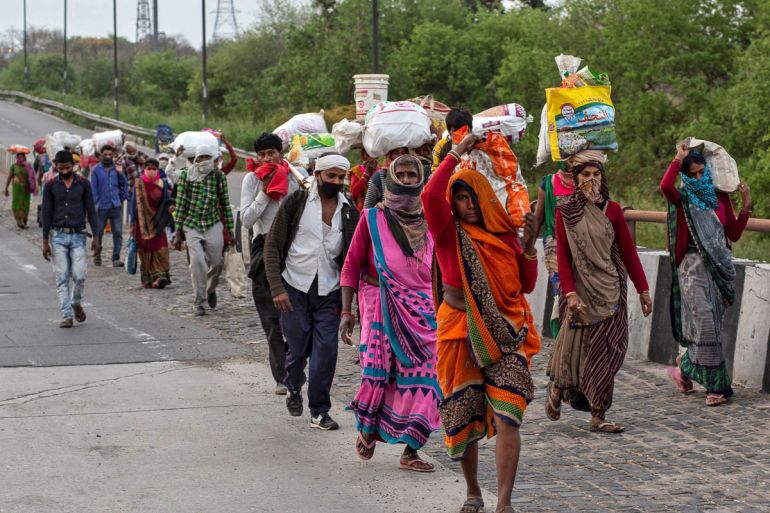
Friends and relatives of Kushwaha family who work as migrant workers walk along a road to return to their villages, during a 21-day nationwide lockdown to limit the spreading of coronavirus, in New De
Friends and relatives of Kushwaha family who work as migrant workers walk along a road to return to their villages during a nationwide lockdown to limit the spreading of coronavirus, in New Delhi. [Danish Siddiqui/Reuters]
Published On 22 Apr 202022 Apr 2020

As soon as India announced its coronavirus lockdown on March 24, tens of thousands of migrant workers in cities left for their homes in one of the biggest mass movements of people in the country since the partition of India and Pakistan in 1947.

For decades, villages across India have been emptying out. To many people, the decision is one of simple arithmetic: to earn $6 a day instead of $3 back home.

In areas like the parched Bundelkhand region in the central Madhya Pradesh state, home to construction worker Dayaram Kushwaha’s ancestral village, living off the land has become increasingly difficult as rainfall recedes.

Others seek something more abstract: the prospect of escape that pulls anyone towards a big city. But after the shutdown, the cities themselves began to empty.

Dayaram and his family were among the first to move.

As the days went on, and the situation became more desperate, thousands of migrants emerged from factories and workplaces in search of a way home.

Indian officials say the shutdown – the world’s largest – is necessary to beat coronavirus in the densely populated country of 1.3 billion people, with a health infrastructure that can ill afford a widespread outbreak.

But for Dayaram and many of India’s estimated 140 million migrant labourers, the epidemic is much more than a threat to their health – it endangers their very economic survival.

In the shutdown, India has banned domestic and international travel, and factories, schools, offices and all shops other than those supplying essential services have been shut. Taken together, the measures amount to one of the harshest lockdowns in the world.

Advertisement

Cases here have spiked to nearly 20,000, with more than 600 deaths. On April 14, the government extended the curbs until at least May 3, prompting clashes between police and migrants trying to leave India’s financial capital, Mumbai, and the western city of Surat.

Migrants, such as Dayaram, are the backbone of India’s urban economy, and a necessity for its rapidly expanding cities. Others clean toilets, drive taxis and deliver takeout.

They predominantly earn daily wages, with no prospect of job security, and live in dirty, densely populated slums, saving money to send back home.

That money is essential to the young and elderly left behind in villages. Approximately $30bn flows from urban to rural areas in India each year, according to government and academic estimates.

Now that infusion of money, transferred through rural banks or in worn stacks of rupees borne home on rare visits, has come to a halt.

Dayaram Kushwaha, a migrant worker, carries his 5-year-old son, Shivam, on his shoulders as they walk along a road to return to their village, during a 21-day nationwide lockdown to limit the spreadin
With no way to feed his family or pay the rent, Dayaram hoisted his son Shivam, 5, onto his shoulders and began to walk to the village where he was born, 500 km (300 miles) away. He said he was also thinking of his other son, seven-year-old Mangal, who had been left behind in the village with elderly relatives because it was too hard to care for two children while he and his wife worked. In the middle of a pandemic, there was one consolation: 'At least I will be with him.' [Danish Siddiqui/Reuters]
Advertisement
Dayaram Kushwaha, a migrant worker who returned home from New Delhi, harvests wheat during nationwide lockdown in India to slow the spread of the coronavirus, in Jugyai village in the central state of
Dayaram harvests wheat in Jugyai village in the central state of Madhya Pradesh. In a dingy room in his house filled with sacks of grain and clothes, an unframed poster hangs on the wall. It depicts a red-roofed house on a lake, sun setting behind snow-capped mountains. 'I want to turn the clock back to when people lived in small villages and took care of each other,' it says. [Danish Siddiqui/Reuters]
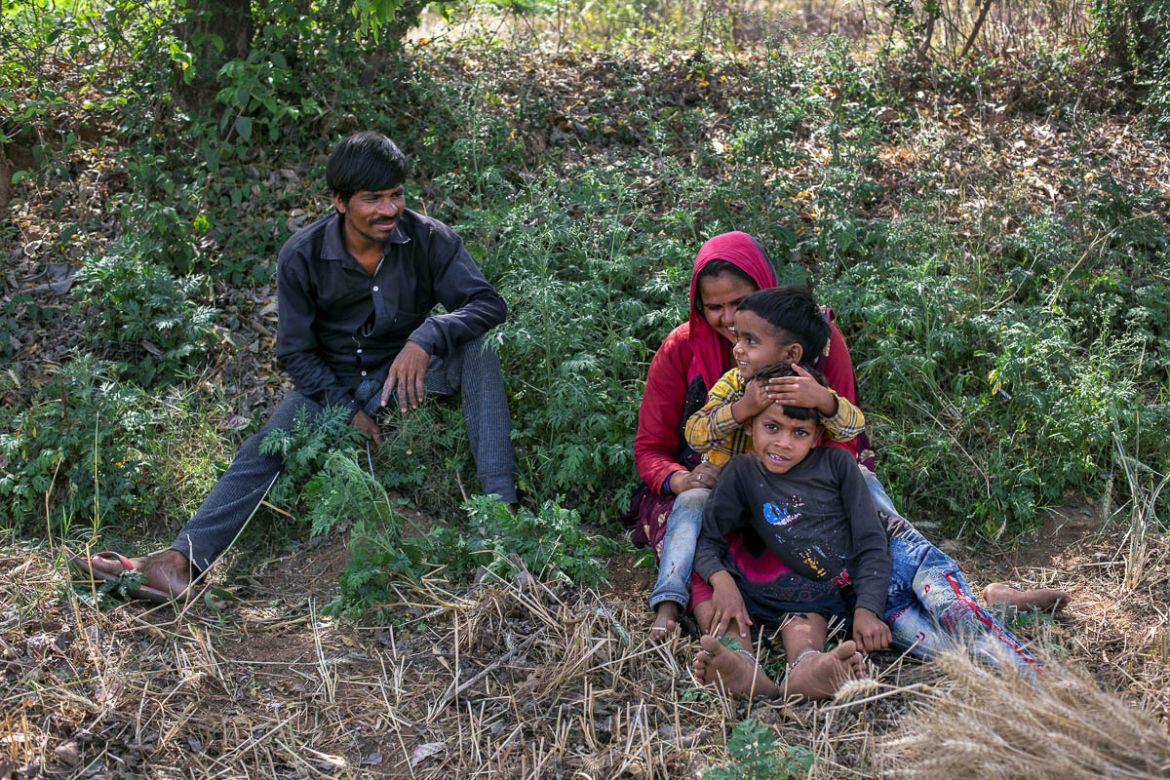
Dayaram Kushwaha and Gyanvati, migrant workers who returned home from New Delhi, play with their sons Mangal and Shivam as they take a break from harvesting wheat, during nationwide lockdown in India
Dayaram and his wife Gyanvati play with their sons Mangal and Shivam as they take a break from harvesting wheat. 'It's not that I love Delhi,' he says. 'I need the money to survive. If we had it, we would have stayed here. This is home.' [Danish Siddiqui/Reuters]
Gyanvati, a migrant worker, cooks food for her family after she returned home from New Delhi during nationwide lockdown in India to slow the spread of the coronavirus, in Jugyai village in the central
After Mangal was born, Gyanvati stayed behind in Jugyai to look after him. When he was barely one, she came to New Delhi with him, too. But after Shivam was born, they were faced with a choice: take Mangal, too, or leave him in the village. 'It's easier to carry one child while working, but two is too difficult,' Gyanvati said. 'So we had to leave him behind.' [Danish Siddiqui/Reuters]
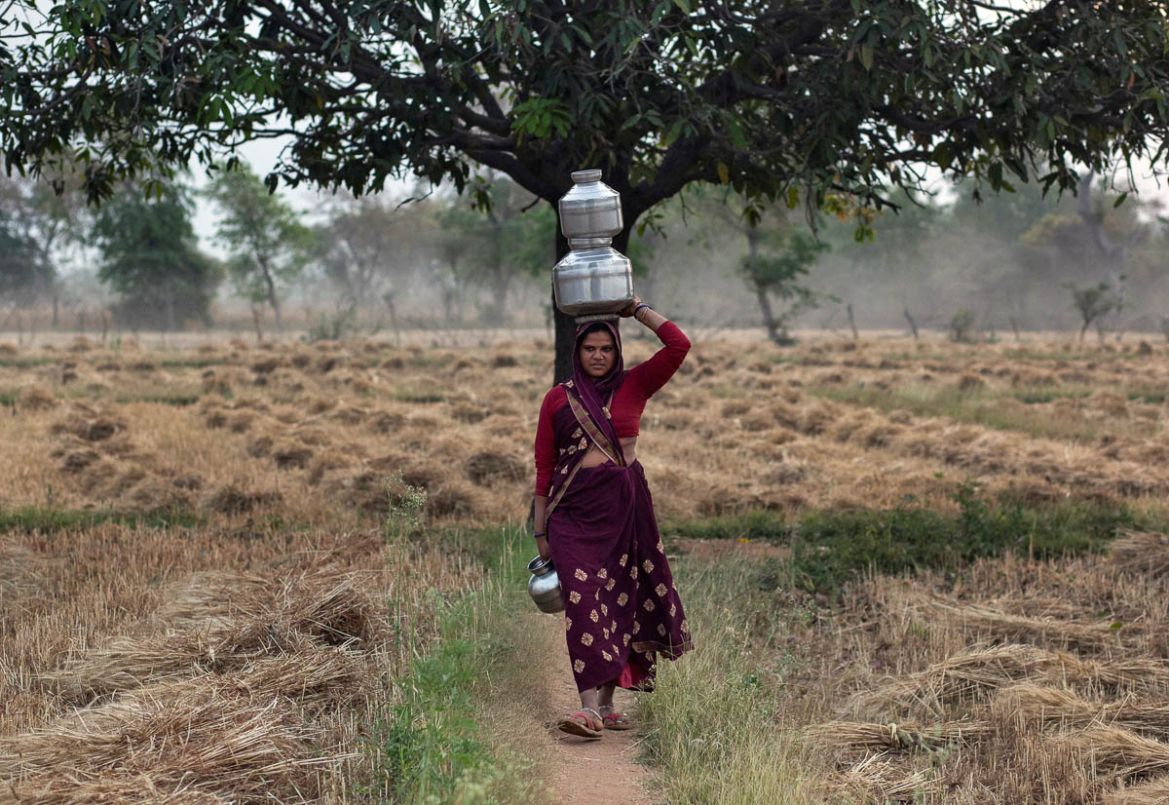
Gyanvati, a migrant worker, carries pots filled with water after she returned home from New Delhi during nationwide lockdown in India to slow the spread of the coronavirus, in Jugyai village in the ce
Dayaram talks continuously about fate. His marriage, his move to New Delhi, his flight back home – all were decisions made not out of choice, but a necessity. Dayaram's maternal aunt played matchmaker when it came time for him to marry. He and Gyanvati were from the same Kushwaha caste, from a lower rung of India's ancient social order who traditionally worked in agriculture. They first met a month before their wedding day. 'She was ok,' Dayaram said, a smile briefly crossing his face, remembering their meeting. 'But whatever is in my fate is fine, whether it is good or bad.' [Danish Siddiqui/Reuters]
Two-room concrete house of Dayaram Kushwaha and Gyanvati, migrant workers who returned home from New Delhi, is pictured during nationwide lockdown in India to slow the spread of the coronavirus, in Ju
The two-room concrete hut of Dayaram Kushwaha and Gyanvati. After four days of walking and hitching lifts on a series of goods trucks, they reached their home in Jugyai, a farming village of 2,000 people. [Danish Siddiqui/Reuters]
Advertisement
Pramod Kushwaha, a migrant worker who returned home from New Delhi with Dayaram Kushwaha, poses for a portrait during nationwide lockdown in India to slow the spread of the coronavirus, in Churari vil
Pramod Kushwaha, a migrant worker who returned home from New Delhi in Churari village in the central state of Madhya Pradesh. [Danish Siddiqui/Reuters]
Women walk through an empty street during nationwide lockdown in India to slow the spread of the coronavirus, in Jugyai village in the central state of Madhya Pradesh, India, April 8, 2020. Picture ta
Women walk through an empty street during the nationwide lockdown in Jugyai village. Dayaram worries the shutdown will end any hope of providing his children with an education. 'No parents want their child to work as a labourer,' he said. But there is no alternative, he said. 'They will have to do what I have done.' [Danish Siddiqui/Reuters]
Kesra (L) and Takur Das, migrant workers and parents of Dayaram Kushwaha, a migrant worker who returned home from New Delhi, pose for a portrait during nationwide lockdown in India to slow the spread
Dayaram's parents - Kesra, left, and Takur Das - also migrant workers. He said he tried not to worry about what would happen once he got to his village with empty pockets instead of the money he usually sent home to help support those left behind. At least he would have a home, he said. [Danish Siddiqui/Reuters]

Related

  • From: NewsFeed

    What does the US withdrawal from the WHO mean for global health?

    The US completed its withdrawal from the World Health Organization, ending its membership for the first time since 1948.

    Published On 23 Jan 202623 Jan 2026
    A girl suffering from mpox waits for treatment at a clinic in Munigi, eastern Congo on Aug. 19, 2024. [Moses Sawasawa/AP]
    Video Duration 03 minutes 18 seconds play-arrow03:18
  • US officially withdraws from the World Health Organization

    US health secretary, secretary of state announce that Washington completes the process of WHO withdrawal.

    Published On 23 Jan 202623 Jan 2026
  • ‘Chaotic’ culture in UK government led to more COVID deaths, inquiry finds

    An inquiry commissioned in 2021 has found ex-PM Boris Johnson failed to act decisively to combat the global pandemic.

    Published On 20 Nov 202520 Nov 2025
    Boris
  • From: The Stream

    Is the world ready for another pandemic?

    With countries struggling to bring the chikungunya virus under control, is the world prepared for another pandemic?

    Published On 31 Oct 202531 Oct 2025
    Video Duration 25 minutes 12 seconds play-arrow25:12

More from Gallery

  • Photos: Manila’s streets empty as fuel prices surge amid Hormuz crisis

    A sharp increase in prices of basic commodities and the possible loss of employment for thousands of people due to the fuel price hike have raised the spectre of stagflation in the Philippines.
    This gallery article has 10 imagescamera10
  • Photos: More than one million displaced by Israel’s evacuations in Lebanon

    Over one million displaced by Israel’s evacuations in Lebanon
    This gallery article has 10 imagescamera10
  • Migrants march in southern Mexico to denounce immigration restrictions

    Migrants, some carrying children, walk on the highway through the municipality of Huehuetan, Chiapas state, Mexico, Wednesday, March 25, 2026, after leaving Tapachula the previous night. (AP Photo/Edgar H. Clemente)
    This gallery article has 9 imagescamera9
  • Photos: Iran fires new waves of missiles at Israel

    This picture shows damaged buildings at the site of an Iranian missile strike in Tel Aviv
    This gallery article has 8 imagescamera8

Most popular

  • Israel vows no let-up in Iran attacks despite US push to end war

    TOPSHOT - This video grab taken from images released by the Iranian state broadcaster (IRIB) on March 26, 2026, shows what it says is the second phase of the 82nd wave of missiles launched against Israel and US bases in the United Arab Emirates and Kuwait.
  • How extensive is Russia’s military aid to Iran?

    Iranian missile strikes
  • Saudi, UAE, Iraq: Can three pipelines help oil escape Strait of Hormuz?

    TOPSHOT - Indian vessel 'Nanda Devi' carrying liquefied petroleum gas (LPG) arrives at Vadinar Port in the Jamnagar district of Gujarat state on March 17, 2026 after Iran allowed it to pass through the Strait of Hormuz, a key energy corridor that remains disrupted by the Middle East war.
  • ‘Raising 10 red flags’: Is Israel’s army exhausted?

    Israeli soldiers

  • About

    • About Us
    • Code of Ethics
    • Terms and Conditions
    • EU/EEA Regulatory Notice
    • Privacy Policy
    • Cookie Policy
    • Cookie Preferences
    • Accessibility Statement
    • Sitemap
    • Work for us
  • Connect

    • Contact Us
    • User Accounts Help
    • Advertise with us
    • Stay Connected
    • Newsletters
    • Channel Finder
    • TV Schedule
    • Podcasts
    • Submit a Tip
    • Paid Partner Content
  • Our Channels

    • Al Jazeera Arabic
    • Al Jazeera English
    • Al Jazeera Investigative Unit
    • Al Jazeera Mubasher
    • Al Jazeera Documentary
    • Al Jazeera Balkans
    • AJ+
  • Our Network

    • Al Jazeera Centre for Studies
    • Al Jazeera Media Institute
    • Learn Arabic
    • Al Jazeera Centre for Public Liberties & Human Rights
    • Al Jazeera Forum
    • Al Jazeera Hotel Partners

Follow Al Jazeera English:

  • facebook
  • twitter
  • youtube
  • instagram-colored-outline
  • rss
Al Jazeera Media Network logo
© 2026 Al Jazeera Media Network