Skip linksSkip to Content
play
Live
Navigation menu
  • News
    • Africa
    • Asia
    • US & Canada
    • Latin America
    • Europe
    • Asia Pacific
  • Middle East
  • Explained
  • Opinion
  • Sport
  • Video
    • Features
    • Economy
    • Human Rights
    • Climate Crisis
    • Investigations
    • Interactives
    • In Pictures
    • Science & Technology
    • Podcasts
    • Travel
play
Live

In Pictures

Gallery|Climate Crisis

Ecological ‘holocaust’: Women saving India’s Western Ghats forest

All-female rainforest force battling to protect one of the last enclaves of biodiversity along the Western Ghats mountains.
Save

Share

facebooktwitterwhatsappcopylink
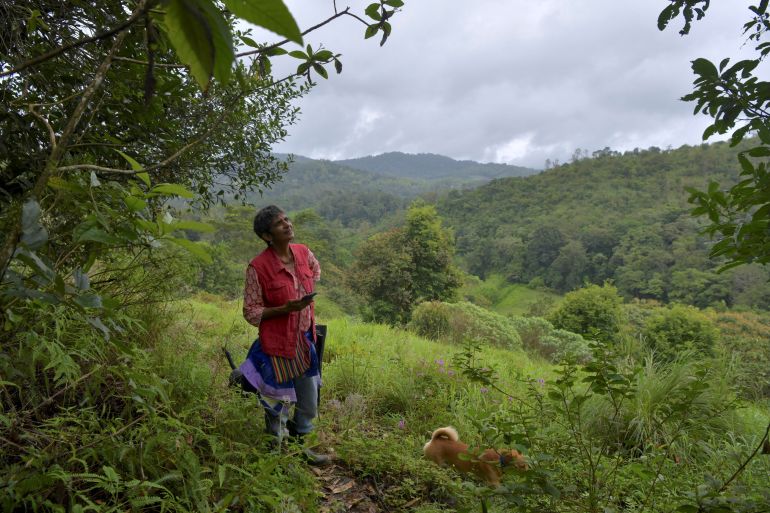
Suprabha Seshan, plant conservationist, restoration ecologist and director of the Gurukula Botanical Sanctuary situated in the Western Ghat mountains, looks at the tranfer of an epiphyte plant on a tree at the Gurukula Botanical Sanctuary in Kerala's Wayanad District. [Manjunath Kiran/AFP]
By AFP
Published On 4 Nov 20214 Nov 2021

As deforestation and climate change ravage India’s UNESCO heritage-listed Western Ghats mountain range, an all-female rainforest force is battling to protect one of the area’s last enclaves of biodiversity.

The region is home to at least 325 globally threatened flora, fauna, bird, amphibian, reptile and fish species but the International Union for the Conservation of Nature (IUCN) has ranked its outlook as a “significant concern”.

At Gurukula Botanical Sanctuary, a group of 27 women act as guardians of the rare ferns, tree-hugging mosses and thousands of other plants that may otherwise be lost forever.

“We are trying to salvage what is possible. It is like a refugee camp,” said Suprabha Seshan, one of the curators at the reserve.

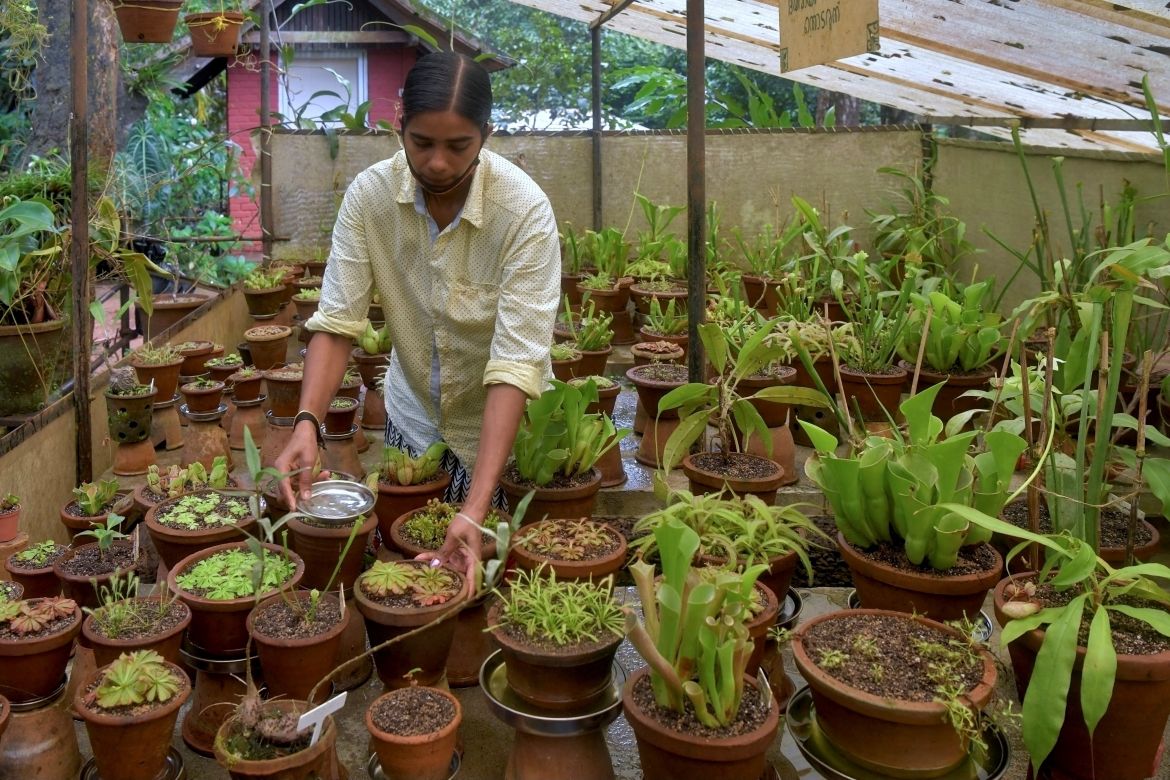
It is also like a hospital. “The intensive care unit is in the pots and when you take them out that’s like the general ward where they get other forms of primary healthcare,” Seshan added.

She estimated that more than 90 percent of the forests once graced the area have disappeared, a situation she describes as an ecological “holocaust”.

Gurukula was created as a haven for the native flora struggling for survival because of global warming and human encroachment, in the hope of slowly repopulating the region with indigenous plants.

Gurukula, which means a “retreat with a guru”, was set up 50 years ago by German conservationist Wolfgang Theuerkauf.

Theuerkauf, who became an Indian citizen in 1978 and died seven years ago, started with seven acres (three hectares) of forest. Today it is 10 times that size.

Advertisement

“Wolfgang said ‘this forest is our guru’,” Seshan explained.

Three generations of “rainforest gardeners” – women from local villages in the hot and humid Kerala state – have worked with botanists to build up the sanctuary.

“We have between 30 and 40 percent of the Western Ghats flora under conservation here,” added Seshan.

The work is becoming increasingly crucial. The region won its UNESCO listing in 2012 in part because it is one of the world’s biodiversity hotspots. But in its 2020 World Heritage Outlook report, the International Union for Conservation of Nature (IUCN) warned of the threat of encroaching human activity and habitat loss.

“Fifty million people are estimated to live in the Western Ghats region, resulting in pressures that are orders of magnitude greater than many protected areas around the world,” it said.

Seshan, who has worked at the sanctuary for 28 years, has seen things deteriorate first-hand.

She recalled: “When I came here plastic was still not a part of our culture. I remember when Wolfgang found the first plastic bag in the river, he said: ‘civilisation has arrived’.”

The small plants of the Western Ghats are vulnerable to rising temperatures, rainfall fluctuations and the loss of habitat, said Seshan.

“The more the climate changes, the more their reproductive life strategies have to change to adapt.”

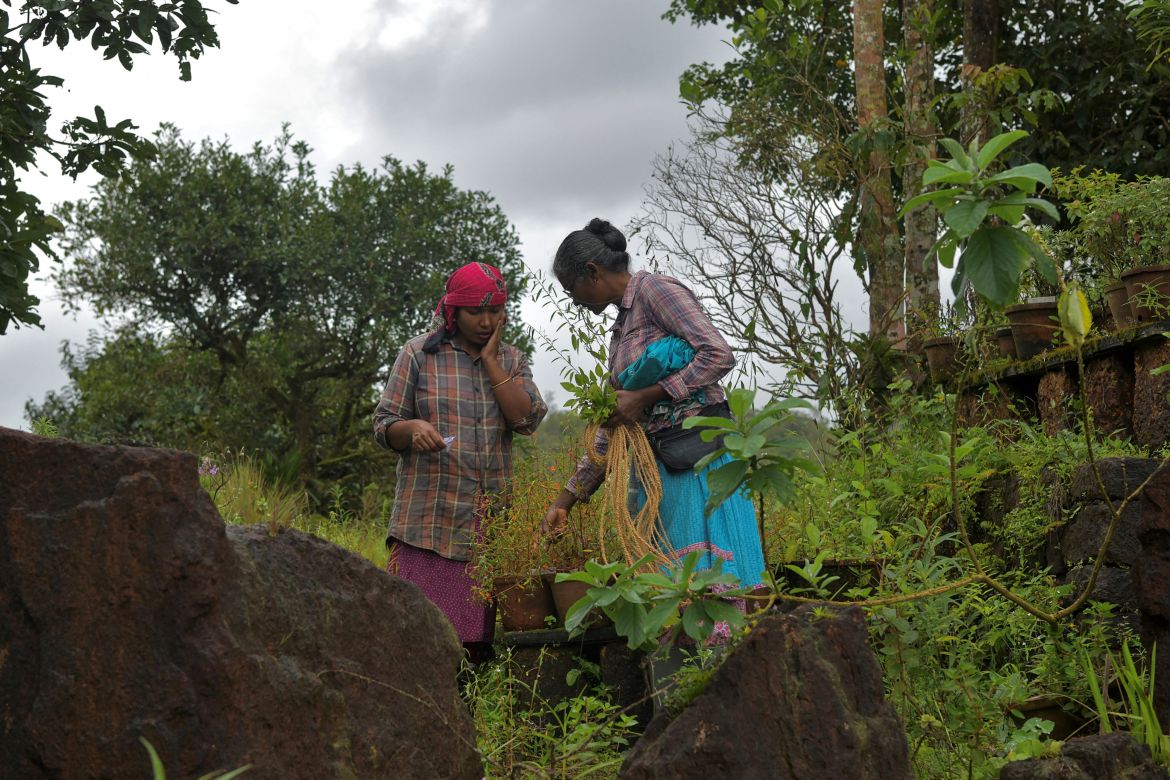
Laly Joseph, another of the senior gardeners, scours the mountains for species that need to be moved to Gurukula for intensive care.

She tries to find simple ways to reproduce the natural conditions for each species being cared for. It is also carefully listed in an inventory.

Joseph showed off an Impatiens jerdoniae with red and yellow flowers that had been struggling before being nurtured and transplanted onto a tree. Three years on it is thriving.

Joseph, who has worked at the sanctuary for 25 years, says saving a rare species and seeing it live again in a forest is incredibly satisfying.

“They’re happy here, I am happy when they’re happy,” Joseph said of the plant.

But she fears the increasingly unpredictable climate may destroy their work.

The plants are struggling to cope, Joseph said. “They wilt, they can’t pollinate, they don’t get seeds. That is the way you lose species,” she added.

“I suffer when a tree has fallen when the rainforest dies.”

Replanted grass grows on a hillock at Gurukula Botanical Sanctuary (GBS). [Manjunath Kiran/AFP]
Advertisement
Dressed in big boots - to protect against cobras and insects - and brightly coloured tunics, their hair tied under scarves, the women put in long days in the forests, the sanctuary's greenhouses and its nursery. They replant the suffering flora, sift compost and seeds and make a malodorous natural pesticide from cow urine. [Manjunath Kiran/AFP]
Workers repot plants cultivated at the Gurukula Botanical Sanctuary. Fighting off bloodsucking leeches that thrive in the humidity, the rainforest gardeners tend to a multitude of endangered ferns, flowers and herbs that grow around the rocks and in the shade of tropical trees. [Manjunath Kiran/AFP]
A worker shows seeds extracted from endemic plant species. The Western Ghats normally get up to 500 centimetres (200 inches) of rain a year, but the monsoon is increasingly erratic. [Manjunath Kiran/AFP]
A flowering plant belonging to the species Annual Impatiens, endemic to the Western Ghats and discovered by Laly Joseph, a plant conservationist and ecosystem gardener at the Gurukula Botanical Sanctuary. [Manjunath Kiran/AFP]
At Gurukula Botanical Sanctuary a group of 27 women act as guardians of the rare ferns, tree-hugging mosses and thousands of other plants that may otherwise be lost forever. [Manjunath Kiran/AFP]
Advertisement
"We are trying to salvage what is possible. It is like a refugee camp," said Suprabha Seshan. [Manjunath Kiran/AFP]
Laly Joseph, another of the senior gardeners, scours the mountains for species that need to be moved to Gurukula for intensive care. She tries to find simple ways to reproduce the natural conditions for each species being cared for. [Manjunath Kiran/AFP]
Three generations of "rainforest gardeners" - women from local villages in the hot and humid Kerala state - have worked with botanists to build up the sanctuary. [Manjunath Kiran/AFP]
The region won its UNESCO listing in 2012 in part because it is one of the world's biodiversity hotspots, but in its 2020 World Heritage Outlook report, the IUCN warned of the threat of encroaching human activity and habitat loss. [Manjunath Kiran/AFP]

Related

  • India targets net-zero carbon emissions by 2070, says Modi

    India is the last of the world’s major carbon polluters to announce a net-zero target, with US and EU aiming for 2050.

    Published On 1 Nov 20211 Nov 2021
    India's Prime Minister Narendra Modi made several climate pledges [Alastair Grant/AFP]
  • Protests as India’s Goa plans infra projects in protected forest

    Government approves three infrastructure projects cutting through Western Ghats as residents fear loss of biodiversity.

    Published On 13 Apr 202113 Apr 2021
    Goa residents protest against the infrastructure projects approved in the Mollem forest [Gina Pereira/Al Jazeera]
  • India unveils renewable energy ambitions with big solar push

    PM Narendra Modi says India to produce more energy through solar and other renewables than nation’s entire grid by 2030.

    Published On 3 Nov 20213 Nov 2021
    solar power
    This gallery article has 8 imagescamera8
  • ‘Saved by coal’: Far from COP26, another reality in India

    While getting rid of coal may be possible for some developed nations, it is not so simple for developing countries.

    Published On 1 Nov 20211 Nov 2021
    Naresh Chauhan, 50, and his wife Rina Devi, 45, fill sacks with coal in Dhanbad, an eastern Indian city in Jharkhand state. The two have lived in a village at the edge of the Jharia coalfield in Dhanbad all their lives. The couple earn $3 a day selling four baskets of scavenged coal to traders. [Altaf Qadri/AP Photo]
    This gallery article has 13 imagescamera13

More from Gallery

  • Photos: Manila’s streets empty as fuel prices surge amid Hormuz crisis

    A sharp increase in prices of basic commodities and the possible loss of employment for thousands of people due to the fuel price hike have raised the spectre of stagflation in the Philippines.
    This gallery article has 10 imagescamera10
  • Photos: More than one million displaced by Israel’s evacuations in Lebanon

    Over one million displaced by Israel’s evacuations in Lebanon
    This gallery article has 10 imagescamera10
  • Migrants march in southern Mexico to denounce immigration restrictions

    Migrants, some carrying children, walk on the highway through the municipality of Huehuetan, Chiapas state, Mexico, Wednesday, March 25, 2026, after leaving Tapachula the previous night. (AP Photo/Edgar H. Clemente)
    This gallery article has 9 imagescamera9
  • Photos: Iran fires new waves of missiles at Israel

    This picture shows damaged buildings at the site of an Iranian missile strike in Tel Aviv
    This gallery article has 8 imagescamera8

Most popular

  • ‘Playing with fire’: Iran vows response after civilian nuclear sites struck

    epaselect epa12854185 Rescuers work at a site following an Israeli airstrike that targeted a building in the village of Al Saksakiyah, southern Lebanon, 27 March 2026. According to the Lebanese Ministry of Public Health, at least 1,116 people have been killed and over 3,229 others injured in airstrikes across Beirut's southern suburbs and villages in southern Lebanon since the start of renewed hostilities. EPA/STRINGER
  • Iran war updates: Tehran vows retaliation for Israeli hits on nuclear sites

    TOPSHOT - This video grab taken from images released by the Iranian state broadcaster (IRIB) on March 26, 2026, shows what it says is the second phase of the 82nd wave of missiles launched against Israel and US bases in the United Arab Emirates and Kuwait.
  • US diplomat Marco Rubio denounces settler violence, tolls in Hormuz strait

    US Secretary of State Marco Rubio looks on as he speaks to the press before his departure following a G7 Foreign Ministers' meeting with Partner Countries before his departure at the Bourget airport in Le Bourget, outside Paris, France, March 27, 2026. Brendan Smialowski/Pool via REUTERS
  • Israel launches strikes on nuclear sites as Iran warns of retaliation

    People gather near a damaged car at the site of a residential building damaged by a strike, amid the U.S.-Israeli conflict with Iran, in Tehran, Iran, March 27, 2026. Majid Asgaripour/WANA (West Asia News Agency) via REUTERS ATTENTION EDITORS - THIS PICTURE WAS PROVIDED BY A THIRD PARTY

  • About

    • About Us
    • Code of Ethics
    • Terms and Conditions
    • EU/EEA Regulatory Notice
    • Privacy Policy
    • Cookie Policy
    • Cookie Preferences
    • Accessibility Statement
    • Sitemap
    • Work for us
  • Connect

    • Contact Us
    • User Accounts Help
    • Advertise with us
    • Stay Connected
    • Newsletters
    • Channel Finder
    • TV Schedule
    • Podcasts
    • Submit a Tip
    • Paid Partner Content
  • Our Channels

    • Al Jazeera Arabic
    • Al Jazeera English
    • Al Jazeera Investigative Unit
    • Al Jazeera Mubasher
    • Al Jazeera Documentary
    • Al Jazeera Balkans
    • AJ+
  • Our Network

    • Al Jazeera Centre for Studies
    • Al Jazeera Media Institute
    • Learn Arabic
    • Al Jazeera Centre for Public Liberties & Human Rights
    • Al Jazeera Forum
    • Al Jazeera Hotel Partners

Follow Al Jazeera English:

  • facebook
  • twitter
  • youtube
  • instagram-colored-outline
  • rss
Al Jazeera Media Network logo
© 2026 Al Jazeera Media Network