Skip linksSkip to Content
play
Live
Navigation menu
  • News
    • Africa
    • Asia
    • US & Canada
    • Latin America
    • Europe
    • Asia Pacific
  • Middle East
  • Explained
  • Opinion
  • Sport
  • Video
    • Features
    • Economy
    • Human Rights
    • Climate Crisis
    • Investigations
    • Interactives
    • In Pictures
    • Science & Technology
    • Podcasts
    • Travel
play
Live

In Pictures

Gallery|Poverty and Development

Venezuelan children pick through rubbish to survive

Acute economic crisis coupled with coronavirus lockdowns have reduced garbage output, making valuable finds rare.
Save

Share

facebooktwitterwhatsappcopylink
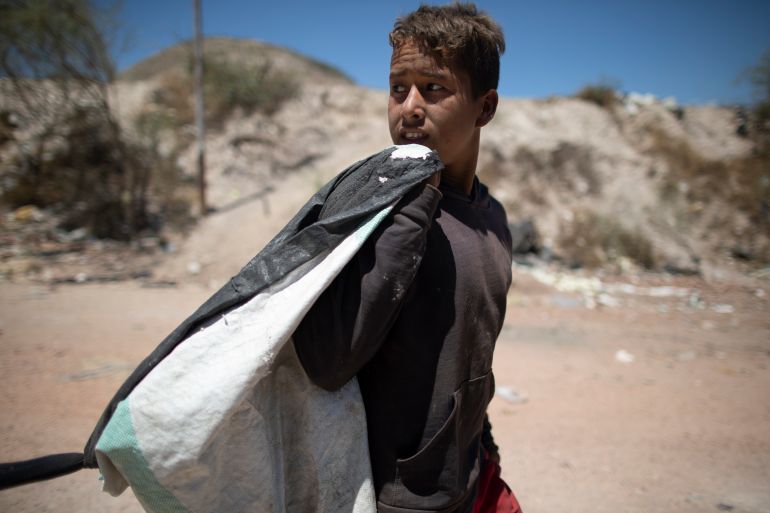
Ronaikel Brito walks home with items collected from the Pavia garbage dump. [Ariana Cubillos/AP]
Published On 11 Mar 202111 Mar 2021

For some children in Venezuela, rubbish is the main source of their livelihood.

This has been the case for several generations of garbage collectors in Venezuela, among them Ronaikel Brito, 16, who, like his mother when she was a child, and before her, her grandmother, looks for something of value every day in a landfill on an arid plain about five hours drive west of the capital, Caracas.

But their work has never been so challenging: The nation’s acute economic crisis coupled with stay-at-home orders prompted by the coronavirus pandemic have reduced rubbish output, making valuable finds rare.

“The reality today is that you don’t get as many things as before,” Ronaikel told The Associated Press at the landfill in Pavia, outside the city of Barquisimeto.

“I go searching to see what I get, but I get almost nothing,” he added, noting that in recent months the children and adults who sift through garbage are spending more time trying to find objects they can sell or food in good enough condition to eat or feed horses, goats or pigs.

Waste has been drastically reduced during the pandemic, particularly food from homes, restaurants and wholesale markets. That rubbish was coveted by garbage pickers in Barquisimeto, once a thriving agro-industrial city where food waste was notable.

Annually, about 14 percent of the world’s food ends up in the garbage, even before it reaches the market, according to figures from the Food and Agriculture Organization of the United Nations.

In Venezuela, in addition to the large amounts of food, tonnes of aluminium containers and clothing were thrown away. Furniture, stoves and refrigerators ended up in the rubbish, too, because it was cheaper to buy new things than to repair them.

Advertisement

Now, extremely high costs push people to reconsider what they throw away.

Venezuela is mired in a deep political, social and economic crisis that has left the once-rich oil country bankrupt. The country is also in its sixth year of recession, and its residents are dealing with soaring food prices set in dollars, low wages and four-digit inflation, condemning millions to live in poverty.

The crisis has forced almost five million people to leave Venezuela in recent years in search of better living conditions. But for many who stayed – adults and children alike – rummaging through garbage in search of food scraps or valuable items has become an increasingly common activity.

Due to the pandemic and “the situation in the country, people are not throwing away almost anything right now because they don’t get to throw away as before,” said Marbelis Brito, the mother of Ronaikel and seven other children who have lived almost all their lives near the Pavia landfill. Ronaikel began to help his mother sift through garbage when he was five years old.

In Pavia, few follow pandemic-related guidelines. People rarely wear masks and virtually no one is aware of maintaining a physical distance.

The government has reported fewer than 150,000 cases and almost 1,400 deaths fom COVID-19.

Brito would like her children to participate in other activities.

“I did not want the same as me to happen,” she said. But “the work as garbage collectors falls on them as a natural activity in order to help support the family”.

Marbelis Brito holds her seven-month-old daughter Antonela at the Pavia garbage dump. The 35-year-old mother of eight grew up here with her mother, who also survived by reselling items found in the dump. [Ariana Cubillos/AP]
Advertisement
Garbage trucks drive through the Pavia dump. The garbage dump serves as a source of income for poor people. [Ariana Cubillos/AP]
Children jump a rope as they play at a court close to the garbage dump. [Ariana Cubillos/AP]
Ronaikel Brito sharpens the tip of a spike he uses to pick through the garbage. Brito said that three weeks ago he found gold in the trash and made $20 selling it. [Ariana Cubillos/AP Photo]
Waste, particularly food from homes, restaurants and wholesale markets, has been drastically reduced during the pandemic. [Ariana Cubillos/AP]
Marbelis Brito sits with her daughters while her teenage son Ronaikel searches for valuable items they can sell. [Ariana Cubillos/AP]
Advertisement
Ronaikel walks behind his sister Brismar, 17, on their way home from the Pavia garbage dump. Despite the hardships, their mother Marbelis considers the Pavia landfill 'a blessing,' saying that compared to other places, one can find anything. [Ariana Cubillos/AP]
Annually, about 14 percent of the world’s food ends up in the garbage, according to UN figures. But now in Venezuela, extremely high costs push people to reconsider what they throw away. [Ariana Cubillos/AP Photo]
The Brito family dog looks out of the entrance of their home near the Pavia garbage dump. Three generations of the Brito family have survived by selling items they collected at the dump. [Ariana Cubillos/AP]
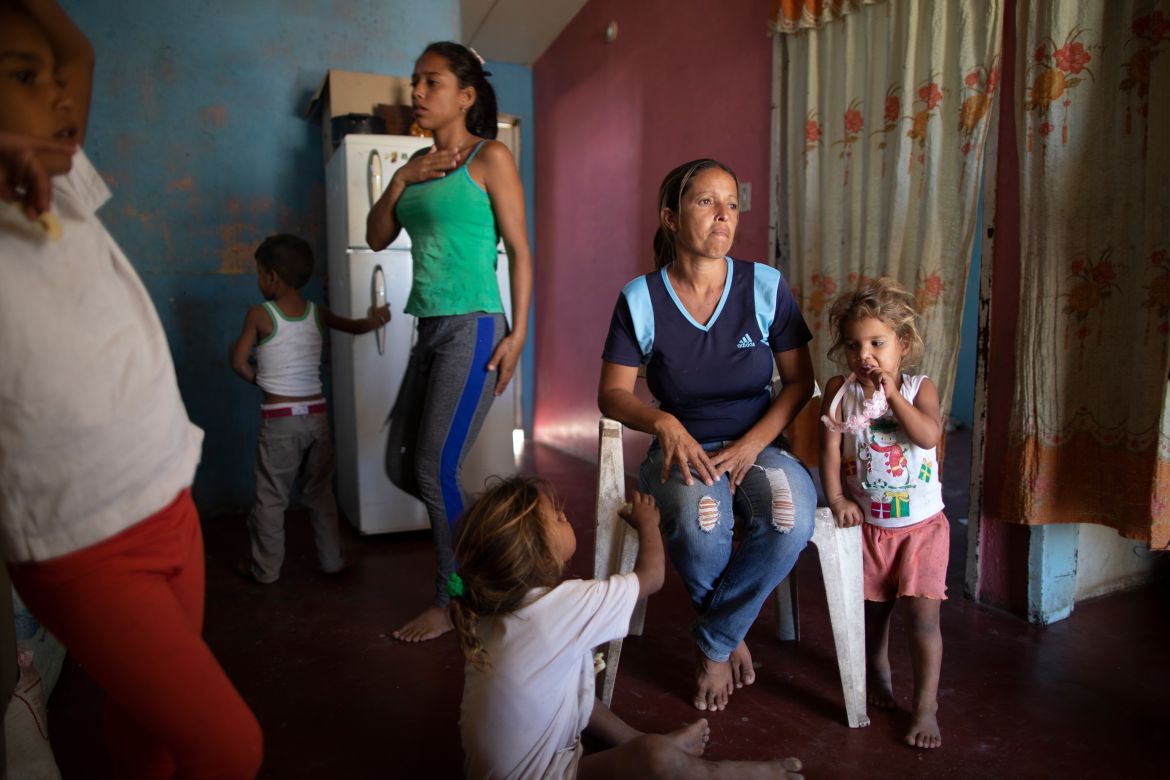
Marbelis Brito is surrounded by some of her eight children at her home near the garbage dump. Venezuela is in its sixth year in recession, and its residents are dealing with soaring food prices set in dollars, low wages, and four-digit inflation, condemning millions to live in poverty. [Ariana Cubillos/AP]
A boy pulls the remains of a toy car through the Pavia garbage dump. Venezuela's deep political, social and economic crisis has forced almost five million people to leave, but for many who stayed, rummaging through garbage in search of food scraps or valuable items has become an increasingly common activity. [Ariana Cubillos/AP]

Related

  • US offers temporary protected status to thousands of Venezuelans

    Biden administration move would shield Venezuelans already in the US from deportation and allow them to work legally.

    Published On 9 Mar 20219 Mar 2021
    A Venezuelan exile loads boxes into a container, next to a poster of opposition leader Juan Guaido, during a collection drive of humanitarian aid in Miami, Florida, in March 2019 [File: Gaston De Cardenas/Reuters]
  • Venezuela sent gold to Mali, UAE for cash, opposition claims

    Maduro’s government got about $1.21bn from the trade despite crippling US sanctions, an opposition figure alleges.

    Published On 3 Mar 20213 Mar 2021
    Venezuelan gold was refined in Mali and then resold primarily in the United Arab Emirates, Julio Borges, the opposition leader's chief overseas envoy, told reporters on Wednesday [File: Reuters]
  • Colombia’s response to Venezuela’s humanitarian crisis

    Nearly two million Venezuelan refugees are living in the neighbouring country without stability or visas.

    Published On 24 Feb 202124 Feb 2021
    Venezuelan migrants rest as they walk towards Bogota, passing through Tunja, Colombia, on Tuesday, October 6, 2020 [Ivan Valencia / AP Photo]
  • Colombia to grant temporary protection to nearly 1m Venezuelans

    Move means Venezuelan migrants and asylum seekers will have greater access to formal jobs and social services.

    Published On 8 Feb 20218 Feb 2021
    Venezuelan migrants walk towards the border between Venezuela and Colombia, in San Cristobal, Venezuela on October 12, 2020 [Carlos Eduardo Ramirez/Reuters]

More from Gallery

  • Photos: Manila’s streets empty as fuel prices surge amid Hormuz crisis

    A sharp increase in prices of basic commodities and the possible loss of employment for thousands of people due to the fuel price hike have raised the spectre of stagflation in the Philippines.
    This gallery article has 10 imagescamera10
  • Photos: More than one million displaced by Israel’s evacuations in Lebanon

    Over one million displaced by Israel’s evacuations in Lebanon
    This gallery article has 10 imagescamera10
  • Migrants march in southern Mexico to denounce immigration restrictions

    Migrants, some carrying children, walk on the highway through the municipality of Huehuetan, Chiapas state, Mexico, Wednesday, March 25, 2026, after leaving Tapachula the previous night. (AP Photo/Edgar H. Clemente)
    This gallery article has 9 imagescamera9
  • Photos: Iran fires new waves of missiles at Israel

    This picture shows damaged buildings at the site of an Iranian missile strike in Tel Aviv
    This gallery article has 8 imagescamera8

Most popular

  • ‘Playing with fire’: Iran vows response after civilian nuclear sites struck

    epaselect epa12854185 Rescuers work at a site following an Israeli airstrike that targeted a building in the village of Al Saksakiyah, southern Lebanon, 27 March 2026. According to the Lebanese Ministry of Public Health, at least 1,116 people have been killed and over 3,229 others injured in airstrikes across Beirut's southern suburbs and villages in southern Lebanon since the start of renewed hostilities. EPA/STRINGER
  • Iran war updates: Tehran vows retaliation for Israeli hits on nuclear sites

    TOPSHOT - This video grab taken from images released by the Iranian state broadcaster (IRIB) on March 26, 2026, shows what it says is the second phase of the 82nd wave of missiles launched against Israel and US bases in the United Arab Emirates and Kuwait.
  • US diplomat Marco Rubio denounces settler violence, tolls in Hormuz strait

    US Secretary of State Marco Rubio looks on as he speaks to the press before his departure following a G7 Foreign Ministers' meeting with Partner Countries before his departure at the Bourget airport in Le Bourget, outside Paris, France, March 27, 2026. Brendan Smialowski/Pool via REUTERS
  • Guns in the streets as US, Israel intensify month-long attacks across Iran

    TEHRAN, IRAN - MARCH 27: A resident cleans up debris in a damaged apartment across from another residential building following an airstrike in the early hours of March 27, 2026 in Tehran, Iran. The Israeli military said that it had carried out strikes on targets across Tehran and other Iranian cities overnight. The United States and Israel have continued their joint attack on Iran that began on February 28. Iran retaliated by firing waves of missiles and drones at Israel and U.S. allies in the region, while also effectively blockading the Strait of Hormuz, a critical shipping route. (Photo by Majid Saeedi/Getty Images)

  • About

    • About Us
    • Code of Ethics
    • Terms and Conditions
    • EU/EEA Regulatory Notice
    • Privacy Policy
    • Cookie Policy
    • Cookie Preferences
    • Accessibility Statement
    • Sitemap
    • Work for us
  • Connect

    • Contact Us
    • User Accounts Help
    • Advertise with us
    • Stay Connected
    • Newsletters
    • Channel Finder
    • TV Schedule
    • Podcasts
    • Submit a Tip
    • Paid Partner Content
  • Our Channels

    • Al Jazeera Arabic
    • Al Jazeera English
    • Al Jazeera Investigative Unit
    • Al Jazeera Mubasher
    • Al Jazeera Documentary
    • Al Jazeera Balkans
    • AJ+
  • Our Network

    • Al Jazeera Centre for Studies
    • Al Jazeera Media Institute
    • Learn Arabic
    • Al Jazeera Centre for Public Liberties & Human Rights
    • Al Jazeera Forum
    • Al Jazeera Hotel Partners

Follow Al Jazeera English:

  • facebook
  • twitter
  • youtube
  • instagram-colored-outline
  • rss
Al Jazeera Media Network logo
© 2026 Al Jazeera Media Network