Skip linksSkip to Content
play
Live
Navigation menu
  • News
    • Africa
    • Asia
    • US & Canada
    • Latin America
    • Europe
    • Asia Pacific
  • Middle East
  • Explained
  • Opinion
  • Sport
  • Video
    • Features
    • Economy
    • Human Rights
    • Climate Crisis
    • Investigations
    • Interactives
    • In Pictures
    • Science & Technology
    • Podcasts
    • Travel
play
Live

In Pictures

Gallery|Arts and Culture

Taliban paints over Kabul’s colourful blast walls

Blast walls adorned with various murals in tribute to individuals and pop art are being painted over by the Taliban.
Save

Share

facebooktwitterwhatsappcopylink
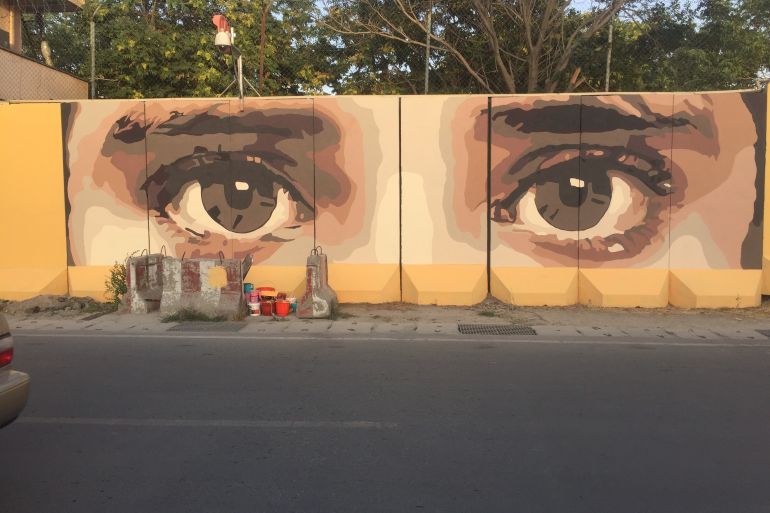
The most common criticism of blast walls was that they were built to protect the rich and powerful, and created new traffic bottlenecks in already overcrowded cities across Afghanistan. [Ali M Latifi/Al Jazeera]
By Ali M Latifi
Published On 5 Sep 20215 Sep 2021

Kabul – For years, Kabul’s forboding concrete blast walls were adorned with images decrying corruption, dedications to fallen journalists, portraits of iconic musicians and pop art depictions of children transporting hearts in place of buckets of water.

Over the last four days though, those images have been whitewashed as the Taliban slowly paints over each one with textual messages of national unity, praise for the mujahideen, as they refer to their forces, and declarations of triumph against the 20-year US occupation of Afghanistan.

Bright, colourful images have been replaced with austere black-and-white text, saying the Taliban “are your brothers and sons, they are the protectors of this land and people”.

To Afghans who lived through it, this phenomenon harkens back to the Taliban’s original rule from 1996 to 2001 when the group banned images of people and animals.

Jawed, who would only give his first name for security reasons, is one of the artists who have been commissioned by the Taliban to paint over the portraits of a member of the nation’s Sikh community who was killed in a 2018 bombing and Tetsu Nakamura, the Japanese doctor who had worked for decades in the eastern province of Nangarhar and was killed in 2019.

“These people don’t know anything, not even art. They tell us things like, ‘The letters should be as big as me,'” the 20-something says while constantly looking behind him to make sure no Taliban are lurking in the background. “Who does that?” he added.

The international relations student says painting over the images goes against everything he believes in. However, Jawed says the current state of the nation’s economy is forcing him to take part in what he says amounts to a literal cover-up of progress and advancement.

Advertisement

“They want us to go back to 20 years ago, when they kept us under a cage,” he said.

Since the Taliban seized power on August 15 and former President Ashraf Ghani fled the country, Afghanistan’s economy has been dealt several blows. Initially, banks were shut for more than a week. When they reopened, hundreds of people lined up outside the financial institutions desperate to regain access to cash. Many government and private offices also remain closed, leaving millions without an income.

“Can you believe we do all this for 600 Afghanis ($6.95 USD) a day?” Jawed said.

Prior to the Taliban’s arrival, he said he could earn 10 times as much each day through painting and other work. But now those income sources have dried up as business all over the city has suffered from people’s inability to obtain physical money and due to the number of offices and businesses that have yet to resume operations.

The most common criticism of those structures was that they were built to protect the rich and powerful – government buildings, wealthy businessmen, warlords, MPs, former government officials – and created new traffic bottlenecks in already overcrowded capitals across Afghanistan.

Regardless of what is on them, blast walls have long been a point of disdain in Afghanistan. In 2017, the government of former President Ashraf Ghani started to remove some blast walls, however many of them went back up soon afterwards. In late August, a week after taking power, the Taliban joined with then Mayor of Kabul, Daoud Sultanzoy, to begin removing blast walls and concrete barriers.

“These walls had created a choking environment for the people of Kabul because they blocked streets,” Sultanzoy said of the thousands of 3.7-metre (12-foot) high, steel-reinforced behemoths that have taken over much of the streets of Kabul, Herat, Jalalabad and Kandahar at the time.

Over the years, as the murals became more popular, the government began to commission their own, including for the 100th anniversary of independence in 2019. [Ali M Latifi/Al Jazeera]
Advertisement
After the 2020 murders of George Floyd by police in the US and of Afghan refugees by Iranian police, a mural was painted as commentary on police brutality in both nations. [Ali M Latifi/Al Jazeera]
After the December 2019 murder of Tetsu Nakamura, a Japanese doctor who had worked for decades in the Eastern province of Nangarhar, a mural was painted in honour of the slain doctor. It, too, was painted over by the Taliban. [Mohammad Aref Karimi/Al Jazeera]
The Taliban has covered the colourful, elaborate murals with austere black on white text, with statements like, 'Dear countryman, congratulations on your independence,' in reference to the August 31 end of the US occupation. [Mohammad Aref Karimi/Al Jazeera]
Painters said they were paid less than $7 a day to paint over the murals. [Mohammad Aref Karimi/Al Jazeera]
The first mural was painted on a wall outside an office of the Afghan intelligence agency. It was a statement against government corruption, reading 'I see you'. [Ali M Latifi/Al Jazeera]
Advertisement

Related

  • War-weary Afghans divided on Taliban rule as US forces depart

    Many Afghans fear a potential economic collapse as the Taliban celebrates the withdrawal of the last US troops.

    Published On 31 Aug 202131 Aug 2021
    Taliban forces took of Hamid Karzai International Airport in Kabul after the US withdrew in the early hours of August 31 [EPA]
  • ‘Channels of communication’ open with Taliban: Blinken

    Top US diplomat to visit Qatar and Germany, says Washington in constant contact with Americans remaining in Afghanistan.

    Published On 3 Sep 20213 Sep 2021
    A view of Kabul Bazaar in Kabul, Afghanistan September 1, 2021 [West Asia News Agency via Reuters]
  • Putin hopes the Taliban will be ‘civilised’, open to dialogue

    The Russian president is treading carefully with the hardline group, which Moscow still considers a ‘terrorist’ group.

    Published On 3 Sep 20213 Sep 2021
    Russian President Vladimir Putin speaks during a plenary session at the Eastern Economic Forum in Vladivostok, Russia on September 3, 2021 [Alexander Zemlianichenko/Pool via Reuters]

More from Gallery

  • Photos: Manila’s streets empty as fuel prices surge amid Hormuz crisis

    A sharp increase in prices of basic commodities and the possible loss of employment for thousands of people due to the fuel price hike have raised the spectre of stagflation in the Philippines.
    This gallery article has 10 imagescamera10
  • Photos: More than one million displaced by Israel’s evacuations in Lebanon

    Over one million displaced by Israel’s evacuations in Lebanon
    This gallery article has 10 imagescamera10
  • Migrants march in southern Mexico to denounce immigration restrictions

    Migrants, some carrying children, walk on the highway through the municipality of Huehuetan, Chiapas state, Mexico, Wednesday, March 25, 2026, after leaving Tapachula the previous night. (AP Photo/Edgar H. Clemente)
    This gallery article has 9 imagescamera9
  • Photos: Iran fires new waves of missiles at Israel

    This picture shows damaged buildings at the site of an Iranian missile strike in Tel Aviv
    This gallery article has 8 imagescamera8

Most popular

  • ‘Playing with fire’: Iran vows response after civilian nuclear sites struck

    epaselect epa12854185 Rescuers work at a site following an Israeli airstrike that targeted a building in the village of Al Saksakiyah, southern Lebanon, 27 March 2026. According to the Lebanese Ministry of Public Health, at least 1,116 people have been killed and over 3,229 others injured in airstrikes across Beirut's southern suburbs and villages in southern Lebanon since the start of renewed hostilities. EPA/STRINGER
  • Iran war updates: Tehran vows retaliation for Israeli hits on nuclear sites

    TOPSHOT - This video grab taken from images released by the Iranian state broadcaster (IRIB) on March 26, 2026, shows what it says is the second phase of the 82nd wave of missiles launched against Israel and US bases in the United Arab Emirates and Kuwait.
  • US diplomat Marco Rubio denounces settler violence, tolls in Hormuz strait

    US Secretary of State Marco Rubio looks on as he speaks to the press before his departure following a G7 Foreign Ministers' meeting with Partner Countries before his departure at the Bourget airport in Le Bourget, outside Paris, France, March 27, 2026. Brendan Smialowski/Pool via REUTERS
  • Guns in the streets as US, Israel intensify month-long attacks across Iran

    TEHRAN, IRAN - MARCH 27: A resident cleans up debris in a damaged apartment across from another residential building following an airstrike in the early hours of March 27, 2026 in Tehran, Iran. The Israeli military said that it had carried out strikes on targets across Tehran and other Iranian cities overnight. The United States and Israel have continued their joint attack on Iran that began on February 28. Iran retaliated by firing waves of missiles and drones at Israel and U.S. allies in the region, while also effectively blockading the Strait of Hormuz, a critical shipping route. (Photo by Majid Saeedi/Getty Images)

  • About

    • About Us
    • Code of Ethics
    • Terms and Conditions
    • EU/EEA Regulatory Notice
    • Privacy Policy
    • Cookie Policy
    • Cookie Preferences
    • Accessibility Statement
    • Sitemap
    • Work for us
  • Connect

    • Contact Us
    • User Accounts Help
    • Advertise with us
    • Stay Connected
    • Newsletters
    • Channel Finder
    • TV Schedule
    • Podcasts
    • Submit a Tip
    • Paid Partner Content
  • Our Channels

    • Al Jazeera Arabic
    • Al Jazeera English
    • Al Jazeera Investigative Unit
    • Al Jazeera Mubasher
    • Al Jazeera Documentary
    • Al Jazeera Balkans
    • AJ+
  • Our Network

    • Al Jazeera Centre for Studies
    • Al Jazeera Media Institute
    • Learn Arabic
    • Al Jazeera Centre for Public Liberties & Human Rights
    • Al Jazeera Forum
    • Al Jazeera Hotel Partners

Follow Al Jazeera English:

  • facebook
  • twitter
  • youtube
  • instagram-colored-outline
  • rss
Al Jazeera Media Network logo
© 2026 Al Jazeera Media Network