Skip linksSkip to Content
play
Live
Navigation menu
  • News
    • Africa
    • Asia
    • US & Canada
    • Latin America
    • Europe
    • Asia Pacific
  • Middle East
  • Explained
  • Opinion
  • Sport
  • Video
    • Features
    • Economy
    • Human Rights
    • Climate Crisis
    • Investigations
    • Interactives
    • In Pictures
    • Science & Technology
    • Podcasts
    • Travel
play
Live

In Pictures

Gallery|Coronavirus pandemic

Photos: COVID surge batters Afghanistan’s crumbling healthcare

Between January 30 and February 5, nearly half of the total samples tested in Afghanistan were positive for COVID-19.
Save

Share

facebooktwitterwhatsappcopylink
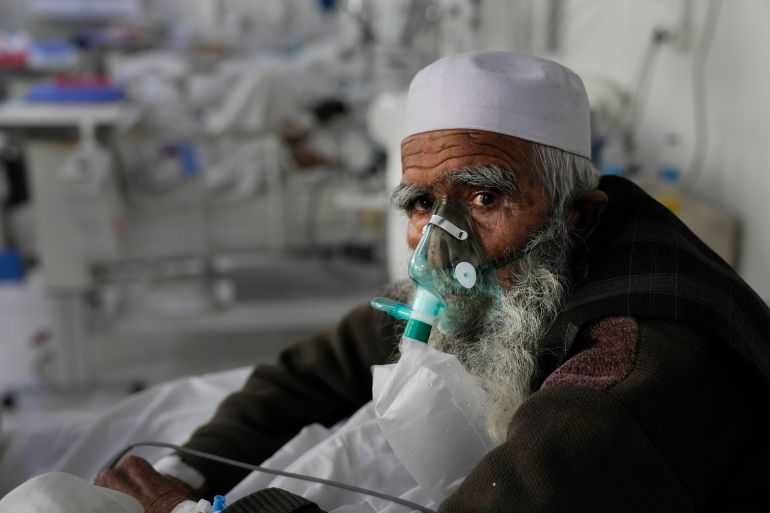
An Afghan patient infected with COVID-19 sits on a bed in the intensive care unit of the Afghan Japan Communicable Disease Hospital
An Afghan patient infected with COVID-19 sits on a bed in the intensive care unit of the Afghan Japan Communicable Disease Hospital in Kabul, Afghanistan. [Hussein Malla/AP Photo]
By AP
Published On 10 Feb 202210 Feb 2022

Only five hospitals in Afghanistan still offer COVID-19 treatment, with 33 others having been forced to close in recent months for lack of doctors, medicines and even heating.

This comes as the economically devastated nation is hit by a steep rise in the number of reported coronavirus cases.

At Kabul’s only hospital offering COVID-19 treatment, staff can heat the building only at night because of lack of fuel, even as winter temperatures drop below freezing point during the day. Patients are bundled under heavy blankets.

Its director, Dr Mohammed Gul Liwal, said they lack everything from oxygen to medicine supplies.

The facility, called the Afghan Japan Communicable Disease Hospital, has 100 beds. The COVID-19 ward is almost always full as the virus rages. Before late January, the hospital was getting one or two new coronavirus patients a day. In the past two weeks, 10 to 12 new patients have been admitted daily, Liwal said.

“The situation is worsening day by day,” said Liwal, speaking inside a chilly conference room.

Since the Taliban takeover of the country six months ago, hospital employees have received only one month’s salary – in December.

The health system’s collapse has only worsened the humanitarian crisis in the country. Roughly 90 percent of the population has fallen below the poverty level, and with families barely able to afford food, at least a million children are threatened with starvation.

The Omicron coronavirus variant is likely hitting Afghanistan hard, Liwal said, but he admits it is just a guess because the country is still waiting for kits that test specifically for the variant.

Advertisement

They were supposed to arrive before the end of last month, said Public Health Ministry spokesman Javid Hazhir. The World Health Organization (WHO) now says Afghanistan will get the kits by the end of February.

WHO says that between January 30 and February 5, public laboratories in Afghanistan tested 8,496 samples, of which nearly half were positive for COVID-19. Those numbers translate into a 47.4 percent positivity rate, the world health body said.

WHO recorded more than 7,400 deaths and close to 167,000 infections since the start of the pandemic almost two years ago. In the absence of large-scale testing, these relatively low figures are believed to be a result of extreme under-reporting.

With 3.2 million vaccine doses in stock, Hazhir said the administration has launched a campaign through mosques, spiritual leaders and mobile vaccine clinics to get more people vaccinated. Currently, barely 27 percent of Afghanistan’s 38 million people have been vaccinated, most of them with the single-dose Johnson and Johnson vaccine.

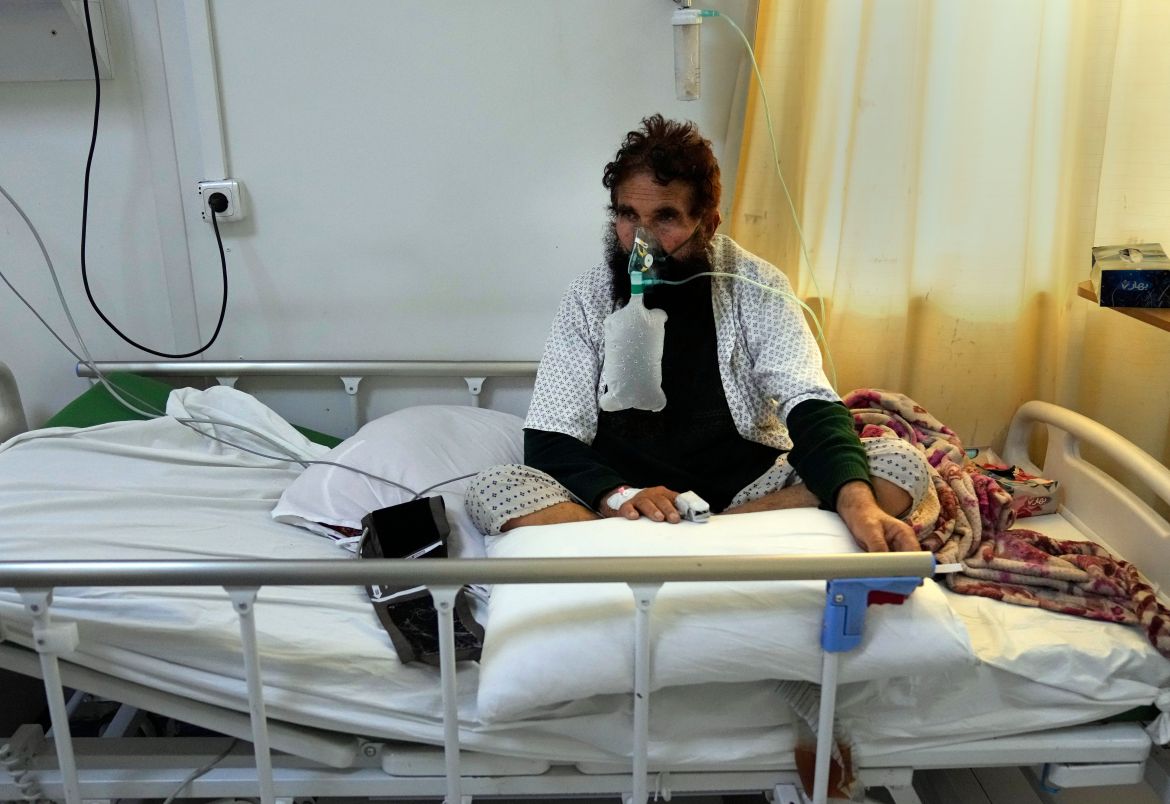
An Afghan patient infected with COVID-19 lies on a bed in the intensive care unit of the Afghan Japan Communicable Disease Hospital
An Afghan patient infected with COVID-19 lies on a bed in the intensive care unit of the Afghan Japan Communicable Disease Hospital. [Hussein Malla/AP Photo]
Advertisement
An Afghan patient who infected with COVID-19 sits on a bed in the intensive care unit
All but five of 38 COVID treatment hospitals that once operated in Afghanistan have been forced to close for lack of doctors, medicines and even heat. [Hussein Malla/AP Photo]
A nurse exits the COVID-19 intensive care unit of the Afghan Japan Communicable Disease Hospital
Afghanistan last week experienced a 67 percent increase in the numbers of reported COVID cases, according to the World Health Organization. [Hussein Malla/AP Photo]
A sticker displays COVID-19, guidelines in a corridor of the COVID-19 intensive care unit
A sticker displays COVID-19 guidelines in a corridor of the intensive care unit at the Afghan Japan Communicable Disease Hospital. [Hussein Malla/AP Photo]
Masks to help prevent the spread of the coronavirus are on sale sale at a market, in Kabul
Masks to help prevent the spread of the coronavirus are on sale at a market in Kabul. [Hussein Malla/AP Photo]
Dr. Mohammad Gul Liwal, the head of the Afghan Japan Communicable Disease Hospital
The Omicron variant is likely hitting Afghanistan hard, Dr Mohammed Gul Liwal said, but he admits it is just a guess because the country is still waiting for kits that test specifically for the variant. [Hussein Malla/AP Photo]
Advertisement
An Afghan patient infected with COVID-19 lies on a bed in the intensive care unit
The head of the intensive care unit at the Afghan Japan hospital, Dr Naeemullah, said he needs more ventilators and, even more urgently, he needs doctors trained on using ventilators. [Hussein Malla/AP Photo]
Two doctors talk as an Afghan patient with COVID-19
Most of the hospital's 200 employees come to work regularly despite months without pay. [Hussein Malla/AP Photo]
An Afghan man wears a mask to help curb the spread of COVID-19, as he walks in the snow, in Kabul
Currently, 27 percent of Afghanistan’s 38 million people have been vaccinated, most of them with the single-dose Johnson and Johnson vaccine. [Hussein Malla/AP Photo]

Related

  • OPINIONOPINION,

    Afghanistan’s economy is collapsing, the US can help stop it

    Giving the Afghan Central Bank limited, monitored access to its national reserves can save Afghan lives.

    Opinion by Shah MehrabiShah Mehrabi
    Published On 29 Jan 202229 Jan 2022
    A person holds a bundle of Afghan afghani banknotes at a money exchange market, following banks and markets reopening after the Taliban took over in Kabul, Afghanistan
    quotes
  • Can Afghanistan avoid a hunger crisis?

    Millions of families cannot afford to eat as prices rise and an economic crisis deepens.

    Published On 16 Jan 202216 Jan 2022
    Video Duration 25 minutes 00 seconds play-arrow25:00
  • Afghanistan’s last Sikhs in a dilemma: To stay or leave

    Community leaders estimate just 140 Sikhs remain in the Taliban-ruled country, mostly in Jalalabad and capital Kabul.

    Published On 20 Jan 202220 Jan 2022
    Afghan Sikh priest praying at the Karte Parwan Gurdwara temple in Kabul.
  • In Afghanistan, Taliban diktat sparks debate about women’s attire

    Some Afghan women protest burqa diktat while others say the Taliban should focus on more pressing issues.

    Published On 26 Jan 202226 Jan 2022
    Afghan women wearing the blue burqa ride in a vehicle.

More from Gallery

  • Photos: Manila’s streets empty as fuel prices surge amid Hormuz crisis

    A sharp increase in prices of basic commodities and the possible loss of employment for thousands of people due to the fuel price hike have raised the spectre of stagflation in the Philippines.
    This gallery article has 10 imagescamera10
  • Photos: More than one million displaced by Israel’s evacuations in Lebanon

    Over one million displaced by Israel’s evacuations in Lebanon
    This gallery article has 10 imagescamera10
  • Migrants march in southern Mexico to denounce immigration restrictions

    Migrants, some carrying children, walk on the highway through the municipality of Huehuetan, Chiapas state, Mexico, Wednesday, March 25, 2026, after leaving Tapachula the previous night. (AP Photo/Edgar H. Clemente)
    This gallery article has 9 imagescamera9
  • Photos: Iran fires new waves of missiles at Israel

    This picture shows damaged buildings at the site of an Iranian missile strike in Tel Aviv
    This gallery article has 8 imagescamera8

Most popular

  • Trump issues new 10-day deadline for attack on Iran energy infrastructure

    FILE PHOTO: Emergency personnel respond at a site following Iranian missile barrages in central Israel, amid the U.S.-Israel conflict with Iran, in Tel Aviv, Israel, March 24, 2026. REUTERS/Tomer Appelbaum ISRAEL OUT. NO COMMERCIAL OR EDITORIAL SALES IN ISRAEL/File Photo
  • Iran war updates: US, Israel attack ignites worst trade rupture in 80 years

    This handout image taken by the European Space Agency (ESA) captured by the Copernicus Sentinel-2 satellite shows a view of smoke plumes billowing in the vicinity Kuwait International Airport on March 25, 2026.
  • Tehran’s ‘toll booth’: How Iran picks who to let through Strait of Hormuz

    The Callisto tanker sits anchored in Port Sultan Qaboos as the traffic is down in the Strait of Hormuz
  • US-Israel war on Iran: What’s happening on day 28 of attacks?

    Protesters attend a rally.

  • About

    • About Us
    • Code of Ethics
    • Terms and Conditions
    • EU/EEA Regulatory Notice
    • Privacy Policy
    • Cookie Policy
    • Cookie Preferences
    • Accessibility Statement
    • Sitemap
    • Work for us
  • Connect

    • Contact Us
    • User Accounts Help
    • Advertise with us
    • Stay Connected
    • Newsletters
    • Channel Finder
    • TV Schedule
    • Podcasts
    • Submit a Tip
    • Paid Partner Content
  • Our Channels

    • Al Jazeera Arabic
    • Al Jazeera English
    • Al Jazeera Investigative Unit
    • Al Jazeera Mubasher
    • Al Jazeera Documentary
    • Al Jazeera Balkans
    • AJ+
  • Our Network

    • Al Jazeera Centre for Studies
    • Al Jazeera Media Institute
    • Learn Arabic
    • Al Jazeera Centre for Public Liberties & Human Rights
    • Al Jazeera Forum
    • Al Jazeera Hotel Partners

Follow Al Jazeera English:

  • facebook
  • twitter
  • youtube
  • instagram-colored-outline
  • rss
Al Jazeera Media Network logo
© 2026 Al Jazeera Media Network