Skip linksSkip to Content
play
Live
Navigation menu
  • News
    • Africa
    • Asia
    • US & Canada
    • Latin America
    • Europe
    • Asia Pacific
  • Middle East
  • Explained
  • Opinion
  • Sport
  • Video
    • Features
    • Economy
    • Human Rights
    • Climate Crisis
    • Investigations
    • Interactives
    • In Pictures
    • Science & Technology
    • Podcasts
    • Travel
play
Live

In Pictures

Features|Climate

Photos: Scientists fight to protect DR Congo rainforest

Fears grow for future of rainforest, deemed critical for sequestering CO2, as loggers and farmers push deeper inside.
Save

Share

facebooktwitterwhatsappcopylink
DR CONGO
The Congo Basin rainforest covers an immense area and is home to a dizzying array of species threatened by farmers and loggers [Guerchom Ndebo/AFP]
By AFP
Published On 8 Sep 20228 Sep 2022

A tower bristling with sensors juts above the canopy in northern Democratic Republic of the Congo, measuring carbon dioxide (CO2) emitted from the world’s second-largest tropical rainforest.

Spanning several countries in central Africa, the Congo Basin rainforest covers an immense area and is home to a dizzying array of species.

But concerns are growing for the future of the forest, deemed critical for sequestering CO2, as loggers and farmers push ever deeper inside.

Scientists at the Yangambi Biosphere Reserve in the DRC’s Tshopo province are studying the rainforest’s role in climate change – a subject that received scant attention until recently.

Standing 55 metres (180 feet) tall, the CO2-measuring flux tower came online in 2020 in the lush reserve of 250,000 hectares (620,000 acres). Yangambi was renowned for tropical agronomy research during the Belgian colonial era.

This week, it also hosted scientists as part of meetings in the DRC dubbed pre-COP 27, ahead of the COP27 climate summit in Egypt in November.

Thomas Sibret, who runs the CongoFlux CO2 measuring project, said that flux towers are common worldwide.

But until one was set up in Yangambi, there had been none in Congo, which had “limited our understanding of this ecosystem”, he said.

About 30 billion tonnes of carbon are stored across the Congo Basin, researchers estimated in a study in Nature in 2016. The figure is roughly equivalent to three years of global emissions.

Sibret said more time is required to draw definitive conclusions from the data gathered by DRC’s flux tower, but one thing is certain: the rainforest sequesters more greenhouse gases than it emits.

Advertisement

Paolo Cerutti, the head of the Center for International Forestry Research’s operations in the DRC, warned that slash-and-burn agriculture poses a particular threat to the future of the rainforest, pointing out that half a million hectares of forest were lost last year.

Slash-and-burn agriculture sees villagers cultivate lands until they become depleted, then clear forests to create new lands, and repeat the cycle. With the DRC’s population of about 100 million people set to expand, many worry the forest is in dire threat.

There are efforts to help farmers in the remote and impoverished region to make a living while sustaining the environment.

Helene Fatouma, the president of a women’s association, says fish ponds on the edge of the forest now yield 1,450 kilogrammes of fish in six months, as opposed to 30 previously.

Experts also encourage the use of more efficient kilns to produce more charcoal and teach loggers how to select which trees to fell.

DRCONGO-ENVIRONMENT-CLIMATE-FORESTS
Trees in the Yangambi forest with the flux tower, 100km (62 miles) from the city of Kisangani, in the Tshopo province. The 55-metre tower, which measures the carbon absorbed or emitted by the forest, stands in the lush setting of the Yangambi biosphere reserve, which covers some 250,000 hectares along the Congo river, in Tshopo province. [Guerchom Ndebo/AFP]
Advertisement
DRCONGO-ENVIRONMENT-CLIMATE-FORESTS
Thomas Sibret, scientist and student at the University of Ghent, verifies the devices installed in the trees in the Yangambi Biosphere Reserve. [Guerchom Ndebo/AFP]
DRCONGO-ENVIRONMENT-CLIMATE-FORESTS
Tresor Bolaya, 26, a technician at the wood laboratory, looks at a piece of wood under a microscope in Yangambi. [Guerchom Ndebo/AFP]
DRCONGO-ENVIRONMENT-CLIMATE-FORESTS
Elasi Ramazani (L), 69, director of the Yangambi herbarium and a scientist for nearly 25 years, talks with another scientist in the room where they study herbs in Yangambi, Tshopo province. The site, renowned for its research in tropical agronomy during the time of Belgian colonisation, hosts a herbarium that has more than 6000 species. [Guerchom Ndebo/AFP]
DRCONGO-ENVIRONMENT-CLIMATE-FORESTS
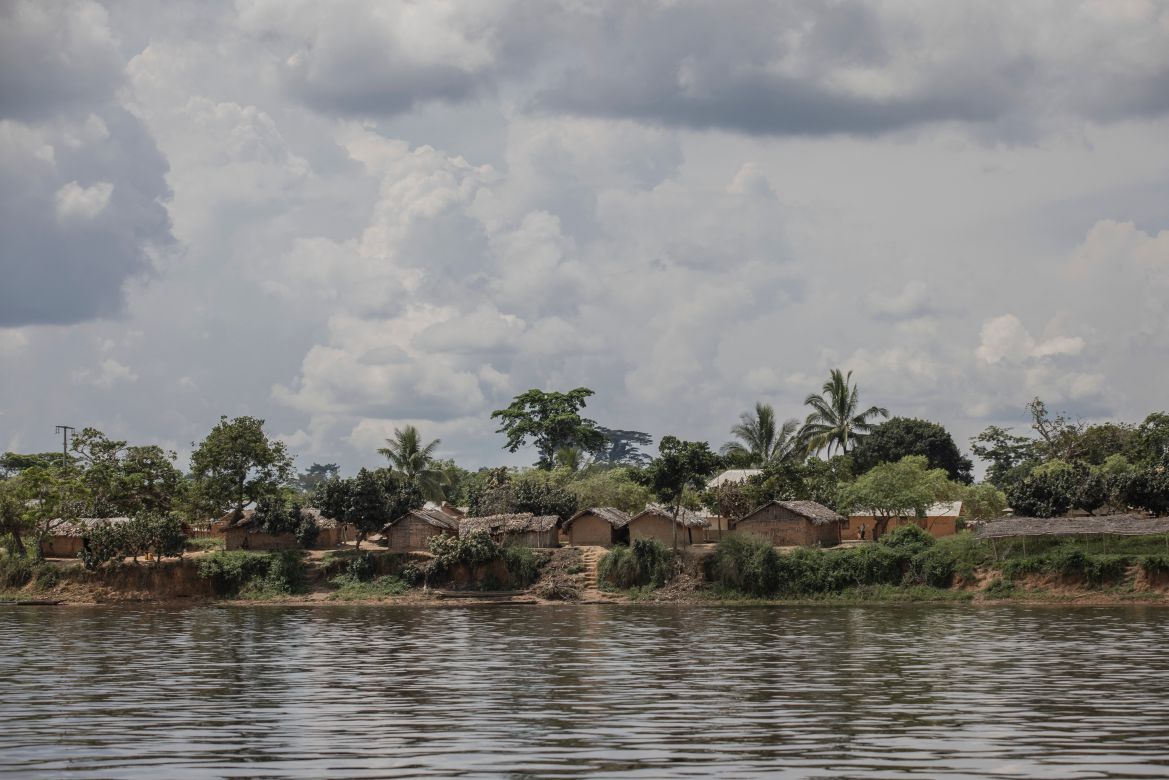
A general view of villages on the bank of the Congo River some kilometres from the city of Kisangani, in the Tshopo province of northeastern Democratic Republic of the Congo. [Guerchom Ndebo/AFP]
DRCONGO-ENVIRONMENT-CLIMATE-FORESTS
A man fells a tree used in a charcoal oven in Yanonge, 60km (37 miles) from the city of Kisangani, in the province of Tshopo. At least six trees are felled for this purpose and will produce between 12-13 bags of charcoal. [Guerchom Ndebo/AFP]
Advertisement
DRCONGO-ENVIRONMENT-CLIMATE-FORESTS
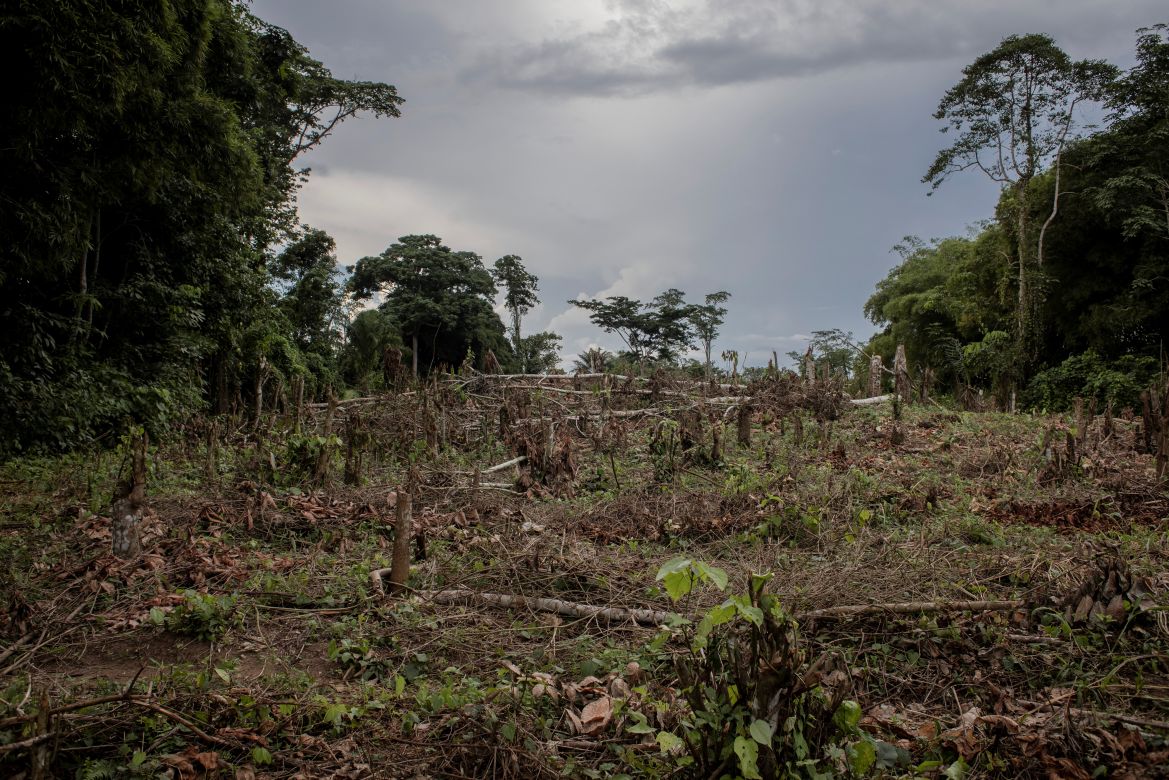
A general view of a deforested farm in Yanonge in Tshopo province, northeastern Democratic Republic of the Congo, on August 31, 2022. [Guerchom Ndebo/AFP]
DRCONGO-ENVIRONMENT-CLIMATE-FORESTS
A group of people work on a charcoal kiln in Yanonge. The charcoal is produced in conditions where the environment is not polluted. The community leaves the wood for 45 days to reduce the rate of humidity and they produce the charcoal within a legal framework from the Center for International Forestry Research (CIFOR) that supports the local community in training as well as in the legal process of obtaining logging documents. [Guerchom Ndebo/AFP]
DRCONGO-ENVIRONMENT-CLIMATE-FORESTS
Boloka Nafisa (L), 18, works with husband Yuma Haishi Jean-Benie, 22, in a charcoal kiln to collect charcoal and bring it to market in the centre of the village as well as other surrounding areas of Yanonge. [Guerchom Ndebo/AFP]
DRCONGO-ENVIRONMENT-CLIMATE-FORESTS
Berta, a housewife, keeps the fire going for cooking food in the courtyard of her plot in Yanonge. [Guerchom Ndebo/AFP]
DRCONGO-ENVIRONMENT-CLIMATE-FORESTS
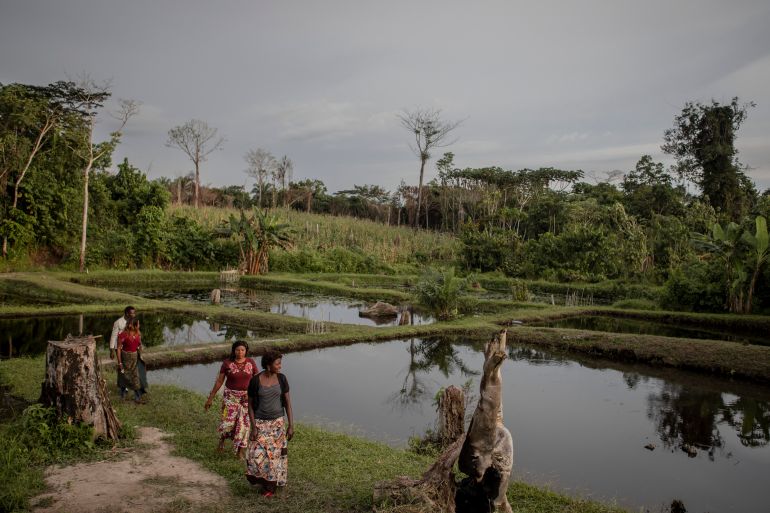
Members of the Akili Ni Mali structure feed fish in Yanonge. Akili Ni Mali is a structure that was created to meet the primary needs of women who were unemployed and had no other option than to make charcoal or practise agriculture in the region of Yanongo. These activities accelerate deforestation but with the technical support of the Center for International Forestry Research (CIFOR), the women have come together to do other activities that help preserve the environment. [Guerchom Ndebo/AFP]
DRCONGO-ENVIRONMENT-CLIMATE-FORESTS
After a day's work, a group of members of the Akili Ni Mali structure return to their homes in the center of the village of Yanonge. [Guerchom Ndebo/AFP]

Related

  • Gabon sets example of how to preserve the Congo Basin rainforest

    As Gabon hosts the Africa Climate Week, its environmental industry is setting the pace for the region and continent.

    Published On 31 Aug 202231 Aug 2022
    Gabon's Pongara National Park forest
  • Africa’s wildlife park managers in Kigali to boost conservation

    Officials are meeting in Kigali in a congress to expand the protection of land and marine wildlife in the region.

    Published On 19 Jul 202219 Jul 2022
    A general view of elephants grazing with a view of the snow-capped Mount Kilimanjaro in the background
  • How Uganda’s endangered mountain gorillas survived the pandemic

    Relationships between forest dwellers and the animals have deteriorated in recent years, especially during the pandemic.

    Published On 5 Apr 20225 Apr 2022
    Gorilla trapped in a snare in Bwindi forest, Uganda.

More from Features

  • Meet the children left without parents under El Salvador’s emergency decree

    Rubidia Hernández and her 6-year-old granddaughter pictured in their home, where her son also used to live, in the outskirts of Nahuizalco, El Salvador. [Euan Wallace/ Al Jazeera]
  • ‘Raising 10 red flags’: Is Israel’s army exhausted?

    Israeli soldiers
  • Yemenis fear economic consequences of being dragged into US-Iran conflict

    Supporters of Yemen's Houthi rebels hold a placard bearing a portrait of Iran’s slain supreme leader Ayatollah Ali Khamenei during the Al-Quds (Jerusalem) Day rally, a commemoration in support of the Palestinian people on the last Friday of the Islamic holy month of Ramadan, in Sanaa on March 13, 2026.
  • How extensive is Russia’s military aid to Iran?

    Iranian missile strikes

Most popular

  • Israel vows no let-up in Iran attacks despite US push to end war

    TOPSHOT - This video grab taken from images released by the Iranian state broadcaster (IRIB) on March 26, 2026, shows what it says is the second phase of the 82nd wave of missiles launched against Israel and US bases in the United Arab Emirates and Kuwait.
  • Saudi, UAE, Iraq: Can three pipelines help oil escape Strait of Hormuz?

    TOPSHOT - Indian vessel 'Nanda Devi' carrying liquefied petroleum gas (LPG) arrives at Vadinar Port in the Jamnagar district of Gujarat state on March 17, 2026 after Iran allowed it to pass through the Strait of Hormuz, a key energy corridor that remains disrupted by the Middle East war.
  • Nixon to Trump: Pakistan’s long record as backchannel between rival powers

    Trump
  • US-Israel war on Iran: What’s happening on day 28 of attacks?

    Protesters attend a rally.

  • About

    • About Us
    • Code of Ethics
    • Terms and Conditions
    • EU/EEA Regulatory Notice
    • Privacy Policy
    • Cookie Policy
    • Cookie Preferences
    • Accessibility Statement
    • Sitemap
    • Work for us
  • Connect

    • Contact Us
    • User Accounts Help
    • Advertise with us
    • Stay Connected
    • Newsletters
    • Channel Finder
    • TV Schedule
    • Podcasts
    • Submit a Tip
    • Paid Partner Content
  • Our Channels

    • Al Jazeera Arabic
    • Al Jazeera English
    • Al Jazeera Investigative Unit
    • Al Jazeera Mubasher
    • Al Jazeera Documentary
    • Al Jazeera Balkans
    • AJ+
  • Our Network

    • Al Jazeera Centre for Studies
    • Al Jazeera Media Institute
    • Learn Arabic
    • Al Jazeera Centre for Public Liberties & Human Rights
    • Al Jazeera Forum
    • Al Jazeera Hotel Partners

Follow Al Jazeera English:

  • facebook
  • twitter
  • youtube
  • instagram-colored-outline
  • rss
Al Jazeera Media Network logo
© 2026 Al Jazeera Media Network