Skip linksSkip to Content
play
Live
Navigation menu
  • News
    • Africa
    • Asia
    • US & Canada
    • Latin America
    • Europe
    • Asia Pacific
  • Middle East
  • Explained
  • Opinion
  • Sport
  • Video
    • Features
    • Economy
    • Human Rights
    • Climate Crisis
    • Investigations
    • Interactives
    • In Pictures
    • Science & Technology
    • Podcasts
    • Travel
play
Live

In Pictures

Gallery|Environment

As Indians try to save a river, officials deny problems

Residents of Eloor town say the Periyar River was teeming with fish. Now, a putrid stench fills the air.
Save

Share

facebooktwitterwhatsappcopylink
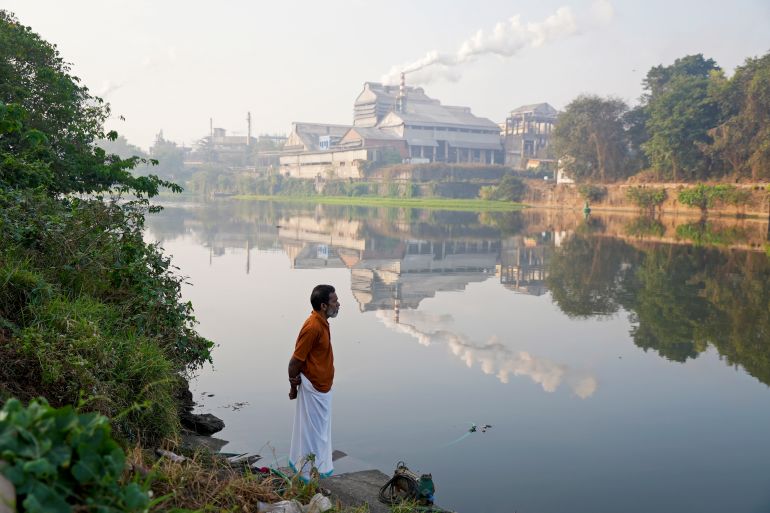
Adam Kutty stands on the bank of the Periyar River
Industrial plants line the Periyar River in Eloor in southern India's Kerala state. The town's residents and scientific studies say they are polluting the area. [AP]
By AP
Published On 11 Apr 202311 Apr 2023

Eloor smells like it is dying.

Once it was an island of rich farmland on the Periyar River, 17km (10.5 miles) from the Arabian Sea and teeming with fish. Now, a putrid stench permeates the air. Most of the fish are gone. Locals say people living near the river are hardly even having children anymore.

Yet here is Shaji, alone in his small fibre boat, fishing with his handmade rod, the southern Indian state of Kerala’s massive industrial smokestacks behind him.

About 300 chemical companies belch out dense fumes, and the river water has turned dark. Shaji, a fisherman in his late 40s who uses only one name, is among the few people who remain.

“Most of the people here are trying to migrate from this place. If we look at the streets, it’s almost empty. There are no jobs, and now we cannot even find work on the river,” said Shaji, displaying the few pearl spot fish he managed to catch during an entire day in March.

Many of the petrochemical plants here are more than five decades old. They produce pesticides, rare earth elements, rubber-processing chemicals, fertilisers, zinc-chrome products and leather treatments.

Some are government owned, including Fertilisers and Chemicals Travancore, Indian Rare Earths Ltd and Hindustan Insecticides Ltd.

Residents say the industries take in large amounts of freshwater from the Periyar and discharge concentrated wastewater with almost no treatment.

Anwar CI, who uses initials for his last name as is the custom in southern India, is a member of a Periyar anti-pollution committee and a private contractor who lives in the area. He said residents have grown accustomed to the reek that hangs over the area like a heavy curtain.

Advertisement

The groundwater is now fully contaminated, and the government’s contention that the businesses benefit people is wrong, he said.

“When they claim to provide employment to many people through industrialisation, the net impact is that the livelihood of thousands is lost,” Anwar said. “People cannot make a living from ruined land and water.”

Residents have periodically protested against the factories. Demonstrations began in 1970 when the village first witnessed thousands of fish dying. Both die-offs and protests happened again many times after that, said Shabeer Mooppan, a longtime resident who has often demonstrated.

Some of the early protest leaders are elderly now and bedridden, Mooppan said, emphasizing just how long people in the community have been trying to get the river cleaned up.

Now Mooppan is trying to improve surveillance, to catch those responsible for fouling the river. It is a method used for rivers and bays in other cities around the world. He is also pursuing legal cases against polluting industries.

The state Pollution Control Board has downplayed the industrial pollution in the Periyar River, blaming it on sewage from homes, commercial institutions and markets upstream.

“We have not found any alarming rate of metals in the river water,” said Baburajan PK, the board’s chief environmental engineer. “All the levels are within the limits.”

Baburajan said only five major companies of the more than 300 industrial plants in the region are allowed to discharge wastewater into the river, and it must be treated. The rest must treat their wastewater, reusing or disposing of it on their own land. He said hefty environmental levies have been imposed on violators.

But research tells a story of a river in distress.

As far back as 1998, scientists at the Kerala University of Fisheries and Ocean Studies found about 25 species of fish had disappeared from the region. Experts have found contamination in vegetables, chicken, eggs, fruit and tuber crops.

Chandramohan Kumar, a professor in chemical oceanography at Cochin University of Science and Technology, has researched Periyar River pollution in several studies.

“We have observed pollution from various organic fertilisers, metallic components,” Kumar said. “Toxic metals like cadmium, copper, zinc and all the heavy metals can be detected there.”

India has an environmental court called the National Green Tribunal. A decade ago, it ordered the government to create an action plan to restore water quality in the river to protect the environment and public health. It also ordered the formation of a monitoring committee.

Advertisement

More recently, the tribunal was worried enough to initiate its own proceedings on the pollution. It cited studies going back to 2005 carried out by the environmental non-profit group Thanal that showed “hundreds of people living near Kuzhikandam Creek at Eloor were afflicted with various diseases, such as cancer, congenital birth defects, bronchitis, asthma, allergic dermatitis, nervous disorders and behavior changes.”

The court cited another survey of 327 families in the region that showed hazardous chemicals – including DDT, hexachlorochyclohexane, cadmium, copper, mercury, lead, toluene, manganese and nickel – had been discharged into Kuzhikandam Creek and harmed the health of people in Eloor.

Kumar said the remedy for this pollution is on-site treatment at each facility, which comes down to money. “If they are ready to invest, the effluent discharge can be resolved,” he said.

The Pollution Control Board said it had recently begun a study that could lead to curbing air pollution and reducing the intolerable stench in the area largely caused, it said, by bone meal fertiliser factories and meat rendering plants. The study is expected to be finished in May.

Omana Manikuttan fills a bucket with drinking water she gets from a pipe at her home's front yard
Omana Manikuttan fills a bucket with water she gets from a pipe in her front yard. She and her neighbours don't use water from the nearby Periyar River, fearing pollution will damage their health. [AP]
Advertisement
Activist Shabeer Mooppan stands next to a pipe discharging liquid directly into the Periyar River
Activist Shabeer Mooppan inspects a pipe discharging liquid from a small manufacturer directly into the Periyar River. He is stepping up surveillance to try to catch polluters. [AP]
An empty drum from Hindustan Organic Chemicals lies next to the factory on the banks of the Periyar River
An empty drum from Hindustan Organic Chemicals lies next to its factory on the Periyar River. Many petrochemical plants on the riverbank are more than five decades old. [AP]
Anwar C. I., an official of the Periyar River anti-pollution committee
The government says factories provide employment, but Anwar CI, an official with the Periyar River anti-pollution committee, argues that the plants there cost more jobs than they create by contaminating land and water and driving away locals. [AP]
Climate India River Pollution
A document shows the samples of Periyar River water collected by Kerala Pollution Control Board trainees. They make daily trips to collect samples from six points along the river. [AP]
Lab workers conduct tests at the Chemical Oceanography lab at Cochin University of Science and Technology in Eloor,
Lab workers conduct tests at the chemical oceanography lab at Cochin University of Science and Technology. [AP]
Advertisement
A polluted creek, a tributary of the Periyar River
This creek, a tributary of the Periyar River, is polluted. People who live nearby have repeatedly protested since 1970 against the contamination. (AP]
Smokestacks spew fumes from chemical industries located along the banks of the Periyar River
Smokestacks spew fumes from chemical plants along the banks of the Periyar River in Eloor. Few people fish from the river anymore. Many locals have left the area. [AP]

Related

  • Pollution curbs lifted in India’s capital despite ‘very poor’ air

    Air quality index in nearly all monitoring stations in New Delhi was between 300 and 400, in the ‘very poor’ category.

    Published On 7 Nov 20227 Nov 2022
    An aerial view of residential buildings shrouded in smog in New Delhi, India, November 7, 2022.
  • How river pollution is killing people in an Indian village

    Villagers say they are suffering after years of unchecked industrial pollution has contaminated their water.

    Published On 21 Oct 202221 Oct 2022
    Vikas in his house in Gangnauli, Uttar Pradesh, India.
  • Scientists discover how air pollution causes lung cancer

    New study illustrates the health risk posed by the tiny particles produced by burning fossil fuels.

    Published On 10 Sep 202210 Sep 2022
    Lahore smog
  • India bans 19 single-use plastic items to combat pollution

    Ban includes plastic straws, disposable cutlery, earbuds, candy and ice cream packaging, and cigarette packets.

    Published On 1 Jul 20221 Jul 2022
    An Indian worker sorts used plastic bottles before sending them to be recycled, at a railway station on World Environment Day in Ahmadabad, India in 2018 [Ajit Solanki/AP]

More from Gallery

  • Photos: Manila’s streets empty as fuel prices surge amid Hormuz crisis

    A sharp increase in prices of basic commodities and the possible loss of employment for thousands of people due to the fuel price hike have raised the spectre of stagflation in the Philippines.
    This gallery article has 10 imagescamera10
  • Photos: More than one million displaced by Israel’s evacuations in Lebanon

    Over one million displaced by Israel’s evacuations in Lebanon
    This gallery article has 10 imagescamera10
  • Migrants march in southern Mexico to denounce immigration restrictions

    Migrants, some carrying children, walk on the highway through the municipality of Huehuetan, Chiapas state, Mexico, Wednesday, March 25, 2026, after leaving Tapachula the previous night. (AP Photo/Edgar H. Clemente)
    This gallery article has 9 imagescamera9
  • Photos: Iran fires new waves of missiles at Israel

    This picture shows damaged buildings at the site of an Iranian missile strike in Tel Aviv
    This gallery article has 8 imagescamera8

Most popular

  • Iran targets Saudi capital, hits Kuwait port as Middle East tensions surge

    TOPSHOT - This video grab taken from images released by the Iranian state broadcaster (IRIB) on March 26, 2026, shows what it says is the second phase of the 82nd wave of missiles launched against Israel and US bases in the United Arab Emirates and Kuwait.
  • How extensive is Russia’s military aid to Iran?

    Iranian missile strikes
  • US-Israel war on Iran: What’s happening on day 28 of attacks?

    Protesters attend a rally.
  • Iran war updates: US, Israel attack ignites worst trade rupture in 80 years

    This handout image taken by the European Space Agency (ESA) captured by the Copernicus Sentinel-2 satellite shows a view of smoke plumes billowing in the vicinity Kuwait International Airport on March 25, 2026.

  • About

    • About Us
    • Code of Ethics
    • Terms and Conditions
    • EU/EEA Regulatory Notice
    • Privacy Policy
    • Cookie Policy
    • Cookie Preferences
    • Accessibility Statement
    • Sitemap
    • Work for us
  • Connect

    • Contact Us
    • User Accounts Help
    • Advertise with us
    • Stay Connected
    • Newsletters
    • Channel Finder
    • TV Schedule
    • Podcasts
    • Submit a Tip
    • Paid Partner Content
  • Our Channels

    • Al Jazeera Arabic
    • Al Jazeera English
    • Al Jazeera Investigative Unit
    • Al Jazeera Mubasher
    • Al Jazeera Documentary
    • Al Jazeera Balkans
    • AJ+
  • Our Network

    • Al Jazeera Centre for Studies
    • Al Jazeera Media Institute
    • Learn Arabic
    • Al Jazeera Centre for Public Liberties & Human Rights
    • Al Jazeera Forum
    • Al Jazeera Hotel Partners

Follow Al Jazeera English:

  • facebook
  • twitter
  • youtube
  • instagram-colored-outline
  • rss
Al Jazeera Media Network logo
© 2026 Al Jazeera Media Network