Skip linksSkip to Content
play
Live
Navigation menu
  • News
    • Africa
    • Asia
    • US & Canada
    • Latin America
    • Europe
    • Asia Pacific
  • Middle East
  • Explained
  • Opinion
  • Sport
  • Video
    • Features
    • Economy
    • Human Rights
    • Climate Crisis
    • Investigations
    • Interactives
    • In Pictures
    • Science & Technology
    • Podcasts
    • Travel
play
Live

In Pictures

Gallery|Conflict

UN peacekeepers begin pullout from DR Congo’s restive east

Kinshasa has long accused the UN force of failing to protect civilians from the armed groups in the east of the country.
Save

Share

facebooktwitterwhatsappcopylink
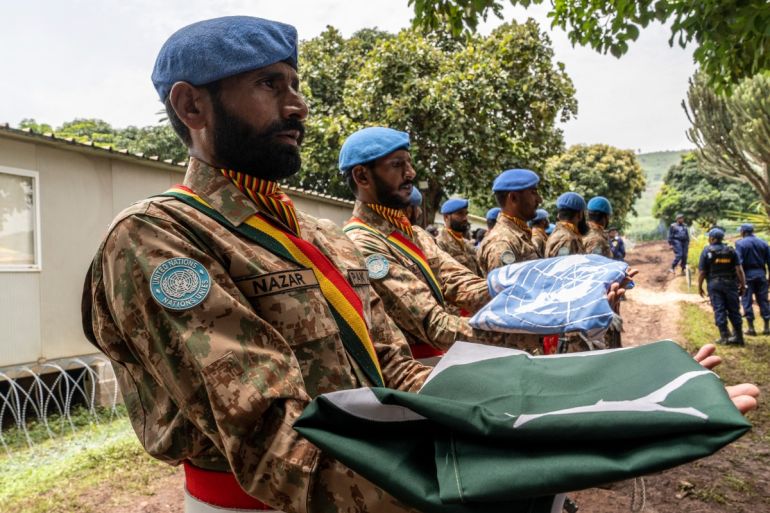
Pakistani peacekeepers hold the Pakistani and UN flags
Pakistani peacekeepers hold the Pakistan and UN flags at the United Nations Organization Stabilization Mission in the Democratic Republic of the Congo (MONUSCO) base during the handover ceremony with the Police Nationale Congolaise in Kamanyola, eastern Democratic Republic of the Congo. [Glody Murhabazi/AFP]
By AFP
Published On 1 Mar 20241 Mar 2024

The United Nations on Wednesday started pulling peacekeepers out of Democratic Republic of the Congo (DRC), moving to end a 25-year presence amid rising violence in the east of the long-troubled African nation.

The withdrawal of the UN forces comes as thousands of civilians have been displaced by heavy fighting between the Congolese armed forces (FARDC) and the M23 rebel group in the country’s troubled North Kivu province in recent weeks. Dozens have been killed and hundreds of thousands displaced since January.

The DRC demanded the withdrawal of the remaining 13,500 troops and 2,000 police in regions bordering Rwanda and Burundi despite international concerns over violence by armed groups.

At an official ceremony at the Kamanyola base in South Kivu province, the first to be handed over, the flags of the United Nations and the Pakistan peacekeepers at the base, were replaced by those of the DRC.

The UN stabilisation mission in the DRC (MONUSCO), was set up in 1999 in a bid to halt the second DRC war which pitted local forces backed by Angola, Namibia and Zimbabwe against armed groups supported by Uganda and Rwanda.

At its peak, there were 20,000 UN troops in the country. More than 270 MONUSCO peacekeepers have been killed, according to UN figures.

Kinshasa has long accused the UN force of failing to protect civilians from the armed groups that have plagued the east of the country for 30 years.

Hundreds of thousands of deaths are blamed on the succession of conflicts since the 1990s.

Advertisement

Foreign Minister Christophe Lutundula has said he wants the withdrawal completed by the end of this year, though the UN Security Council has not fixed a date.

The troops are based in Ituri, South Kivu and North Kivu provinces which have suffered most over the decades. About six million people have been killed and an equal number of people displaced since 1996.

The disengagement is to be carried out in three phases.

Phase one will see the departure of peacekeepers from 14 bases in South Kivu by the end of April. North Kivu and Ituri will follow.

Kinshasa, the United Nations and Western countries have accused Rwanda of supporting the M23, which has been advancing on Goma in recent weeks. Rwanda denies any role.

Local people have also criticised the UN troops for failing to protect civilians in the mineral-rich eastern region, but some have expressed concerns of a possible security vacuum.

The United Nations has insisted DRC security forces must be reinforced and take care of civilians at the same time as MONUSCO pulls out.

This aerial view shows the United Nations Organization Mission for the Stabilization of the Congo (MONUSCO) base in Kamanyola, eastern Democratic Republic of Congo
The United Nations Organization Stabilization Mission for the Democratic Republic of the Congo (MONUSCO) base in Kamanyola. [Glody Murhabazi/AFP]
Advertisement
UN peacekeepers begin pullout from war-torn DR Congo
Pakistani peacekeepers dismantle their infrastructure at the MONUSCO base in Kamanyola. [Glody Murhabazi/AFP]
UN peacekeepers begin pullout from war-torn DR Congo
The United Nations on Wednesday started pulling peacekeepers out of Democratic Republic of the Congo, moving to end a 25-year presence as conflict surges in the east of the long-troubled African state. [Glody Murhabazi/AFP]
UN peacekeepers begin pullout from war-torn DR Congo
The DRC demanded the withdrawal of the remaining 13,500 troops and 2,000 police in regions bordering Rwanda and Burundi despite international concerns over rampant violence. [Glody Murhabazi/AFP]
UN peacekeepers begin pullout from war-torn DR Congo
Kinshasa has long accused the UN force of failing to protect civilians from the armed groups that have plagued the east of the country for 30 years. [Glody Murhabazi/AFP]
UN peacekeepers begin pullout from war-torn DR Congo
At an official ceremony at the Kamanyola base in South Kivu province, the first to be handed over, the flags of the United Nations and the Pakistan peacekeepers at the base were replaced by those of the DRC. [Glody Murhabazi/AFP]
Advertisement
UN peacekeepers begin pullout from war-torn DR Congo
Congolese police officers deploy at the United Nations Organization Stabilization Mission in the Democratic Republic of the Congo (MONUSCO) base in Kamanyola. [Glody Murhabazi/AFP]
UN peacekeepers begin pullout from war-torn DR Congo
Congolese soldiers sit in their military vehicle at the MONUSCO base in Kamanyola. [Glody Murhabazi/AFP]
UN peacekeepers begin pullout from war-torn DR Congo
The United Nations has insisted DRC security forces must be reinforced and take care of civilians at the same time as MONUSCO pulls out. [Glody Murhabazi/AFP]

Related

  • A guide to the decades-long conflict in DR Congo

    The resource-rich country, now facing a major rebel attack, has been racked by conflict for more than 30 years.

    Published On 21 Feb 202421 Feb 2024
    M23 rebels' patrol Gisenyi border point
  • Crisis in eastern DR Congo

    Heavy fighting between Congolese armed forces and the M23 rebel group have forced thousands of civilians to flee.

    Published On 23 Feb 202423 Feb 2024
    Congolese people carry their belongings as they flee from their villages around Sake in Masisi territory, following clashes between M23 rebels and the Armed Forces of the Democratic Republic of the Congo (FARDC); towards Goma, North Kivu province of the Democratic Republic of Congo February 7, 2024. REUTERS/Arlette Bashizi
    Video Duration 01 minutes 53 seconds play-arrow01:53
  • Democratic Republic of Congo is facing a humanitarian crisis

    Heavy fighting between the Congolese army and M23 rebels is fuelling displacement and regional tensions.

    Published On 26 Feb 202426 Feb 2024
    Video Duration 28 minutes 15 seconds play-arrow28:15
  • The Take: What’s behind the armed conflict in eastern DR Congo?

    Thousands of Congolese civilians flee their homes as fighting escalates between government forces and M23 rebel group.

    Published On 27 Feb 202427 Feb 2024
    Congolese traders off load goods from pirogues carrying food from Minova village, after the roads were blocked due to the ongoing war between the M23 rebels and the Congolese army, at the Kituku market in Goma, North Kivu province of the Democratic Republic of Congo February 15, 2024.

More from Gallery

  • Photos: Manila’s streets empty as fuel prices surge amid Hormuz crisis

    A sharp increase in prices of basic commodities and the possible loss of employment for thousands of people due to the fuel price hike have raised the spectre of stagflation in the Philippines.
    This gallery article has 10 imagescamera10
  • Photos: More than one million displaced by Israel’s evacuations in Lebanon

    Over one million displaced by Israel’s evacuations in Lebanon
    This gallery article has 10 imagescamera10
  • Migrants march in southern Mexico to denounce immigration restrictions

    Migrants, some carrying children, walk on the highway through the municipality of Huehuetan, Chiapas state, Mexico, Wednesday, March 25, 2026, after leaving Tapachula the previous night. (AP Photo/Edgar H. Clemente)
    This gallery article has 9 imagescamera9
  • Photos: Iran fires new waves of missiles at Israel

    This picture shows damaged buildings at the site of an Iranian missile strike in Tel Aviv
    This gallery article has 8 imagescamera8

Most popular

  • ‘Playing with fire’: Iran vows response after civilian nuclear sites struck

    epaselect epa12854185 Rescuers work at a site following an Israeli airstrike that targeted a building in the village of Al Saksakiyah, southern Lebanon, 27 March 2026. According to the Lebanese Ministry of Public Health, at least 1,116 people have been killed and over 3,229 others injured in airstrikes across Beirut's southern suburbs and villages in southern Lebanon since the start of renewed hostilities. EPA/STRINGER
  • Iran war updates: Tehran vows retaliation for Israeli hits on nuclear sites

    TOPSHOT - This video grab taken from images released by the Iranian state broadcaster (IRIB) on March 26, 2026, shows what it says is the second phase of the 82nd wave of missiles launched against Israel and US bases in the United Arab Emirates and Kuwait.
  • US diplomat Marco Rubio denounces settler violence, tolls in Hormuz strait

    US Secretary of State Marco Rubio looks on as he speaks to the press before his departure following a G7 Foreign Ministers' meeting with Partner Countries before his departure at the Bourget airport in Le Bourget, outside Paris, France, March 27, 2026. Brendan Smialowski/Pool via REUTERS
  • Guns in the streets as US, Israel intensify month-long attacks across Iran

    TEHRAN, IRAN - MARCH 27: A resident cleans up debris in a damaged apartment across from another residential building following an airstrike in the early hours of March 27, 2026 in Tehran, Iran. The Israeli military said that it had carried out strikes on targets across Tehran and other Iranian cities overnight. The United States and Israel have continued their joint attack on Iran that began on February 28. Iran retaliated by firing waves of missiles and drones at Israel and U.S. allies in the region, while also effectively blockading the Strait of Hormuz, a critical shipping route. (Photo by Majid Saeedi/Getty Images)

  • About

    • About Us
    • Code of Ethics
    • Terms and Conditions
    • EU/EEA Regulatory Notice
    • Privacy Policy
    • Cookie Policy
    • Cookie Preferences
    • Accessibility Statement
    • Sitemap
    • Work for us
  • Connect

    • Contact Us
    • User Accounts Help
    • Advertise with us
    • Stay Connected
    • Newsletters
    • Channel Finder
    • TV Schedule
    • Podcasts
    • Submit a Tip
    • Paid Partner Content
  • Our Channels

    • Al Jazeera Arabic
    • Al Jazeera English
    • Al Jazeera Investigative Unit
    • Al Jazeera Mubasher
    • Al Jazeera Documentary
    • Al Jazeera Balkans
    • AJ+
  • Our Network

    • Al Jazeera Centre for Studies
    • Al Jazeera Media Institute
    • Learn Arabic
    • Al Jazeera Centre for Public Liberties & Human Rights
    • Al Jazeera Forum
    • Al Jazeera Hotel Partners

Follow Al Jazeera English:

  • facebook
  • twitter
  • youtube
  • instagram-colored-outline
  • rss
Al Jazeera Media Network logo
© 2026 Al Jazeera Media Network