Skip linksSkip to Content
play
Live
Navigation menu
  • News
    • Africa
    • Asia
    • US & Canada
    • Latin America
    • Europe
    • Asia Pacific
  • Middle East
  • Explained
  • Opinion
  • Sport
  • Video
    • Features
    • Economy
    • Human Rights
    • Climate Crisis
    • Investigations
    • Interactives
    • In Pictures
    • Science & Technology
    • Podcasts
    • Travel
play
Live
Navigation menu
  • Israel-Palestine conflict
  • How war has restructured Gaza’s job market
  • What is 'Greater Israel'?
  • The Gaza Tribunal: A question of complicity
  • ‘Tears and grief’: Mother’s Day in Gaza
  • How Israel turned food into a weapon of war

In Pictures

Gallery|Israel-Palestine conflict

Israel promised ‘limited’ operation. Two months on, Rafah turned to rubble

The Israeli military invites reporters into Rafah, the first time international media visit the city since it was invaded.

Save

Share

facebooktwitterwhatsappcopylink
Israel Palestinians Rafah
Israeli army vehicles transport a group of soldiers and journalists inside southern Gaza. [Ohad Zwigenberg/AP Photo]
By AP
Published On 8 Jul 20248 Jul 2024

Israel invaded Rafah on May 6 promising a “limited” operation against Hamas fighters, but two months on, the southern-most city has been turned into a dust-covered ghost town.

The Associated Press photojournalist was among the first foreign journalists allowed into the Palestinian city, which sheltered most of Gaza’s more than two million people displaced by Israel’s devastating war. Israel has barred international journalists from entering Gaza independently.

More than 150 Palestinian journalists, who have been reporting from the ground, have been killed in Israeli attacks, making it one of the deadliest conflicts for journalists.

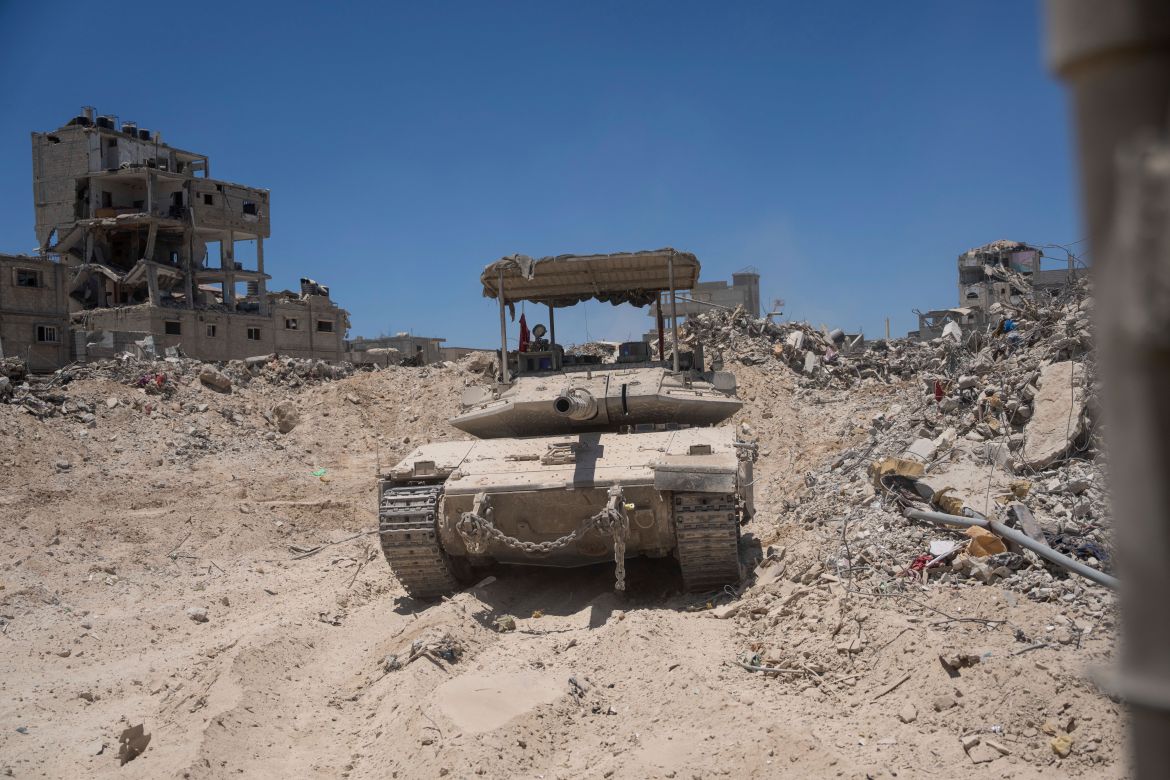
Abandoned, bullet-ridden apartment buildings have blasted out walls and shattered windows. Bedrooms and kitchens are visible from roads dotted with rubble piles that tower over the Israeli military vehicles passing by. Very few civilians remain.

Israel, which has been accused of disproportionate use of force in Gaza, says it aimed for a complete defeat of Hamas. More than 70 percent of the enclave’s houses have been destroyed in Israeli air and ground offensive since October 7, 2023.

In the last week of May, the International Court of Justice (ICJ) ordered Israel to “immediately” halt its military assault on Rafah, which faced a humanitarian crisis due to the blocking of aid. In January, the top UN court had ordered Israel to prevent acts of genocide.

Nearly 40,000 people have been killed, half of them children and women.

Rafah, an area of about 65sq km (25sq miles) bordering Egypt, was considered a safe zone where most Palestinians fleeing from Israeli bombardment took shelter. But Israel invaded the southern city despite international concerns, saying Hamas fighters had moved to the area. It provided no proof for its claims. Israel has repeatedly targeted areas designated as safe zones since the war began nine months ago.

Advertisement

An estimated 1.4 million Palestinians crammed into Rafah after fleeing Israeli bombardment elsewhere in Gaza. The UN estimates that about 50,000 remain in Rafah, which had a pre-war population of about 275,000. Last week, the United Nations said most of Gaza’s 2.4 million people are now displaced.

Most people are clustering in squalid tent camps along the beach with scant access to clean water, food, toilets and medical care.

Efforts to bring aid into southern Gaza have stalled as Israel closed down Rafah, one of two important crossings into the south of Gaza. The UN says little aid can enter from the other main crossing – Karem Abu Salem (Kerem Shalom) – because Israeli settlers have attacked aid trucks.

On Wednesday, a line of trucks on the Gaza side of Karem Abu Salem was visible, but the trucks were hardly moving – a sign of how Israel’s pledge to keep the route safe to facilitate the delivery of aid inside Gaza has fallen flat.

UN officials say some commercial trucks have braved the route into Rafah, but not without hired armed guards riding atop their convoys.

Israel says it is close to dismantling the group as an organised military force in Rafah. In a reflection of that confidence, soldiers brought journalists in open-air military vehicles down the road that leads into the heart of the city.

Along the way, debris lying by the side of the road made clear the perils of aid delivery: carcasses of trucks baking in the hot sun; dashboards covered in fencing meant to protect drivers; and aid pallets lying empty.

The longer the aid delivery is frozen, humanitarian groups say, the closer Gaza comes to running out of fuel, which is needed for hospitals, water desalination plants and vehicles. Most of the hospitals have been crippled by repeated Israeli attacks.

“The hospitals are once again short on fuel, risking disruption of critical services,” said Dr Hanan Balkhy, the World Health Organization’s regional director for the Eastern Mediterranean. “Injured people are dying because the ambulance services are facing delays due to fuel shortages.”

As the humanitarian situation worsens, Israel is pushing ahead with its offensive. Israeli Prime Minister Benjamin Netanyahu has reiterated that any potential ceasefire deal should allow Israel to resume its operation in Gaza. The Hamas group wants an end to the war as part of any deal.

After journalists heard nearby gunshots on Wednesday, the soldiers told the group they would not be visiting the beach as planned.

The group departed the city soon after, with clouds of dust kicked up by vehicles temporarily obscuring the mass of destruction behind them.

Advertisement
Israel Palestinians Rafah
The Israeli military invited reporters for a tour of Rafah, which has witnessed widespread destruction since the invasion on May 6. [Ohad Zwigenberg/AP Photo]
Advertisement
Israel Palestinians Rafah
Before invading Rafah, Israel said Hamas fighters had retreated there, though it provided no proof for its claims. [Ohad Zwigenberg/AP Photo]
Israel Palestinians Rafah
Israel says it has nearly defeated Hamas in Rafah. But most of the city's population is displaced. [Ohad Zwigenberg/AP Photo]
Israel Palestinians Rafah
Israeli tanks are seen next to destroyed buildings. [Ohad Zwigenberg/AP Photo]
Israel Palestinians Rafah
Israeli army vehicles transport a group of soldiers and journalists. It has barred international journalists from entering Gaza independently. [Ohad Zwigenberg/AP Photo]
Israel Palestinians Rafah
Israel says it is close to dismantling Hamas as an organised military force in Rafah. [Ohad Zwigenberg/AP Photo]
Advertisement
Israel Palestinians Rafah
Soldiers brought journalists in open-air military vehicles down the road that leads into the heart of Rafah. [Ohad Zwigenberg/AP Photo]
Israel Palestinians Rafah
The UN estimates that about 50,000 Palestinians remain in Rafah, which sheltered more than 1.5 people displaced in the earlier phase of the war. [Ohad Zwigenberg/AP Photo]

Related

  • What does Israel want in Gaza?

    A ‘defeat’ of Hamas seems out of reach, while analysts say recently a announced ‘Phase Three looks more like occupation.

    Published On 4 Jul 20244 Jul 2024
    An Israeli tank manoeuvres near the Israel-Gaza border
  • Israel continues Gaza attacks, says ‘gaps’ remain in renewed truce talks

    Israeli attacks continue in Gaza City and Khan Younis as delegation travels to Doha for ceasefire talks.

    Published On 5 Jul 20245 Jul 2024
    GAza
  • Five journalists killed as Israel steps up bombardment across Gaza

    Journalist couple Amjad Jahjouh and Wafa Abu Dabaan and their children were killed in a strike on the Nuseirat camp.

    Published On 6 Jul 20246 Jul 2024
    Palestinians asses the damage following an Israeli strike in the Nuseirat refugee camp in the central Gaza Strip on July 6, 2024. [Eyad Baba/AFP]
  • OPINIONOPINION,

    The nightmare of Gaza

    Humanitarian workers in Gaza continue their operations in impossible conditions because there is no other choice.

    Opinion by Olga CherevkoOlga Cherevko
    Published On 7 Jul 20247 Jul 2024
    Palestinian children wait to receive food cooked by a charity kitchen amid shortages of food supplies, as the ongoing conflict between Israel and the Palestinian Islamist group Hamas continues, in Rafah, in the southern Gaza Strip, March 5, 2024. REUTERS/Mohammed Salem
    quotes

More from Gallery

  • Photos: Manila’s streets empty as fuel prices surge amid Hormuz crisis

    A sharp increase in prices of basic commodities and the possible loss of employment for thousands of people due to the fuel price hike have raised the spectre of stagflation in the Philippines.
    This gallery article has 10 imagescamera10
  • Photos: More than one million displaced by Israel’s evacuations in Lebanon

    Over one million displaced by Israel’s evacuations in Lebanon
    This gallery article has 10 imagescamera10
  • Migrants march in southern Mexico to denounce immigration restrictions

    Migrants, some carrying children, walk on the highway through the municipality of Huehuetan, Chiapas state, Mexico, Wednesday, March 25, 2026, after leaving Tapachula the previous night. (AP Photo/Edgar H. Clemente)
    This gallery article has 9 imagescamera9
  • Photos: Iran fires new waves of missiles at Israel

    This picture shows damaged buildings at the site of an Iranian missile strike in Tel Aviv
    This gallery article has 8 imagescamera8

Most popular

  • Iran targets Saudi capital, hits Kuwait port as Middle East tensions surge

    TOPSHOT - This video grab taken from images released by the Iranian state broadcaster (IRIB) on March 26, 2026, shows what it says is the second phase of the 82nd wave of missiles launched against Israel and US bases in the United Arab Emirates and Kuwait.
  • How extensive is Russia’s military aid to Iran?

    Iranian missile strikes
  • US-Israel war on Iran: What’s happening on day 28 of attacks?

    Protesters attend a rally.
  • Iran war updates: US, Israel attack ignites worst trade rupture in 80 years

    This handout image taken by the European Space Agency (ESA) captured by the Copernicus Sentinel-2 satellite shows a view of smoke plumes billowing in the vicinity Kuwait International Airport on March 25, 2026.

  • About

    • About Us
    • Code of Ethics
    • Terms and Conditions
    • EU/EEA Regulatory Notice
    • Privacy Policy
    • Cookie Policy
    • Cookie Preferences
    • Accessibility Statement
    • Sitemap
    • Work for us
  • Connect

    • Contact Us
    • User Accounts Help
    • Advertise with us
    • Stay Connected
    • Newsletters
    • Channel Finder
    • TV Schedule
    • Podcasts
    • Submit a Tip
    • Paid Partner Content
  • Our Channels

    • Al Jazeera Arabic
    • Al Jazeera English
    • Al Jazeera Investigative Unit
    • Al Jazeera Mubasher
    • Al Jazeera Documentary
    • Al Jazeera Balkans
    • AJ+
  • Our Network

    • Al Jazeera Centre for Studies
    • Al Jazeera Media Institute
    • Learn Arabic
    • Al Jazeera Centre for Public Liberties & Human Rights
    • Al Jazeera Forum
    • Al Jazeera Hotel Partners

Follow Al Jazeera English:

  • facebook
  • twitter
  • youtube
  • instagram-colored-outline
  • rss
Al Jazeera Media Network logo
© 2026 Al Jazeera Media Network