Skip linksSkip to Content
play
Live
Navigation menu
  • News
    • Africa
    • Asia
    • US & Canada
    • Latin America
    • Europe
    • Asia Pacific
  • Middle East
  • Explained
  • Opinion
  • Sport
  • Video
    • Features
    • Economy
    • Human Rights
    • Climate Crisis
    • Investigations
    • Interactives
    • In Pictures
    • Science & Technology
    • Podcasts
    • Travel
play
Live

In Pictures

Gallery

In Pictures: Iran marks 1979 hostage crisis

The storming of the US embassy was a major event that followed Iran’s Islamic revolution.
Save

Share

facebooktwitterwhatsappcopylink
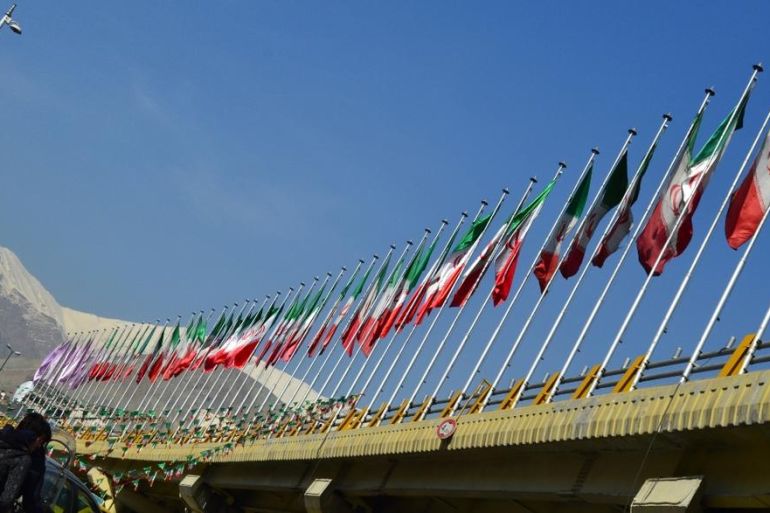
Iran prepares for celebrations of the 35th anniversary of the revolution.
By Soraya Lennie
Published On 9 Feb 20149 Feb 2014

While Iran is set to celebrate the 35th anniversary of its Islamic revolution on Tuesday, the most internationally recognised episode of the uprising remains the American hostage crisis.

On November 4, 1979, a group of revolutionary students stormed the US embassy in downtown Tehran, taking 52 Americans hostage for 444 days. The crisis captivated the world and put the country on the US nightly news for the duration.

Al Jazeera’s Soraya Lennie gained access to the former US embassy compound in the capital and sends us this photo essay.
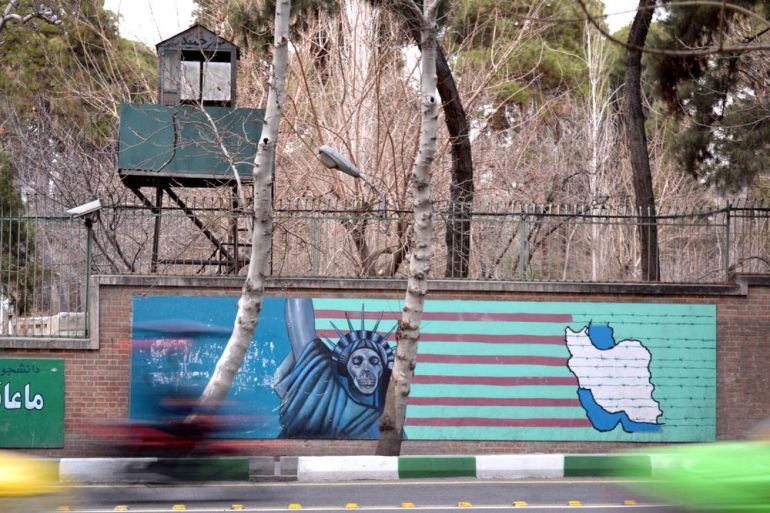
Graffiti adorns the walls of the former US embassy - this one is among the few iconic anti-US murals remaining around Tehran. The compound is one square kilometre, and although part of it is preserved as a museum, most it it remains off-limits to civilians. The compound, dubbed "the den of spies", is under the supervision of the Iranian government and the Revolutionary Guard.
Advertisement
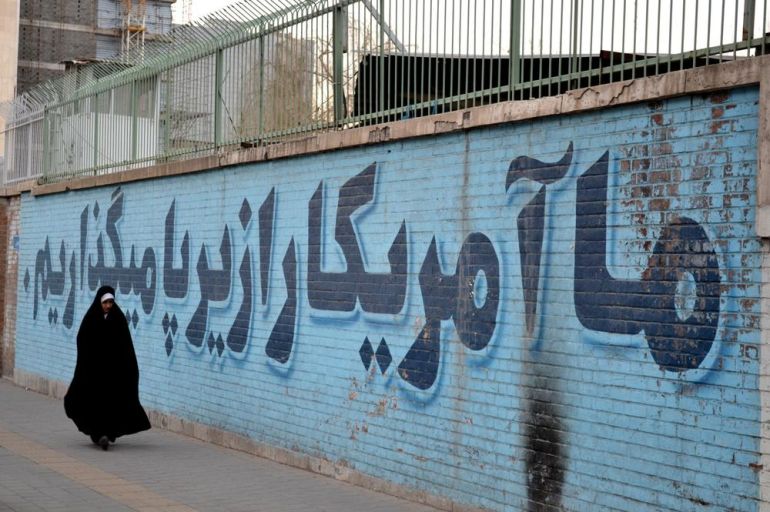
A woman walks past the main entrance to the former US embassy. The slogan painted on the wall after the revolution translates to, "We put America under our foot".
The former US embassy in downtown Tehran. The second floor of its main building is now a museum, open to the public on the anniversary of its seizure. The rest of the year the embassy and its compound remain closed to the public. Al Jazeera English was granted rare access inside, on the eve of the 35th anniversary of the Iranian revolution.
The main staircase of the old embassy, which leads from the lobby to the second floor, was painted over with anti-US murals eight years ago.
The winding staircase leads to a heavy, reinforced metal door like that of a vault, which can only be opened with a combination. On the floor, a doormat reads "Down with the USA" in English and "Death to America" in Farsi.
On the second floor of the embassy, students found communication equipment they said proved that the Americans were spies: telephones, encryption machines, telex machines and other types of devices. Property of the NSA, the encryption machines were used to send messages from the embassy to Washington. The presence of machines like this supported the view held among the revolutionaries: that the CIA was operating out of the embassy and influencing Iranian politics. The embassy continued to operate for eight months after the revolution until students put an end to it with the hostage crisis.
Advertisement
Not much has changed inside the embassy(***)s main building. Light green paint still adorns the walls, cracked and faded. Dust gathers on the windows and windowsills. The building stands as a relic.
Embassy staff could do little but watch as Iran(***)s revolution took hold and swept millions into the streets. The 1979 uprising ended 2,500 years of monarchy and replaced it with an Islamic republic.
When students managed to get through at least two vault doors, they found the shredding room, where embassy staff had been using industrial-sized machines to destroy sensitive documents. The students painstakingly set about piecing the papers back together, discovering internal memos and other documents about the embassy(***)s activities. Some of the reassembled documents have been published.
The inner room, inside the embassy(***)s vaulted floor, was where the most sensitive work in the country took place. The room was built with reinforced steel and security systems. Inside the room, machines that were state-of-the-art in 1979 now look like something out of a retro spy comedy movie.
A rotor from a helicopter downed in the failed Operation Eagle Claw hostage rescue operation sits on a tall metal stand, hovering above the old embassy wall. It is a reminder of the US(***) failed rescue attempt after a sandstorm in the Iranian desert caused a fatal collision between one of the helicopters and an aircraft, killing eight American servicemen.
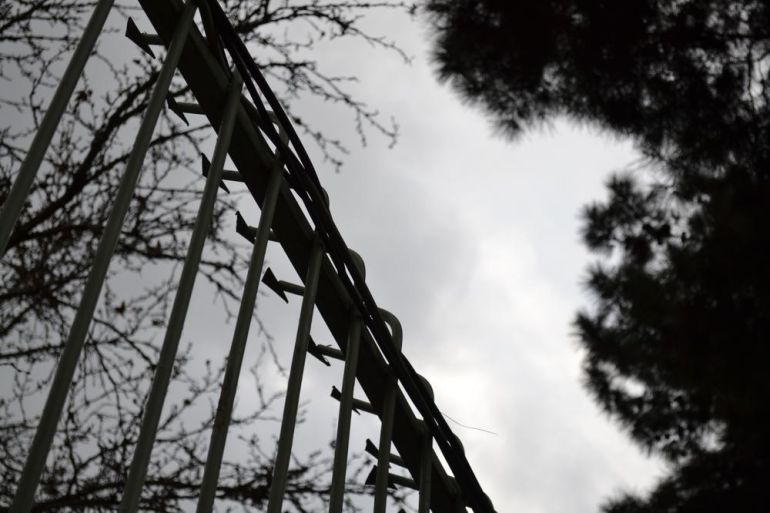
The walls of the old embassy, ringed with metal spikes, were effective in keeping staff safe as the revolution swept through Iran. Students had attempted to storm the embassy three days after the revolution but security forces and Iran(***)s foreign ministry prevented it. Eight months later, the students were successful.
Graffiti on the walls of the embassy(***)s second floor, written during the hostage crisis. One written in Farsi reads, "This den of spies should be closed".
Another bit of graffiti on the walls of the second floor reads, "There is no time for imperialism in Iran anymore". A line in Farsi says, "Hail Khomeini" - referring to Ayatollah Ruhollah Khomeini, the leader of the Islamic revolution.

More from Gallery

  • Photos: Manila’s streets empty as fuel prices surge amid Hormuz crisis

    A sharp increase in prices of basic commodities and the possible loss of employment for thousands of people due to the fuel price hike have raised the spectre of stagflation in the Philippines.
    This gallery article has 10 imagescamera10
  • Photos: More than one million displaced by Israel’s evacuations in Lebanon

    Over one million displaced by Israel’s evacuations in Lebanon
    This gallery article has 10 imagescamera10
  • Migrants march in southern Mexico to denounce immigration restrictions

    Migrants, some carrying children, walk on the highway through the municipality of Huehuetan, Chiapas state, Mexico, Wednesday, March 25, 2026, after leaving Tapachula the previous night. (AP Photo/Edgar H. Clemente)
    This gallery article has 9 imagescamera9
  • Photos: Iran fires new waves of missiles at Israel

    This picture shows damaged buildings at the site of an Iranian missile strike in Tel Aviv
    This gallery article has 8 imagescamera8

Most popular

  • ‘Playing with fire’: Iran vows response after civilian nuclear sites struck

    epaselect epa12854185 Rescuers work at a site following an Israeli airstrike that targeted a building in the village of Al Saksakiyah, southern Lebanon, 27 March 2026. According to the Lebanese Ministry of Public Health, at least 1,116 people have been killed and over 3,229 others injured in airstrikes across Beirut's southern suburbs and villages in southern Lebanon since the start of renewed hostilities. EPA/STRINGER
  • US diplomat Marco Rubio denounces settler violence, tolls in Hormuz strait

    US Secretary of State Marco Rubio looks on as he speaks to the press before his departure following a G7 Foreign Ministers' meeting with Partner Countries before his departure at the Bourget airport in Le Bourget, outside Paris, France, March 27, 2026. Brendan Smialowski/Pool via REUTERS
  • Iran war updates: Tehran vows retaliation for Israeli hits on nuclear sites

    TOPSHOT - This video grab taken from images released by the Iranian state broadcaster (IRIB) on March 26, 2026, shows what it says is the second phase of the 82nd wave of missiles launched against Israel and US bases in the United Arab Emirates and Kuwait.
  • Guns in the streets as US, Israel intensify month-long attacks across Iran

    TEHRAN, IRAN - MARCH 27: A resident cleans up debris in a damaged apartment across from another residential building following an airstrike in the early hours of March 27, 2026 in Tehran, Iran. The Israeli military said that it had carried out strikes on targets across Tehran and other Iranian cities overnight. The United States and Israel have continued their joint attack on Iran that began on February 28. Iran retaliated by firing waves of missiles and drones at Israel and U.S. allies in the region, while also effectively blockading the Strait of Hormuz, a critical shipping route. (Photo by Majid Saeedi/Getty Images)

  • About

    • About Us
    • Code of Ethics
    • Terms and Conditions
    • EU/EEA Regulatory Notice
    • Privacy Policy
    • Cookie Policy
    • Cookie Preferences
    • Accessibility Statement
    • Sitemap
    • Work for us
  • Connect

    • Contact Us
    • User Accounts Help
    • Advertise with us
    • Stay Connected
    • Newsletters
    • Channel Finder
    • TV Schedule
    • Podcasts
    • Submit a Tip
    • Paid Partner Content
  • Our Channels

    • Al Jazeera Arabic
    • Al Jazeera English
    • Al Jazeera Investigative Unit
    • Al Jazeera Mubasher
    • Al Jazeera Documentary
    • Al Jazeera Balkans
    • AJ+
  • Our Network

    • Al Jazeera Centre for Studies
    • Al Jazeera Media Institute
    • Learn Arabic
    • Al Jazeera Centre for Public Liberties & Human Rights
    • Al Jazeera Forum
    • Al Jazeera Hotel Partners

Follow Al Jazeera English:

  • facebook
  • twitter
  • youtube
  • instagram-colored-outline
  • rss
Al Jazeera Media Network logo
© 2026 Al Jazeera Media Network